Search
 Element Search
 Structure Search
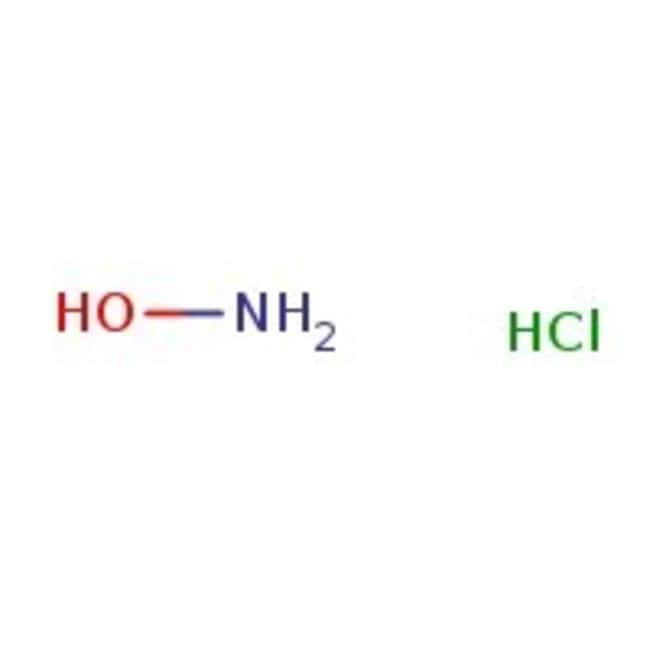


Thermo Scientific Chemicals
Hydroxylamine hydrochloride, 99%
CAS: 5470-11-1 | ClH4NO | 69.49 g/mol
Have Questions?
Change view


Catalog number A15398.0B
also known as A15398-0B
Price (USD)
123.00
Each
Quantity:
1000 g
Price (USD)
123.00
Each
Chemical Identifiers
CAS5470-11-1
IUPAC Namehydroxylamine hydrochloride
Molecular FormulaClH4NO
InChI KeyWTDHULULXKLSOZ-UHFFFAOYSA-N
SMILESCl.NO
View more
Specifications Specification Sheet
Specification SheetAppearance (Color)White
FormCrystals or crystalline powder or powder
CommentSourced in UK and US
Identification (FTIR)Conforms (UK sourced material only)
Assay (Titration ex Chloride)≥98.5 to ≤101.5% (UK sourced material)
View more
Hydroxylamine hydrochloride is a monomoamine oxidase inhibitor. It is used to prepare oximes and hydroxmic acids in organic synthesis. It acts as a copolymerization inhibitor. It can be used to remove bromine and polybromide from a solution during extraction of lignin from lignocellulosic biomass. It is key starting material for the preparation of pharmaceuticals and agrochemicals. It plays a vital role in rubber and plastic industries as an antioxidant, a vulcanization accelerator and a radical scavenger. It is also used as a color stabilizer and emulsion additive in color films.
This Thermo Scientific Chemicals brand product was originally part of the Alfa Aesar product portfolio. Some documentation and label information may refer to the legacy brand. The original Alfa Aesar product / item code or SKU reference has not changed as a part of the brand transition to Thermo Scientific Chemicals.
Applications
Hydroxylamine hydrochloride is a monomoamine oxidase inhibitor. It is used to prepare oximes and hydroxmic acids in organic synthesis. It acts as a copolymerization inhibitor. It can be used to remove bromine and polybromide from a solution during extraction of lignin from lignocellulosic biomass. It is key starting material for the preparation of pharmaceuticals and agrochemicals. It plays a vital role in rubber and plastic industries as an antioxidant, a vulcanization accelerator and a radical scavenger. It is also used as a color stabilizer and emulsion additive in color films.
Solubility
Soluble in water, alcohol, methanol and glycerol.
Notes
Air and moisture sensitive. Incompatible with strong oxidizing agents, phosphorous pentachloride, calcium and anhydrous copper(II) sulfate.
Hydroxylamine hydrochloride is a monomoamine oxidase inhibitor. It is used to prepare oximes and hydroxmic acids in organic synthesis. It acts as a copolymerization inhibitor. It can be used to remove bromine and polybromide from a solution during extraction of lignin from lignocellulosic biomass. It is key starting material for the preparation of pharmaceuticals and agrochemicals. It plays a vital role in rubber and plastic industries as an antioxidant, a vulcanization accelerator and a radical scavenger. It is also used as a color stabilizer and emulsion additive in color films.
Solubility
Soluble in water, alcohol, methanol and glycerol.
Notes
Air and moisture sensitive. Incompatible with strong oxidizing agents, phosphorous pentachloride, calcium and anhydrous copper(II) sulfate.
RUO – Research Use Only
General References:
- For examples of preparation of oximes from carbonyl compounds, see: Org. Synth. Coll., 2, 70, 313 (1955); 7, 149 (1990). Dehydration of aldoximes is a valuable route to nitriles. The preparation of an oxime, and dehydration with acetic anhydride, are exemplified for veratraldehyde: Org. Synth. Coll., 2, 622 (1943). For other methods of dehydrating oximes to nitriles, see Benzaldoxime, A12053. Procedures for the one-pot conversion of aldehydes to nitriles, without isolation of the intermediate oxime, include: refluxing the aldehyde with hydroxylamine hydrochloride in formic acid/ sodium acetate: J. Chem. Soc., 1564 (1965); formic acid alone: Synthesis, 112 (1979); in pyridine and toluene, with azeotropic water removal: Synthesis, 190 (1982); in DMF (reflux; aromatics only): Z. Chem., 15, 302 (1975); heating in NMP at 110-115°, effective for aromatic and aliphatic substrates; under these conditions, DMF gave only 20-30% conversion: Synthesis, 586 (1999). A more recent ambient temperature one-pot procedure utilizes DBU in combination with ethyl dichlorophosphate: Synlett, 1317 (2007).
- For a one-pot synthesis of pyrazoles from aldehydes by cyclization of the intermediate oxime in acidic medium with potassium dihyrogen phosphate, see: Tetrahedron Lett., 47, 43 (2006).
- For a brief feature on uses of this reagent in Organic synthesis, see: Synlett, 1326 (2007).
- Mahajan, S.; Sharma, B.; Kapoor, K. K. A solvent-free one step conversion of ketones to amides via Beckmann rearrangement catalysed by FeCl 3· 6H 2 O in presence of hydroxylamine hydrochloride. Tetrahedron Lett. 2015, 56 (14), 1915-1918.
- Wang, W.; Zhao, X. M.; Wang, J. L.; Geng, X.; Gong, J. F.; Hao, X. Q.; Song, M. P. Transition metal-free synthesis of primary amides from aldehydes and hydroxylamine hydrochloride. Tetrahedron Lett. 2014, 55 (20), 3192-3194.