Search
 Element Search
 Structure Search

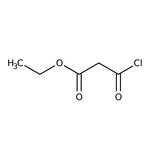

Thermo Scientific Chemicals
Ethyl malonyl chloride, 95%
CAS: 36239-09-5 | C5H7ClO3 | 150.56 g/mol
Have Questions?
Change view


Catalog number A15616.22
also known as A15616-22
Price (USD)
686.65
Online Exclusive
763.00Save 76.35 (10%)
Each
Quantity:
100 g
Price (USD)
686.65
Online Exclusive
763.00Save 76.35 (10%)
Each
Chemical Identifiers
CAS36239-09-5
IUPAC Nameethyl 3-chloro-3-oxopropanoate
Molecular FormulaC5H7ClO3
InChI KeyKWFADUNOPOSMIJ-UHFFFAOYSA-N
SMILESCCOC(=O)CC(Cl)=O
View more
Specifications Specification Sheet
Specification SheetAssay (Titration ex Chloride)≥94.0 to ≤106.0%
FormLiquid
Appearance (Color)Clear colorless to yellow
Refractive Index1.4265-1.4325 @ 20?C
Ethyl malonyl chloride is used in the syntheses of methanofullerodendimers and 3-pyrrolin-2-ones. It plays a vital role in the preparation of 3,5-disubstituted 1,2,4-oxadiazole derivatives, which are potential peptidomimetic building blocks. It is a versatile acylating agent for propargyl alcohols, hydrazines and amines.
This Thermo Scientific Chemicals brand product was originally part of the Alfa Aesar product portfolio. Some documentation and label information may refer to the legacy brand. The original Alfa Aesar product / item code or SKU reference has not changed as a part of the brand transition to Thermo Scientific Chemicals.
Applications
Ethyl malonyl chloride is used in the syntheses of methanofullerodendimers and 3-pyrrolin-2-ones. It plays a vital role in the preparation of 3,5-disubstituted 1,2,4-oxadiazole derivatives, which are potential peptidomimetic building blocks. It is a versatile acylating agent for propargyl alcohols, hydrazines and amines.
Solubility
Miscible with water.
Notes
Store in cool place. Moisture sensitive. Keep the container tightly closed in a dry and well-ventilated place. Incompatible with alcohols. It reacts with water.
Ethyl malonyl chloride is used in the syntheses of methanofullerodendimers and 3-pyrrolin-2-ones. It plays a vital role in the preparation of 3,5-disubstituted 1,2,4-oxadiazole derivatives, which are potential peptidomimetic building blocks. It is a versatile acylating agent for propargyl alcohols, hydrazines and amines.
Solubility
Miscible with water.
Notes
Store in cool place. Moisture sensitive. Keep the container tightly closed in a dry and well-ventilated place. Incompatible with alcohols. It reacts with water.
RUO – Research Use Only
General References:
- Useful synthetic building block, e.g. in an oxazole synthesis: J. Med. Chem., 36, 3871 (1993):
- Formation of amides has been used in the syntheses of 1,2,4-triazine-3,6-diones, and of a vicinal tricarbonyl amide derivative of L-phenylalanine: J. Org. Chem., 60, 5992 (1995); 61, 1872 (1996).
- Yang, Z.; Li, S.; Zhang, Z.; Xu, J. Base-switched annuloselectivity in the reactions of ethyl malonyl chloride and imines. Org. Biomol. Chem. 2014, 12 (48), 9822-9830.
- Hayat, F.; Kang, L.; Lee, C. Y.; Shin, D. Synthesis of arylnaphthalene lignan lactone using benzoin condensation, intramolecular thermal cyclization and Suzuki coupling. Tetrahedron 2015, 71 (19), 2945-2950.