Search
 Element Search
 Structure Search


Thermo Scientific Chemicals
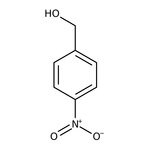
4-Nitrobenzyl alcohol, 99%
CAS: 619-73-8 | C7H7NO3 | 153.14 g/mol
Have Questions?
Change view

Catalog number A15742.22
also known as A15742-22
Price (USD)
109.65
Online Exclusive
122.00Save 12.35 (10%)
Each
Quantity:
100 g
Price (USD)
109.65
Online Exclusive
122.00Save 12.35 (10%)
Each
Chemical Identifiers
CAS619-73-8
IUPAC Name(4-nitrophenyl)methanol
Molecular FormulaC7H7NO3
InChI KeyJKTYGPATCNUWKN-UHFFFAOYSA-N
SMILESOCC1=CC=C(C=C1)[N+]([O-])=O
View more
Specifications Specification Sheet
Specification SheetAppearance (Color)Pale cream to cream to yellow
FormPowder or lumps
Assay (GC)≥98.5%
Melting Point (clear melt)90.0-97.0?C
4-nitrobenzyl alcohol is used as the sole source of carbon and nitrogen to study the pathway for the catabolism of 4-nitrotoluene by Pseudomonas.
This Thermo Scientific Chemicals brand product was originally part of the Alfa Aesar product portfolio. Some documentation and label information may refer to the legacy brand. The original Alfa Aesar product / item code or SKU reference has not changed as a part of the brand transition to Thermo Scientific Chemicals.
Applications
4-nitrobenzyl alcohol is used as the sole source of carbon and nitrogen to study the pathway for the catabolism of 4-nitrotoluene by Pseudomonas.
Solubility
Soluble in water (2 mg/ml at 20°C).
Notes
Store at room temperature. Keep away from oxidizing agents.
4-nitrobenzyl alcohol is used as the sole source of carbon and nitrogen to study the pathway for the catabolism of 4-nitrotoluene by Pseudomonas.
Solubility
Soluble in water (2 mg/ml at 20°C).
Notes
Store at room temperature. Keep away from oxidizing agents.
RUO – Research Use Only
General References:
- Iraj Mohammadpoor-Baltork.; Hamid Aliyan.; Ahmad Reza Khosropour. Bismuth(III) salts as convenient and efficient catalysts for the selective acetylation and benzoylation of alcohols and phenols.Tetrahedron. 2001, 57 (27),5851-5854 .
- Adina Haimova.; Ronny Neumann. Polyethylene glycol as a non-ionic liquid solvent for polyoxometalate catalyzed aerobic oxidation.Chem. Commun. 2002, (8), 876-877 .
- Protection of alcohols as their 4-nitrobenzyl ethers has been carried out, e.g. in the presence of trifluoroacetic anhydride and 2,6-lutidine: Tetrahedron Lett., 31, 389 (1990).
- Selective deprotection at room temperature can be accomplished by sodium dithionite in aqueous acetonitrile: Synth. Commun., 12, 219 (1982). Photolytic cleavage has been employed in the carbohydrate series: J. Org. Chem., 37, 2281, 2285 (1972). For reviews of photoremovable protecting groups, see: Synthesis, 1 (1980); Org. Photochem., 9, 225 (1987). Reduction to the aniline, followed by chemical or electrolytic oxidation has also been reported: Tetrahedron Lett., 31, 389 (1990).
- Has also found use to protect carboxylic acids as their 4-nitrobenzyl esters, particularly in the penicillin and peptide fields. See also 4-Nitrobenzyl bromide, A15236, and 4-Nitrobenzyl chloride, A15749.