Search
 Element Search
 Structure Search


Thermo Scientific Chemicals
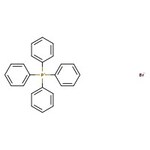
Tetraphenylphosphonium bromide, 98+%
CAS: 2751-90-8 | C24H20BrP | 419.30 g/mol
Have Questions?
Change view


Catalog number A15860.09
also known as A15860-09
Price (USD)
38.65
Online Exclusive
43.10Save 4.45 (10%)
Each
Quantity:
10 g
Price (USD)
38.65
Online Exclusive
43.10Save 4.45 (10%)
Each
Chemical Identifiers
CAS2751-90-8
IUPAC Nametetraphenylphosphanium bromide
Molecular FormulaC24H20BrP
InChI KeyBRKFQVAOMSWFDU-UHFFFAOYSA-M
SMILES[Br-].C1=CC=C(C=C1)[P+](C1=CC=CC=C1)(C1=CC=CC=C1)C1=CC=CC=C1
View more
Specifications Specification Sheet
Specification SheetFormCrystals or powder or crystalline powder
Appearance (Color)White to cream
Water Content (Karl Fischer Titration)≤1.5%
Assay (Titration ex Bromide)≥98.0 to ≤102.0%
Tetraphenylphosphonium bromide is a supporting electrolyte for the electroreduction of buckminsterfullerene. It is used to extract heavy metals from aqueous solution as ion-association complexes
This Thermo Scientific Chemicals brand product was originally part of the Alfa Aesar product portfolio. Some documentation and label information may refer to the legacy brand. The original Alfa Aesar product / item code or SKU reference has not changed as a part of the brand transition to Thermo Scientific Chemicals.
Applications
Tetraphenylphosphonium bromide is a supporting electrolyte for the electroreduction of buckminsterfullerene. It is used to extract heavy metals from aqueous solution as ion-association complexes
Solubility
Soluble in water.
Notes
Store in cool place. Keep container tightly closed in a dry and well-ventilated place. It is hygroscopic in nature. Incompatible with strong oxidizing agents. Stable at room temperature in closed containers under normal storage and handling conditions.
Tetraphenylphosphonium bromide is a supporting electrolyte for the electroreduction of buckminsterfullerene. It is used to extract heavy metals from aqueous solution as ion-association complexes
Solubility
Soluble in water.
Notes
Store in cool place. Keep container tightly closed in a dry and well-ventilated place. It is hygroscopic in nature. Incompatible with strong oxidizing agents. Stable at room temperature in closed containers under normal storage and handling conditions.
RUO – Research Use Only
General References:
- Dominique Dubois.; Gilles Moninot.; Wlodzimierz Kutner.; M. Thomas Jones.; Karl M. Kadish. Electroreduction of Buckminsterfullerene, C60, in aprotic solvents. Solvent, supporting electrolyte, and temperature effects. J. Phys. Chem. 1992, 96 (17), 7137-7145 .
- Nicolay V. Tsarevsky.; Brent S. Sumerlin.; Krzysztof Matyjaszewski. Step-Growth Click Coupling of Telechelic Polymers Prepared by Atom Transfer Radical Polymerization. Macromolecules. 2005, 38 (9), 3558-3561.
- This salt, or the more water-soluble chloride (next entry), has been used to extract heavy metals from aqueous solution as ion-association complexes: J. Organomet. Chem., 160, 17 (1978), Z. Naturforsch. B, 33B(5), 533 (1978); Microchem. J., 22, 275 (1977).
- Thermally stable phase-transfer catalyst (see Appendix 2): in combination with o-phthaloyl chloride (nitrite trap), facilitates the otherwise difficult displacement by F- of a nitro-group meta to an activating group: Chem. Lett., 2213 (1989):
- For a similar reaction, see 4-Chlorobenzaldehyde, A12757.