Search


Citations & References (2)
Invitrogen™
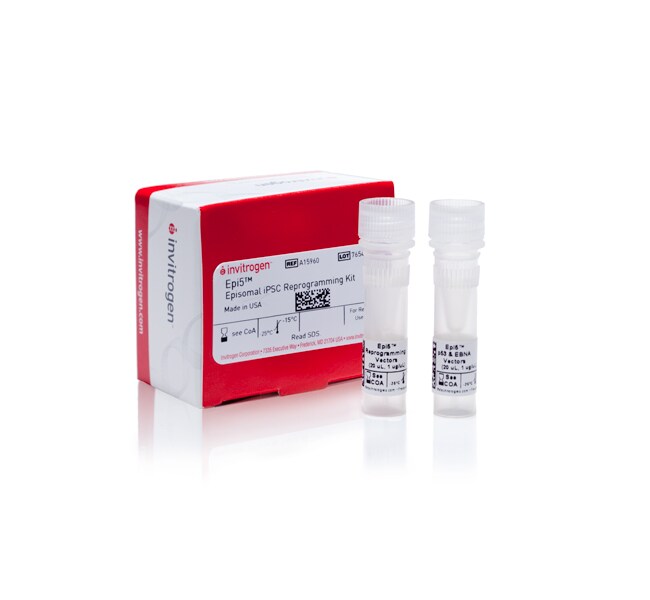
Epi5™ Episomal iPSC Reprogramming Kit
The Epi5™ Episomal iPSC Reprogramming Kit provides an easy-to-use, highly efficient set of 5 episomal vectors designed by Dr. OkitaRead more
| Catalog Number | Quantity |
|---|---|
| A15960 | 1 kit |
Catalog number A15960
Price (USD)
1,875.65
Online exclusive
1,934.00Save 58.35
Each
Quantity:
1 kit
Price (USD)
1,875.65
Online exclusive
1,934.00Save 58.35
Each
The Epi5™ Episomal iPSC Reprogramming Kit provides an easy-to-use, highly efficient set of 5 episomal vectors designed by Dr. Okita in the laboratory of Professor Yamanaka at the Center for iPS Cell Research and Application (CiRA), Kyoto University. This system produces transgene-free, virus-free human induced pluripotent stem cells (iPSCs) with efficiencies in the range of 0.04% to 0.3%, depending upon the cell type being reprogrammed.
Features of the Epi5™ Episomal iPSC Reprogramming Kit include:
• Easy to use and highly efficient—no need for small molecules during reprogramming and the added p53 suppression provides enhanced iPSC generation (1)
• Usable for all stages of your iPSC research—transgene-free and viral-free reprogramming allows use from basic to pre-clinical research
• Flexibility in media systems—can be used in either feeder-free or feeder-based media systems
Create Transgene and Virus-free iPSCs
Episomal vectors are a well-described system for producing transgene-free, virus-free iPSCs, providing a source of iPSCs for all stages of your pluripotent stem cell research. Other reprogramming methods, such as lentivirus, contain transgenes that can integrate into the host genome, potentially disrupting the genome or causing unpredictable results.
As oriP/EBNA1 vectors, these episomal vectors contain 5 reprogramming factors (Oct4, Sox2, Lin28, Klf4, and L-Myc) and replicate extra-chromosomally only once per cell cycle. At this replication rate, the episomes are lost at a rate of approximately 5% per cell generation. This system shows enhanced iPSC generation through p53 suppression, and the inclusion of L-Myc has been shown to be more potent and specific then c-Myc during human iPSC generation (1).
Easy-to-Use System
This 2-vial kit provides the optimal system for episomal vector reprogramming and eliminates the need for use of small molecules in the reprogramming medium. The episomal vectors are introduced into the cell by electroporation. We recommend use of the Neon™Transfection System for electroporation, allowing flexibility in the volume and thus number of cells needed for reprogramming.
Flexibility in Selection of Media Systems
The Epi5™ Episomal iPSC Reprogramming Kit can be used with multiple cell types and media systems. Protocols for fibroblasts and CD34+ blood cells are available in either feeder or feeder-free based reprogramming.
1. Okita K, Matsumara Y, Sato Y, et al. A more efficient method to generate integration free human iPS cells. Nature Methods 8, 409-412, 2011.
Features of the Epi5™ Episomal iPSC Reprogramming Kit include:
• Easy to use and highly efficient—no need for small molecules during reprogramming and the added p53 suppression provides enhanced iPSC generation (1)
• Usable for all stages of your iPSC research—transgene-free and viral-free reprogramming allows use from basic to pre-clinical research
• Flexibility in media systems—can be used in either feeder-free or feeder-based media systems
Create Transgene and Virus-free iPSCs
Episomal vectors are a well-described system for producing transgene-free, virus-free iPSCs, providing a source of iPSCs for all stages of your pluripotent stem cell research. Other reprogramming methods, such as lentivirus, contain transgenes that can integrate into the host genome, potentially disrupting the genome or causing unpredictable results.
As oriP/EBNA1 vectors, these episomal vectors contain 5 reprogramming factors (Oct4, Sox2, Lin28, Klf4, and L-Myc) and replicate extra-chromosomally only once per cell cycle. At this replication rate, the episomes are lost at a rate of approximately 5% per cell generation. This system shows enhanced iPSC generation through p53 suppression, and the inclusion of L-Myc has been shown to be more potent and specific then c-Myc during human iPSC generation (1).
Easy-to-Use System
This 2-vial kit provides the optimal system for episomal vector reprogramming and eliminates the need for use of small molecules in the reprogramming medium. The episomal vectors are introduced into the cell by electroporation. We recommend use of the Neon™Transfection System for electroporation, allowing flexibility in the volume and thus number of cells needed for reprogramming.
Flexibility in Selection of Media Systems
The Epi5™ Episomal iPSC Reprogramming Kit can be used with multiple cell types and media systems. Protocols for fibroblasts and CD34+ blood cells are available in either feeder or feeder-free based reprogramming.
1. Okita K, Matsumara Y, Sato Y, et al. A more efficient method to generate integration free human iPS cells. Nature Methods 8, 409-412, 2011.
For Research Use Only. Not for use in diagnostic procedures.
Specifications
Cloning MethodNone
Delivery TypeTransfection
For Use With (Application)Stem Cell Engineering & Reprogramming
For Use With (Equipment)Electroporator, Neon Transfection System
Key Functionsel
Product LineEpi5
Product TypeEpisomal iPSC Reprogramming Kit
PromoterCAG
Protein TagNone
Quantity1 kit
Replication OriginpUC Origin
Reporter GeneNone
Selection Agent (Eukaryotic)None
VectorEBNA OriP
Unit SizeEach
Contents & Storage
2 tubes. Store at -5 to -20°C.
Frequently asked questions (FAQs)
Can I use pen/strep or other antibiotics for episomal reprogramming of cells?
Can I reprogram mouse cells with the Epi5 Episomal iPSC Reprograming Kit (Cat. No. A15960)?
When generating iPSCs using the Epi5 Episomal iPSC Reprogramming Kit (Cat. No. A15960), how confluent should my cells be on the day of transfection?
How many reprogramming experiments can I perform with the Epi5 Episomal iPSC Reprogramming Kit (Cat. No. A15960)?
Which kits do you offer for stem cell reprogramming?
Citations & References (2)
Citations & References
Abstract
An optogenetic approach for assessing formation of neuronal connections in a co-culture system.
Journal:
PubMed ID:25742527
'Here we describe a protocol to generate a co-culture consisting of 2 different neuronal populations. Induced pluripotent stem cells (iPSCs) are reprogrammed from human fibroblasts using episomal vectors. Colonies of iPSCs can be observed 30 days after initiation of fibroblast reprogramming. Pluripotent colonies are manually picked and grown in neural
Generation of human iPSCs from cells of fibroblastic and epithelial origin by means of the oriP/EBNA-1 episomal reprogramming system.
Journal:
PubMed ID:26088261
The prospect of therapeutic applications of the induced pluripotent stem cells (iPSCs) is based on their ability to generate virtually any cell type present in human body. Generation of iPSCs from somatic cells has opened up new possibilities to investigate stem cell biology, to better understand pathophysiology of human diseases,