Search
 Element Search
 Structure Search


Thermo Scientific Chemicals
Betaine hydrochloride, 99%
CAS: 590-46-5 | C5H12ClNO2 | 153.61 g/mol
Have Questions?
Change view


Catalog number A16122.0B
also known as A16122-0B
Price (USD)
90.65
Special offer
Online exclusive
Ends: 28-Dec-2026
106.00Save 15.35
Each
Quantity:
1000 g
Price (USD)
90.65
Special offer
Online exclusive
Ends: 28-Dec-2026
106.00Save 15.35
Each
Chemical Identifiers
CAS590-46-5
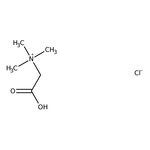
IUPAC Name(carboxymethyl)trimethylazanium chloride
Molecular FormulaC5H12ClNO2
InChI KeyHOPSCVCBEOCPJZ-UHFFFAOYSA-N
SMILES[Cl-].C[N+](C)(C)CC(O)=O
View more
Specifications Specification Sheet
Specification SheetIdentification (FTIR)Conforms
Appearance (Color)White to pale cream
Assay (Titration ex Chloride)≥98.5 to ≤101.5%
FormCrystals or powder or crystalline powder or lumps
Betaine hydrochloride is a naturally occurring compound that has been of interest for its role in osmoregulation. As a drug, it has been used as a source of hydrochloric acid in the treatment of hypochlorhydria. Betaine has also been used in the treatment of liver disorders, for hyperkalemia, for homocystinuria and for gastrointestinal disturbances.
This Thermo Scientific Chemicals brand product was originally part of the Alfa Aesar product portfolio. Some documentation and label information may refer to the legacy brand. The original Alfa Aesar product / item code or SKU reference has not changed as a part of the brand transition to Thermo Scientific Chemicals.
Applications
Betaine hydrochloride is a naturally occurring compound that has been of interest for its role in osmoregulation. As a drug, it has been used as a source of hydrochloric acid in the treatment of hypochlorhydria. Betaine has also been used in the treatment of liver disorders, for hyperkalemia, for homocystinuria and for gastrointestinal disturbances.
Solubility
Soluble in water.
Notes
Stable under recommended storage conditions. Store away from oxidizing agents.
Betaine hydrochloride is a naturally occurring compound that has been of interest for its role in osmoregulation. As a drug, it has been used as a source of hydrochloric acid in the treatment of hypochlorhydria. Betaine has also been used in the treatment of liver disorders, for hyperkalemia, for homocystinuria and for gastrointestinal disturbances.
Solubility
Soluble in water.
Notes
Stable under recommended storage conditions. Store away from oxidizing agents.
RUO – Research Use Only
General References:
- Karine De Oliveira Vigier; Adlene Benguerba; Joel Barrault; Francois Jerome. Conversion of fructose and inulin to 5-hydroxymethylfurfural in sustainable betaine hydrochloride-based media. Green Chemistry. 2012, 14, (2),285-289
- Miroslaw Szafran; Jacek Koput. Calculation of the vibrational spectra of betaine hydrochloride. Journal of Molecular Structure. 1997, 404, (1-2),91-104