Search
 Element Search
 Structure Search

Thermo Scientific Chemicals
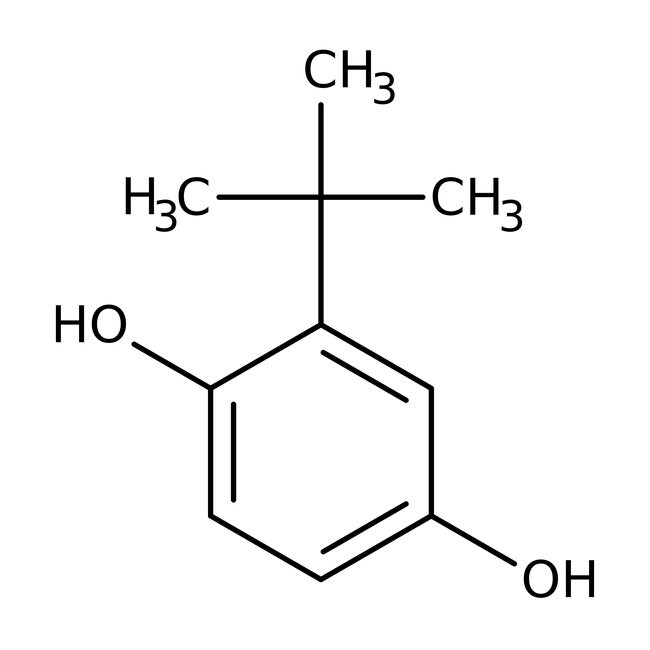
tert-Butylhydroquinone, 97%
CAS: 1948-33-0 | C10H14O2 | 166.22 g/mol
Have Questions?
Change view


Catalog number A19206.0E
also known as A19206-0E
Price (USD)
376.65
Online Exclusive
418.00Save 41.35 (10%)
Each
Quantity:
2500 g
Price (USD)
376.65
Online Exclusive
418.00Save 41.35 (10%)
Each
Chemical Identifiers
CAS1948-33-0
IUPAC Name2-tert-butylbenzene-1,4-diol
Molecular FormulaC10H14O2
InChI KeyBGNXCDMCOKJUMV-UHFFFAOYSA-N
SMILESCC(C)(C)C1=CC(O)=CC=C1O
View more
Specifications Specification Sheet
Specification SheetAssay (GC)≥96.0% (UK-sourced material)
Appearance (Color)White to cream
CommentMaterial sourced in UK and US
Identification (FTIR)Conforms (UK-sourced material)
FormCrystals or powder or crystalline powder
View more
This Thermo Scientific Chemicals brand product was originally part of the Alfa Aesar product portfolio. Some documentation and label information may refer to the legacy brand. The original Alfa Aesar product / item code or SKU reference has not changed as a part of the brand transition to Thermo Scientific Chemicals.
Suitable for battery materials development.
Applications
TBHQ was used to study the inactivation of barotolerant strains of Listeria monocytogenes and Escherichia coli. Environment friendly electrode materials for supercapacitors were attained by decorating the surface of graphene nanosheets with TBHQ. TBHQ is frequently used as a food preservative. Inhibition of oxidative rancidity in frozen cooked fish flakes by tert-butylhydroquinone. Nuclear factor E2-related factor 2-dependent antioxidant response element activation is by tert-butylhydroquinoneoccurring preferentially in Astrocytes conditions.
Solubility
Slightly soluble in water(10g/L).
Notes
Store in cool place. Keep container tightly closed in a dry and well-ventilated place. Store away from strong oxidizing agents.
TBHQ was used to study the inactivation of barotolerant strains of Listeria monocytogenes and Escherichia coli. Environment friendly electrode materials for supercapacitors were attained by decorating the surface of graphene nanosheets with TBHQ. TBHQ is frequently used as a food preservative. Inhibition of oxidative rancidity in frozen cooked fish flakes by tert-butylhydroquinone. Nuclear factor E2-related factor 2-dependent antioxidant response element activation is by tert-butylhydroquinoneoccurring preferentially in Astrocytes conditions.
Solubility
Slightly soluble in water(10g/L).
Notes
Store in cool place. Keep container tightly closed in a dry and well-ventilated place. Store away from strong oxidizing agents.
RUO – Research Use Only
General References:
- Andrew D. Kraft,; Delinda A. Johnson,; Jeffrey A. Johnson. Nuclear Factor E2-Related Factor 2-Dependent Antioxidant Response Element Activation by tert-Butylhydroquinone and Sulforaphane Occurring Preferentially in Astrocytes Conditions Neurons against Oxidative Insult . Journal name. 2004 , 24(5), 1101-1112.
- Yoon-Kyung Chung,; Ahmed E Yousef. Inactivation of barotolerant strains of Listeria monocytogenes and Escherichia coli O157:H7 by ultra high pressure and tert-butylhydroquinone combination.. Journal of Microbiology. 2008, 46 (3), 289-294.