Search
 Element Search
 Structure Search


Thermo Scientific Chemicals
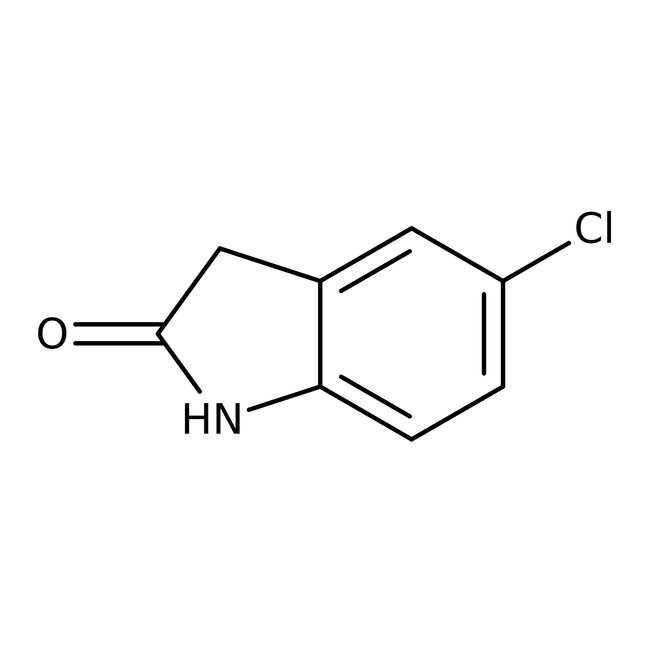
5-Chlorooxindole, 98%
CAS: 17630-75-0 | C8H6ClNO | 167.59 g/mol
Have Questions?
Change view


Catalog number A19210.06
also known as A19210-06
Price (USD)
189.65
Online exclusive
210.00Save 20.35
Each
Quantity:
5 g
Price (USD)
189.65
Online exclusive
210.00Save 20.35
Each
Chemical Identifiers
CAS17630-75-0
Specifications Specification Sheet
Specification SheetFormCrystals or powder or crystalline powder
Appearance (Color)White to cream to pink to pale brown
Assay (HPLC)≥97.5%
Melting Point (clear melt)194-201?C
5-Chloro-2-oxindole was used for the quantitation of 5-chloro-2-oxindole, concomitantly with all of its potential positional isomers using a single, highly specific, normal-phase chromatographic system. 5-Chloro-2-oxindole (5-Chlorooxindole) is a starting material for tenidap sodium, a pharmaceutical drug candidate.
This Thermo Scientific Chemicals brand product was originally part of the Alfa Aesar product portfolio. Some documentation and label information may refer to the legacy brand. The original Alfa Aesar product / item code or SKU reference has not changed as a part of the brand transition to Thermo Scientific Chemicals.
Applications
5-Chloro-2-oxindole was used for the quantitation of 5-chloro-2-oxindole, concomitantly with all of its potential positional isomers using a single, highly specific, normal-phase chromatographic system. 5-Chloro-2-oxindole (5-Chlorooxindole) is a starting material for tenidap sodium, a pharmaceutical drug candidate.
Solubility
Slightly Soluble (2.0 g/L) (25°C).
Notes
Store in cool place. Keep container tightly closed in a dry and well-ventilated place. Store away from strong oxidizing agents.
5-Chloro-2-oxindole was used for the quantitation of 5-chloro-2-oxindole, concomitantly with all of its potential positional isomers using a single, highly specific, normal-phase chromatographic system. 5-Chloro-2-oxindole (5-Chlorooxindole) is a starting material for tenidap sodium, a pharmaceutical drug candidate.
Solubility
Slightly Soluble (2.0 g/L) (25°C).
Notes
Store in cool place. Keep container tightly closed in a dry and well-ventilated place. Store away from strong oxidizing agents.
RUO – Research Use Only
General References:
- Stephen T. Colgan,; Gary R. Haggan,; Robert H. Reed. Assay and purity evaluation of 5-chlorooxindole by liquid chromatography. Journal of Pharmaceutical and Biomedical Analysis. 1996, 14 (7), 825-833.
- ColganS. T. ; Pollarde E. B. ;.Computer-assisted separations of 5-chlorooxindole and potential process-related impurities. LC GC. 1991 , 9 (11), pp. 772-775.