Search
 Element Search
 Structure Search

Thermo Scientific Chemicals
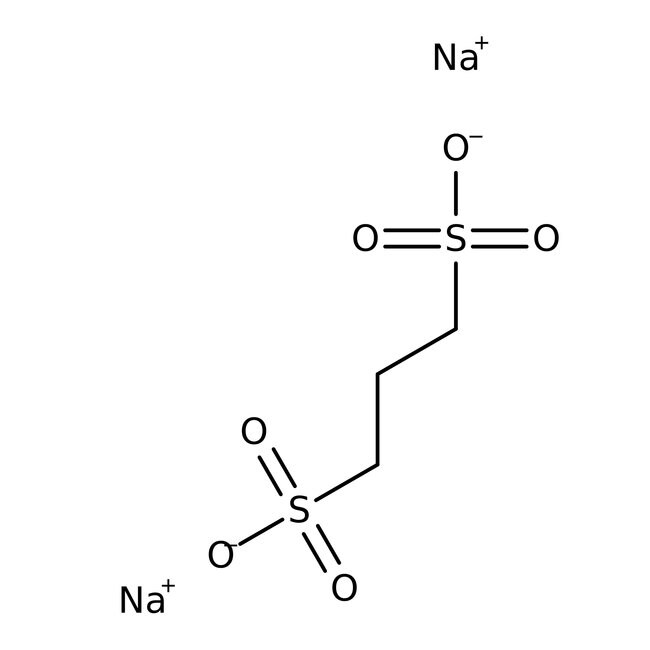
1,3-Propanedisulfonic acid disodium salt, 99% (dry wt.)
CAS: 36589-58-9 | C3H6Na2O6S2 | 248.175 g/mol
Have Questions?
Change view

Catalog number B20092.06
also known as B20092-06
Price (USD)
44.65
Online Exclusive
48.90Save 4.25 (9%)
Each
Quantity:
5 g
Price (USD)
44.65
Online Exclusive
48.90Save 4.25 (9%)
Each
Chemical Identifiers
CAS36589-58-9
IUPAC Namedisodium propane-1,3-disulfonate
Molecular FormulaC3H6Na2O6S2
InChI KeyDKGJFKPIUSHDIT-UHFFFAOYSA-L
SMILES[Na+].[Na+].[O-]S(=O)(=O)CCCS([O-])(=O)=O
View more
Specifications Specification Sheet
Specification SheetSulfated Ash56.4-58.1%
FormPowder
Loss on Drying<5.0% (200?C/constant wt.)
Appearance (Color)White
Assay (ex Sulphated Ash)>98.5 to <101.5% (dry wt. basis)
It is used as a reactant involved in synthesis of cadmium(II) bipyridine complex metal-organic frameworks with alkanedisulfonates, alkylenedisulfonate inorganic-organic hybrid materials and glycosaminoglycan mimetic involved in pharmacological studies for the treatment of amyloid A amyloidosis.
This Thermo Scientific Chemicals brand product was originally part of the Alfa Aesar product portfolio. Some documentation and label information may refer to the legacy brand. The original Alfa Aesar product / item code or SKU reference has not changed as a part of the brand transition to Thermo Scientific Chemicals.
Applications
It is used as a reactant involved in synthesis of cadmium(II) bipyridine complex metal-organic frameworks with alkanedisulfonates, alkylenedisulfonate inorganic-organic hybrid materials and glycosaminoglycan mimetic involved in pharmacological studies for the treatment of amyloid A amyloidosis.
Solubility
Partially soluble in cold water, hot water.
Notes
Hygroscopic. Store away from oxidizing agents and air. Keep the container tightly closed and place it in a cool, dry and well ventilated condition.
It is used as a reactant involved in synthesis of cadmium(II) bipyridine complex metal-organic frameworks with alkanedisulfonates, alkylenedisulfonate inorganic-organic hybrid materials and glycosaminoglycan mimetic involved in pharmacological studies for the treatment of amyloid A amyloidosis.
Solubility
Partially soluble in cold water, hot water.
Notes
Hygroscopic. Store away from oxidizing agents and air. Keep the container tightly closed and place it in a cool, dry and well ventilated condition.
RUO – Research Use Only
General References:
- H. Fei and S. R. J. Oliver Dalton.Two cationic metal-organic frameworks based on cadmium and α,ω-alkanedisulfonate anions and their photoluminescent properties.Trans.2011,3911193-11200.
- D. L. Rogow, et al. Hydrothermal Synthesis and Characterization of Three Cationic Inorganic-Organic Hybrid Materials Based on Lead Fluoride.Cryst. Growth Des. 2010.10823-829.