Search
 Element Search
 Structure Search


Thermo Scientific Chemicals
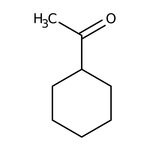
Cyclohexyl methyl ketone, 95%
CAS: 823-76-7 | C8H14O | 126.199 g/mol
Have Questions?
Change view


Catalog number B21000.06
also known as B21000-06
Price (USD)
41.65
Special offer
Online exclusive
Ends: 31-Dec-2025
49.20Save 7.55 (15%)
Each
Quantity:
5 g
Price (USD)
41.65
Special offer
Online exclusive
Ends: 31-Dec-2025
49.20Save 7.55 (15%)
Each
Chemical Identifiers
CAS823-76-7
IUPAC Name1-cyclohexylethan-1-one
Molecular FormulaC8H14O
InChI KeyRIFKADJTWUGDOV-UHFFFAOYSA-N
SMILESCC(=O)C1CCCCC1
View more
Specifications Specification Sheet
Specification SheetAppearance (Color)Clear colorless to pale yellow
FormLiquid
Identification (FTIR)Conforms
Assay (GC)≥94.0%
Refractive Index1.4480-1.4540 @ 20?C
It can be used to produce acetoxycyclohexane. It is also used as a pharmaceutical intermediate.
This Thermo Scientific Chemicals brand product was originally part of the Alfa Aesar product portfolio. Some documentation and label information may refer to the legacy brand. The original Alfa Aesar product / item code or SKU reference has not changed as a part of the brand transition to Thermo Scientific Chemicals.
Applications
It can be used to produce acetoxycyclohexane. It is also used as a pharmaceutical intermediate.
Solubility
Not miscible or difficult to mix in water.
Notes
Store away from oxidizing agents and bases. Keep the container tightly closed and place it in a cool, dry and well ventilated condition.
It can be used to produce acetoxycyclohexane. It is also used as a pharmaceutical intermediate.
Solubility
Not miscible or difficult to mix in water.
Notes
Store away from oxidizing agents and bases. Keep the container tightly closed and place it in a cool, dry and well ventilated condition.
RUO – Research Use Only
General References:
- Bach RD. The role of acid catalysis in the Baeyer-Villiger reaction. A theoretical study.J Org Chem.201277(16), 6801-15.
- Thomas M. Bare and Herbert O. House. Methyl Ketones from Carboxylic Acids: Cyclohexyl Methyl Ketone.Org. Synth.
- Monobromination of unsymmetrical ketones at the less-substituted carbon atom in methanol gives results which parallel the bromination of the corresponding acetal, and in this case results in exclusive reaction at the methyl group: Org. Synth. Coll., 6, 193 (1988).