Search
 Element Search
 Structure Search
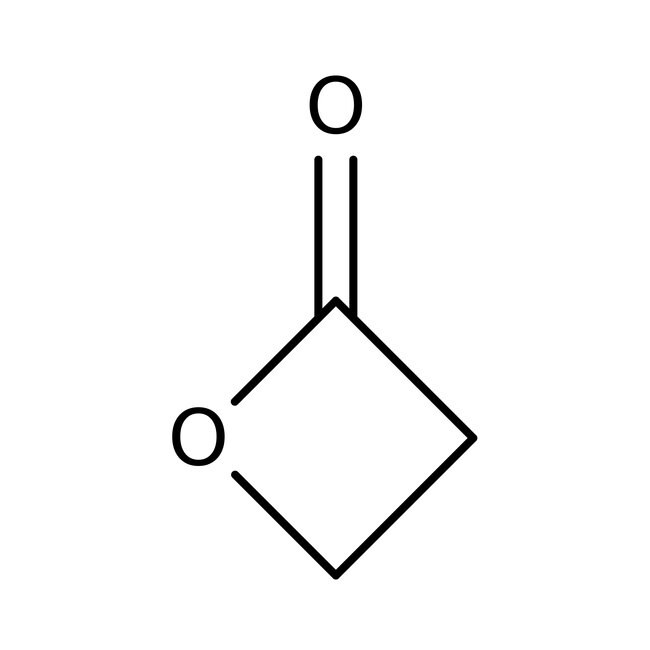

Thermo Scientific Chemicals
beta-Propiolactone, 97%
CAS: 57-57-8 | C3H4O2 | 72.06 g/mol
Have Questions?
Change view


Catalog number B23197.03
also known as B23197-03
Price (USD)
75.65
Online Exclusive
84.40Save 8.75 (10%)
Each
Quantity:
1 g
Price (USD)
75.65
Online Exclusive
84.40Save 8.75 (10%)
Each
Chemical Identifiers
CAS57-57-8
IUPAC Nameoxetan-2-one
Molecular FormulaC3H4O2
InChI KeyVEZXCJBBBCKRPI-UHFFFAOYSA-N
SMILESO=C1CCO1
View more
Specifications Specification Sheet
Specification SheetRefractive Index1.4105-1.4155 @ 20°C (non-U.S. specification)
Appearance (Color)Clear colorless
Assay (GC)≥96.0% (non-U.S. specification)
CommentSpecification differs for U.S. and non-U.S. material where indicated
Assay from Suppliers CofA≥96.0% (U.S. specification)
View more
Beta-Propiolactone is widely used as a sterilizing and sporicidal agent, which is used to sterilize blood plasma, vaccines, tissue grafts, surgical instruments and enzymes. It finds an application in the manufacturing of acrylic acid and its esters. It is utilized as an intermediate in the synthesis of synthetic compounds.
This Thermo Scientific Chemicals brand product was originally part of the Alfa Aesar product portfolio. Some documentation and label information may refer to the legacy brand. The original Alfa Aesar product / item code or SKU reference has not changed as a part of the brand transition to Thermo Scientific Chemicals.
Applications
Beta-Propiolactone is widely used as a sterilizing and sporicidal agent, which is used to sterilize blood plasma, vaccines, tissue grafts, surgical instruments and enzymes. It finds an application in the manufacturing of acrylic acid and its esters. It is utilized as an intermediate in the synthesis of synthetic compounds.
Solubility
Miscible with water and organic solvents.
Notes
Flammable material. Should be stored in a separate safety storage cabinet or room. Keep away from heat and sources of ignition.
Beta-Propiolactone is widely used as a sterilizing and sporicidal agent, which is used to sterilize blood plasma, vaccines, tissue grafts, surgical instruments and enzymes. It finds an application in the manufacturing of acrylic acid and its esters. It is utilized as an intermediate in the synthesis of synthetic compounds.
Solubility
Miscible with water and organic solvents.
Notes
Flammable material. Should be stored in a separate safety storage cabinet or room. Keep away from heat and sources of ignition.
WARNING: Cancer – www.P65Warnings.ca.gov
RUO – Research Use Only
General References:
- Goodman, C. H.; Russell, B. J.; Velez, J. O.; Laven, J. J.; Bagarozzi, Jr. D. A.; Moon, J. L.; Bedi, K.; Johnson, B. W. Production of a Sindbis/Eastern Equine Encephalitis chimeric virus inactivated cell culture antigen. J. Virol. Methods. 2015, 223, 19-24.
- Pawar, S.D.; Murtadak, V. B.; Kale, S. D.; Shinde, P. V.; Parkhi, S. S. Evaluation of different inactivation methods for high and low pathogenic avian influenza viruses in egg-fluids for antigen preparation. J. Virol. Methods. 2015, 222, 28-33.