Search
 Element Search
 Structure Search


Thermo Scientific Chemicals
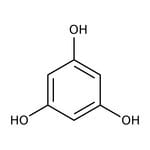
Phloroglucinol, anhydrous, 98%
CAS: 108-73-6 | C6H6O3 | 126.111 g/mol
Have Questions?
Change view


Catalog number B25502.30
also known as B25502-30
Price (USD)
214.65
Special offer
Online exclusive
Ends: 30-Jun-2026
252.00Save 37.35 (15%)
Each
Quantity:
250 g
Price (USD)
214.65
Special offer
Online exclusive
Ends: 30-Jun-2026
252.00Save 37.35 (15%)
Each
Chemical Identifiers
CAS108-73-6
IUPAC Namebenzene-1,3,5-triol
Molecular FormulaC6H6O3
InChI KeyQCDYQQDYXPDABM-UHFFFAOYSA-N
SMILESOC1=CC(O)=CC(O)=C1
View more
Specifications Specification Sheet
Specification SheetAppearance (Color)White to pale cream
FormPowder
Identification (FTIR)Conforms
Water Content (Karl Fischer Titration)≤2.0%
Melting Point (clear melt)213-223°C
View more
Reagent for pentoses, pentosans and aldehydes. Used as a bone decalcifier in microscopy specimens.Phloroglucinol is mainly used as a coupling agent in printing. It is an active component of Tollen’s reagent and Gunzburg reagent used to test pentoses and hydrochloric acid in gastric juice respectively. In analytical chemistry, it is used to study condensed tannins by means of depolymerization. It is also involved in the synthesis of 2,4,6-triamino-1,3,5- trinitrobenzene, trinitrophloroglucinol and pharmaceuticals like flopropione .
This Thermo Scientific Chemicals brand product was originally part of the Alfa Aesar product portfolio. Some documentation and label information may refer to the legacy brand. The original Alfa Aesar product / item code or SKU reference has not changed as a part of the brand transition to Thermo Scientific Chemicals.
Applications
Reagent for pentoses, pentosans and aldehydes. Used as a bone decalcifier in microscopy specimens.Phloroglucinol is mainly used as a coupling agent in printing. It is an active component of Tollen’s reagent and Gunzburg reagent used to test pentoses and hydrochloric acid in gastric juice respectively. In analytical chemistry, it is used to study condensed tannins by means of depolymerization. It is also involved in the synthesis of 2,4,6-triamino-1,3,5- trinitrobenzene, trinitrophloroglucinol and pharmaceuticals like flopropione .
Solubility
Soluble in diethyl ether, ethanol and pyridine.
Notes
Incompatible with acid chlorides, acid anhydrides, bases and oxidizing agents.
Reagent for pentoses, pentosans and aldehydes. Used as a bone decalcifier in microscopy specimens.Phloroglucinol is mainly used as a coupling agent in printing. It is an active component of Tollen’s reagent and Gunzburg reagent used to test pentoses and hydrochloric acid in gastric juice respectively. In analytical chemistry, it is used to study condensed tannins by means of depolymerization. It is also involved in the synthesis of 2,4,6-triamino-1,3,5- trinitrobenzene, trinitrophloroglucinol and pharmaceuticals like flopropione .
Solubility
Soluble in diethyl ether, ethanol and pyridine.
Notes
Incompatible with acid chlorides, acid anhydrides, bases and oxidizing agents.
RUO – Research Use Only
General References:
- Reacts with mono- or dimethylamine in DMF-water, with displacement of one of the OH groups, to give 5-aminoresorcinols: Helv. Chim. Acta, 56, 510 (1973).
- The electron-rich nucleus undergoes acylation with nitriles under mild Lewis acid catalysis, to give ketones (Houben-Hoesch reaction).
- Selective monobromination cannot be achieved conventionally. For bromination-debromination protocols for the preparation of the mono- and di-brominated derivatives, see: Can. J. Chem., 67, 335 (1989).
- Dubey, R.; Desiraju, G. R. Combinatorial Crystal Synthesis: Structural Landscape of Phloroglucinol: 1, 2-bis (4-pyridyl) ethylene and Phloroglucinol: Phenazine. Angew. Chem. Int. Ed. 2014, 53 (48), 13178-13182.
- Ghimbeu, C. M.; Vidal, L.; Delmotte, L.; Le Meins, J. M.; Vix-Guterl, C. Catalyst-free soft-template synthesis of ordered mesoporous carbon tailored using phloroglucinol/glyoxylic acid environmentally friendly precursors. Green Chem. 2014, 16 (6), 3079-3088.