Search


Citations & References (23)
Invitrogen™
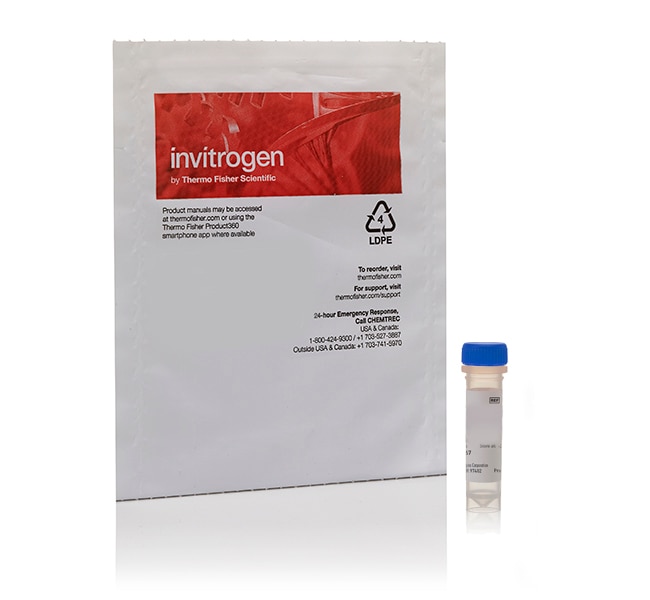
Alpha-Bungarotoxin Conjugates
Thermo Fisher Scientific offers a broad selection of Invitrogen alpha-bungarotoxin conjugates, including Alexa Fluor and Alexa Fluor Plus conjugates.
Have Questions?
Change view

| Catalog Number | Label or Dye |
|---|---|
| B35450 | Alexa Fluor™ 647 |
| B56130 | Alexa Fluor™ Plus 405 |
| B13422 | Alexa Fluor™ 488 |
| B35451 | Alexa Fluor™ 555 |
| B13423 | Alexa Fluor™ 594 |
| B1196 | Biotin-XX |
| T1175 | Tetramethylrhodamine |
| B1601 | Unlabeled |
Catalog number B35450
Price (USD)
610.65
Online exclusive
650.00Save 39.35
Each
Label or Dye:
Alexa Fluor™ 647
Price (USD)
610.65
Online exclusive
650.00Save 39.35
Each
Thermo Fisher Scientific offers a broad selection of Invitrogen alpha-bungarotoxin conjugates, including Alexa Fluor and Alexa Fluor Plus conjugates. Alpha-bungarotoxin, a 74-amino acid peptide extracted from Bungarus multicinctus venom, binds with high affinity to the alpha subunit of the nicotinic acetylcholine receptor (AChR) of neuromuscular junctions.
Our bright and photostable Alexa Fluor 555 alpha-bungarotoxin is a superior choice of probe for visualizing this receptor. Fluorescent alpha-bungarotoxin conjugates can be used to facilitate identification of nicotinic AChRs and localization of neuromuscular junctions. Conjugated alpha-bungarotoxin has been used in variety of applications, including immunofluorescence (IF), immunohistochemistry (IHC), and flow cytometry (FC).
For Research Use Only. Not for use in diagnostic procedures.
Specifications
Label or DyeAlexa Fluor™ 647
Product TypeConjugate
Protein SubtypeOther Proteins
Quantity500 μg
Shipping ConditionRoom Temperature
Excitation/Emission660/668 nm
Product LineAlexa Fluor
Unit SizeEach
Contents & Storage
Store in freezer (–5° to –30°C) and protect from light.
Citations & References (23)
Citations & References
Abstract
Genetic evidence that relative synaptic efficacy biases the outcome of synaptic competition.
Journal:Nature
PubMed ID:12879071
'Synaptic activity drives synaptic rearrangement in the vertebrate nervous system; indeed, this appears to be a main way in which experience shapes neural connectivity. One rearrangement that occurs in many parts of the nervous system during early postnatal life is a competitive process called ''synapse elimination''. At the neuromuscular junction,
Impaired neuromuscular transmission and skeletal muscle fiber necrosis in mice lacking Na/Ca exchanger 3.
Journal:J Clin Invest
PubMed ID:14722618
'We produced and analyzed mice deficient for Na/Ca exchanger 3 (NCX3), a protein that mediates cellular Ca(2+) efflux (forward mode) or Ca(2+) influx (reverse mode) and thus controls intracellular Ca(2+) concentration. NCX3-deficient mice (Ncx3(-/-)) present a skeletal muscle fiber necrosis and a defective neuromuscular transmission, reflecting the absence of NCX3
The use of amphipols as universal molecular adapters to immobilize membrane proteins onto solid supports.
Journal:Proc Natl Acad Sci U S A
PubMed ID:19116278
'Because of the importance of their physiological functions, cell membranes represent critical targets in biological research. Membrane proteins, which make up approximately 1/3 of the proteome, interact with a wide range of small ligands and macromolecular partners as well as with foreign molecules such as synthetic drugs, antibodies, toxins, or
Axonal neuregulin 1 is a rate limiting but not essential factor for nerve remyelination.
Journal:
PubMed ID:23801741
Neuregulin 1 acts as an axonal signal that regulates multiple aspects of Schwann cell development including the survival and migration of Schwann cell precursors, the ensheathment of axons and subsequent elaboration of the myelin sheath. To examine the role of this factor in remyelination and repair following nerve injury, we
Axonally derived neuregulin-1 is required for remyelination and regeneration after nerve injury in adulthood.
Journal:J Neurosci
PubMed ID:21368034
Neuregulin-1 (NRG1) plays a crucial role in axoglial signaling during the development of the peripheral nervous system, but its importance in adulthood after peripheral nerve injury remains unclear. We used single-neuron labeling with inducible Cre-mediated knock-out animals, which enabled visualization of a subset of adult myelinated sensory and motoneurons neurons