Search


Citas y referencias (14)
Invitrogen™
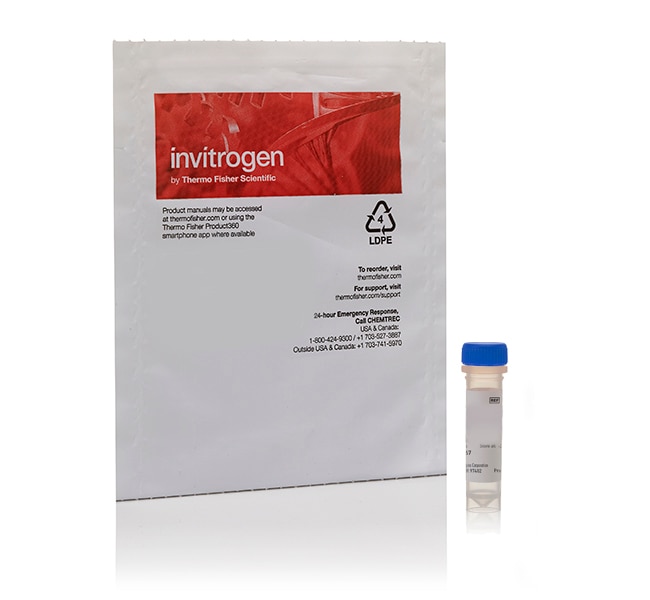
ChromaTide™ Alexa Fluor™ 488-5-dUTP
Pueden usarse nucleidos dUTP, OBEA-dCTP y UTP etiquetados con colorante Molecular Probes™ ChromaTide™ para sintetizar sondas de ADN etiquetadas sinMás información
| Número de catálogo | Cantidad |
|---|---|
| C11397 | 25 μl |
Número de catálogo C11397
Precio (MXN)
-
Cantidad:
25 μl
Pueden usarse nucleidos dUTP, OBEA-dCTP y UTP etiquetados con colorante Molecular Probes™ ChromaTide™ para sintetizar sondas de ADN etiquetadas sin necesidad de nucleidos etiquetados con radioisótopos peligrosos y costosos. Estos nucleidos pueden incorporarse mediante técnicas estándar de biología molecular; a continuación, las sondas etiquetadas pueden utilizarse en protocolos de hibridación in situ, micromatrices o transferencia. Los nucleidos etiquetados con colorante ChromaTide™ están disponibles en diferentes colores fluorescentes para facilitar el análisis multicolor.
Especificaciones de los nucleidos etiquetados con ChromaTide™:
• Ex/Em del colorante: Alexa Fluor™ 488-5-dUTP (490/520 nm)
• Longitud del enlazador alquinilamino: 5 átomos
Métodos para incorporar nucleidos ChromaTide™ en sondas
• Translación de mellas (nick translation)
• Etiquetado de primers aleatorios
• Etiquetado final con desoxinucleotidil transferasa terminal
• Transcripción inversa
• Amplificación de PCR
Consulte Métodos para la incorporación enzimática de dUTP ChromaTide™ para obtener directrices específicas para cada uno de estos métodos.
Los colorantes fluorescentes Alexa Fluor™ y BODIPY™ generan excelentes sondas
Las sondas generadas con nucleidos etiquetados pueden usarse para técnicas multicolores como la hibridación in situ y la hibridación en matrices. Nuestros conjugados de colorantes patentados BODIPY™ y Alexa Fluor™ son excepcionalmente brillantes, fotoestables y esencialmente insensibles al pH. El estrecho perfil de emisión de los colorantes BODIPY™ ayuda a asegurar una superposición espectral mínima. Los colorantes Alexa Fluor™ son muy solubles en agua, al igual que las sondas de ADN fabricadas a partir de ellos, lo que los convierte en las etiquetas preferidas para la hibridación fluorescente in situ.
Los enlazadores largos mejoran el rendimiento
Los nucleidos dUTP y UTP ChromaTide™ se modifican en la posición C-5 de la uridina a través de un único enlazador alquinilamino, que proporciona un espaciador entre el nucleótido y el colorante para reducir las interacciones entre ellos. El número en el nombre del producto, por ejemplo, “12” en fluoresceína-12 dUTP, indica la longitud neta del separador, en átomos. Estos espaciadores dan como resultado conjugados más brillantes y una mayor accesibilidad a los reactivos de detección secundaria.
Para obtener una lista completa de nuestros reactivos ChromaTide™: Nucleidos etiquetados con aha y Molecular Probes ChromaTide™: Tabla 8.5.
Para obtener información adicional sobre estos reactivos de etiquetado, lea la Sección 8.2: Etiquetado de oligonucleótidos y ácidos nucleicos del Manual de Molecular Probes™.
Para uso exclusivo en investigación. No diseñado para uso diagnóstico o terapéutico en humanos ni en animales.
Especificaciones de los nucleidos etiquetados con ChromaTide™:
• Ex/Em del colorante: Alexa Fluor™ 488-5-dUTP (490/520 nm)
• Longitud del enlazador alquinilamino: 5 átomos
Métodos para incorporar nucleidos ChromaTide™ en sondas
• Translación de mellas (nick translation)
• Etiquetado de primers aleatorios
• Etiquetado final con desoxinucleotidil transferasa terminal
• Transcripción inversa
• Amplificación de PCR
Consulte Métodos para la incorporación enzimática de dUTP ChromaTide™ para obtener directrices específicas para cada uno de estos métodos.
Los colorantes fluorescentes Alexa Fluor™ y BODIPY™ generan excelentes sondas
Las sondas generadas con nucleidos etiquetados pueden usarse para técnicas multicolores como la hibridación in situ y la hibridación en matrices. Nuestros conjugados de colorantes patentados BODIPY™ y Alexa Fluor™ son excepcionalmente brillantes, fotoestables y esencialmente insensibles al pH. El estrecho perfil de emisión de los colorantes BODIPY™ ayuda a asegurar una superposición espectral mínima. Los colorantes Alexa Fluor™ son muy solubles en agua, al igual que las sondas de ADN fabricadas a partir de ellos, lo que los convierte en las etiquetas preferidas para la hibridación fluorescente in situ.
Los enlazadores largos mejoran el rendimiento
Los nucleidos dUTP y UTP ChromaTide™ se modifican en la posición C-5 de la uridina a través de un único enlazador alquinilamino, que proporciona un espaciador entre el nucleótido y el colorante para reducir las interacciones entre ellos. El número en el nombre del producto, por ejemplo, “12” en fluoresceína-12 dUTP, indica la longitud neta del separador, en átomos. Estos espaciadores dan como resultado conjugados más brillantes y una mayor accesibilidad a los reactivos de detección secundaria.
Para obtener una lista completa de nuestros reactivos ChromaTide™: Nucleidos etiquetados con aha y Molecular Probes ChromaTide™: Tabla 8.5.
Para obtener información adicional sobre estos reactivos de etiquetado, lea la Sección 8.2: Etiquetado de oligonucleótidos y ácidos nucleicos del Manual de Molecular Probes™.
Para uso exclusivo en investigación. No diseñado para uso diagnóstico o terapéutico en humanos ni en animales.
Para uso exclusivo en investigación. No apto para uso en procedimientos diagnósticos.
Especificaciones
Método de etiquetadoEtiquetado directo
Etiqueta o tinteAlexa Fluor™ 488
Cantidad25 μl
Condiciones de envíoHielo seco
Concentración1 mM
Línea de productosAlexa Fluor, ChromaTide
Unit SizeEach
Contenido y almacenamiento
Almacenar en el congelador (de -5 a -30 °C) y proteger de la luz.
Preguntas frecuentes
I'm getting high background after labeling with ChromaTide nucleotides. What do you recommend I do?
The nucleic acid probe is not fluorescent after labeling with ChromaTide nucleotides. What do you recommend I try?
Can ChromaTide nucleotides be used for labeling nucleic acids in live cells?
How do I determine the incorporation efficiency of the ChromaTide Labeling Nucleotides after enzymatic incorporation?
What is the average dye to base incorporation rate when enzymatically incorporating ChromaTide nucleotides?
Citations & References (14)
Citations & References
Abstract
Super-resolution imaging reveals three-dimensional folding dynamics of the ß-globin locus upon gene activation.
Journal:J Cell Sci
PubMed ID:22767512
The chromatin architecture is constantly changing because of cellular processes such as proliferation, differentiation and changes in the expression profile during gene activation or silencing. Unravelling the changes that occur in the chromatin structure during these processes has been a topic of interest for many years. It is known that
Heterogeneous nuclear ribonucleoprotein (hnRNP) E1 binds to hnRNP A2 and inhibits translation of A2 response element mRNAs.
Journal:Mol Biol Cell
PubMed ID:16775011
'Heterogeneous nuclear ribonucleoprotein (hnRNP) A2 is a trans-acting RNA-binding protein that mediates trafficking of RNAs containing the cis-acting A2 response element (A2RE). Previous work has shown that A2RE RNAs are transported to myelin in oligodendrocytes and to dendrites in neurons. hnRNP E1 is an RNA-binding protein that regulates translation of
Effects of RNA interference of Trypanosoma brucei structure-specific endonuclease-I on kinetoplast DNA replication.
Journal:J Biol Chem
PubMed ID:16096280
'Kinetoplast DNA, the mitochondrial DNA of trypanosomatid protozoa, is a network containing several thousand topologically interlocked DNA minicircles. Kinetoplast DNA synthesis involves release of minicircles from the network, replication of the free minicircles, and reattachment of the progeny back onto the network. One enzyme involved in this process is structure-specific
A beta-catenin survival signal is required for normal lobular development in the mammary gland.
Journal:J Cell Sci
PubMed ID:12584256
'The Wnt (wingless) family of secreted glycoproteins initiates a signalling pathway implicated in the regulation of both normal mouse mammary gland development and tumorigenesis. Multiple Wnt signals ultimately converge on the multifunctional protein beta-catenin to activate the transcription of target genes. Although beta-catenin plays a crucial role in canonical Wnt
The genetic architecture of Down syndrome phenotypes revealed by high-resolution analysis of human segmental trisomies.
Journal:Proc Natl Acad Sci U S A
PubMed ID:19597142
'Down syndrome (DS), or trisomy 21, is a common disorder associated with several complex clinical phenotypes. Although several hypotheses have been put forward, it is unclear as to whether particular gene loci on chromosome 21 (HSA21) are sufficient to cause DS and its associated features. Here we present a high-resolution