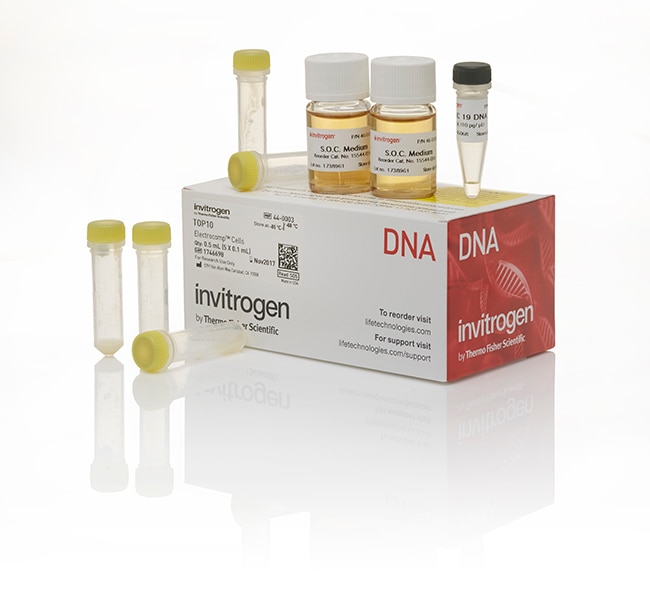
TOP10 Electrocomp™ Kit
Invitrogen™

TOP10 Electrocomp™ Kit

Los compuestos TOP10 E. coli se suministran con una eficacia de transformación de 1 × 10¹⁰ cfu/µg de ADN superhelicoidalMás información
Have Questions?
Cambiar vistabuttonViewtableView
Número de catálogoCantidad
C6641110 x 100 μl
C664555 x 100 μl
Número de catálogo C66411
Precio (MXN)
-
Cantidad:
10 x 100 μl
Los compuestos TOP10 E. coli se suministran con una eficacia de transformación de 1 × 10¹⁰ cfu/µg de ADN superhelicoidal y resultan ideales para la clonación y la propagación plasmídica de alta eficiencia. Permiten la replicación estable de plásmidos de alto número de copias.

El genotipo de las células TOP10 es similar a la cepa DH10B™, y ofrece las siguientes características:

hsdR para una transformación eficaz de ADN no metilado procedente de amplificaciones de PCR
mcrA para una transformación eficaz del ADN metilado a partir de preparaciones genómicas
lacZΔM15 para la detección del color azul/blanco de clones recombinantes
endA1 para unas preparaciones de ADN más transparentes y mejores resultados en aplicaciones posteriores gracias a la eliminación de la digestión inespecífica con endonucleasa I
recA1 para reducir los casos de recombinación inespecífica en ADN clonado

Los kits One Shot™ TOP10 están disponibles con E. coli químicamente competente o electrocompetente para adaptarse a sus necesidades específicas de transformación. Las células E. coli TOP10 también están disponibles en el formato de alto rendimiento MultiShot™.

Nota: Este kit contiene suficientes células electrocompetentes para 12 x 40 µl rxns o 25 x 20 µl rxns. Consulte el manual del producto para conocer las recomendaciones de la escala de reacción.

Genotipo:
F- mcrA Δ(mrr-hsdRMS-mcrBC) φ80lacZΔM15 ΔlacX74 recA1 araD139 Δ(ara-leu)7697 galU galK rpsL endA1 nupG
Para uso exclusivo en investigación. No apto para uso en procedimientos diagnósticos.
Especificaciones
Resistencia bacteriana a los antibióticosYes (Streptomycin)
Tramado azul/blanco
Clonación de ADN metilado
Clonación de ADN inestableNo es adecuado para clonar ADN inestable
Contiene el episoma F'No
Compatibilidad de alto rendimientoNo compatible con alto rendimiento (manual)
Mejora la calidad de los plásmidos
PlásmidoSe puede utilizar para plasmidos > 20 kb
Preparación de ADN no metiladoNo es adecuado para preparar ADN no metilado
Línea de productosElectrocomp
Tipo de productoKit de electroporador
Cantidad10 x 100 μl
Reduce la recombinación
Condiciones de envíoDry Ice
Resistente al fago T1 (tonA)No
Nivel de eficiencia de transformaciónAlta eficiencia (> 10^9 cfu⁄µg)
FormatoTubo
EspecieE. coli
Unit SizeEach
Contenido y almacenamiento
• 10 x 100 μL TOP10 Electrocomp E. coli
• 50 μL pUC19 vector (10 pg/μL)
Store at –80°C.

• 15 mL S.O.C. Medium
Store at room temperature.

Preguntas frecuentes

What is the difference between TOP10 and TOP10F' cells?

The only difference between TOP10 and TOP10F' cells is that the latter contain the F' episome that carries the tetracycline resistance gene and allows isolation of single-stranded DNA from vectors that have an f1 origin of replication. The F' episome also carries the lacIq repressor for inducible expression from trc, tac, and lac promoters using IPTG. TOP10F' cells require IPTG induction for blue/white screening.

I am trying to clone an insert that is supposedly pretty toxic. I used DH5? and TOP10 cells for the transformation and got no colonies on the plate. Do you have any suggestions for me?

If the insert is potentially toxic to the host cells, here are some suggestions that you can try:

- After transforming TOP10 or DH5? cells, incubate at 25-30°C instead of 37°C. This will slow down the growth and will increase the chances of cloning a potentially toxic insert.
- Try using TOP10F' cells for the transformation, but do not add IPTG to the plates. These cells carry the lacIq repressor that represses expression from the lac promoter and so allows cloning of toxic genes. Keep in mind that in the absence of IPTG, blue-white screening cannot be performed.
- Try using Stbl2 cells for the transformation.

Can I directly clone, propagate and express in BL21 without using TOP10?

It is imperative that a cloning strain such as TOP10 be used for characterization of the plasmid, propagation, and maintenance. BL21 cells are wild-type for endA and recA, which could result in poor miniprep quality and a greater chance of plasmid rearrangements due to recombination. In addition, BL21 cells contain the T7 RNA polymerase gene which is expressed at low levels even in the absence of inducer. If the gene is toxic to E. coli, plasmid instability and/or cell death can result.

I need to clone unmethylated DNA from a PCR reaction using a strain that has the hsdRMS mutation to avoid restriction after transformation. Is TOP10 suitable for my purposes?

Yes, TOP10 has the hsdRMS mutation, so this strain can be used to clone DNA from PCR reactions and other non-methylated sources. hsdRMS is a mutation in the system that E. coli uses to recognize foreign DNA. There are two parts to this system, methylation and restriction. E. coli methylate DNA at certain sequences, and if the DNA is not methylated at these sequences it will be recognized as foreign and restricted. Thus, if unmethylated DNA is transformed into E.coli that does not carry the hsdRMS genotype, it is recognized as foreign and enzymatically degraded.