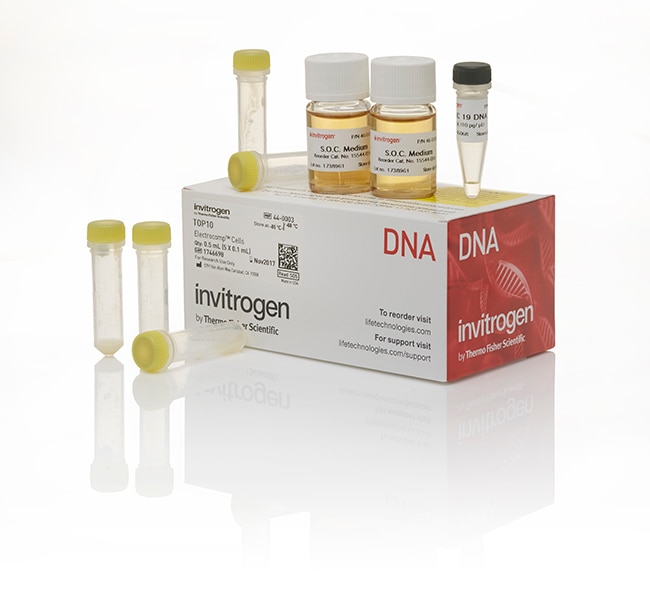
TOP10 Electrocomp™ Kit
Invitrogen™

TOP10 Electrocomp™ Kit

TOP10 E. coli werden mit einer Transformationseffizienz von 1 × 10¹⁰ KbE/µg superhelikaler DNA bereitgestellt und sind ideal für eineWeitere Informationen
Have Questions?
Ansicht ändernbuttonViewtableView
KatalognummerMenge
C664555 x 100 μl
C6641110 x 100 μl
Katalognummer C66455
Preis (EUR)
342,65
Exklusiv online
353,00
Ersparnis 10,35 (3%)
Each
Zum Warenkorb hinzufügen
Menge:
5 x 100 μl
Preis (EUR)
342,65
Exklusiv online
353,00
Ersparnis 10,35 (3%)
Each
Zum Warenkorb hinzufügen
TOP10 E. coli werden mit einer Transformationseffizienz von 1 × 10¹⁰ KbE/µg superhelikaler DNA bereitgestellt und sind ideal für eine hocheffiziente Klonierung und Plasmidpropagation. Sie ermöglichen eine stabile Replikation einer hohen Anzahl von Plasmidkopien.

Der Genotyp von TOP10-Zellen ähnelt dem DH10B™-Stamm und bietet die folgenden Merkmale:

hsdR für die effiziente Transformation von nicht methylierter DNA aus PCR-Amplifikationen
mcrA für die effiziente Transformation von methylierter DNA aus genomischen Präparaten
lacZΔM15 für das Blau-Weiß-Farbscreening rekombinanter Klone
endA1 für sauberere DNA-Präparate und bessere Ergebnisse in Downstream-Prozessen durch die Eliminierung von nicht-spezifischer Aufspaltung durch Endonuklease I
recA1 für ein reduziertes Auftreten unspezifischer Rekombinationen in geklonter DNA

One Shot™ TOP10 Kits sind entweder mit chemisch kompetenten oder elektrokompetenten E. coli erhältlich, um Ihren spezifischen Transformationsanforderungen gerecht zu werden. TOP10 E. coli sind auch im MultiShot™ Format für hohe Durchsätze erhältlich.

Hinweis: Dieses Kit enthält ausreichend elektrokompetente Zellen für 12 x 40 µl-Reaktionen oder 25 x 20 µl-Reaktionen. Empfehlungen zur Reaktionsskala finden Sie im Produkthandbuch.

Genotyp:
F- mcrA Δ(mrr-hsdRMS-mcrBC) φ80lacZΔM15 ΔlacX74 recA1 araD139 Δ(ara-leu)7697 galU galK rpsL endA1 nupG

Nur für Forschungszwecke. Nicht zur Verwendung bei diagnostischen Verfahren.

Specifications
Bakterielle AntibiotikaresistenzYes (Streptomycin)
Blau-Weiß-ScreeningJa
Klonierung methylierter DNAJa
Klonierung instabiler DNANicht geeignet zum Klonen instabiler DNA
Enthält F'-EpisomNo
Hochdurchsatz-KompatibilitätNicht kompatibel mit hohem Durchsatz (manuell)
Verbessert die PlasmidqualitätJa
PlasmidKann für Plasmide > 20 kb verwendet werden
Vorbereitung von nicht methylierter DNANicht geeignet für die Vorbereitung von nicht methylierter DNA
ProduktlinieElectrocomp
ProdukttypElektroporatorkit
Menge5 x 100 μl
Reduziert RekombinationJa
VersandbedingungTrockeneis
T1-Phage – resistent (TonA)Nein
TransformationsleistungsgradHoher Wirkungsgrad (> 10^9 KbE⁄µg)
FormatRörchen
SpeziesE. coli
Unit SizeEach
Inhalt und Lagerung
• 5 x 100μL TOP10 Electrocomp E. coli
• 50 μL pUC19 vector (10 pg/μL)
Store at –80°C.

• S.O.C. Medium (15 mL)
Store at room temperature.

Häufig gestellte Fragen (FAQ)

What is the difference between TOP10 and TOP10F' cells?

The only difference between TOP10 and TOP10F' cells is that the latter contain the F' episome that carries the tetracycline resistance gene and allows isolation of single-stranded DNA from vectors that have an f1 origin of replication. The F' episome also carries the lacIq repressor for inducible expression from trc, tac, and lac promoters using IPTG. TOP10F' cells require IPTG induction for blue/white screening.

I am trying to clone an insert that is supposedly pretty toxic. I used DH5? and TOP10 cells for the transformation and got no colonies on the plate. Do you have any suggestions for me?

If the insert is potentially toxic to the host cells, here are some suggestions that you can try:

- After transforming TOP10 or DH5? cells, incubate at 25-30°C instead of 37°C. This will slow down the growth and will increase the chances of cloning a potentially toxic insert.
- Try using TOP10F' cells for the transformation, but do not add IPTG to the plates. These cells carry the lacIq repressor that represses expression from the lac promoter and so allows cloning of toxic genes. Keep in mind that in the absence of IPTG, blue-white screening cannot be performed.
- Try using Stbl2 cells for the transformation.

Can I directly clone, propagate and express in BL21 without using TOP10?

It is imperative that a cloning strain such as TOP10 be used for characterization of the plasmid, propagation, and maintenance. BL21 cells are wild-type for endA and recA, which could result in poor miniprep quality and a greater chance of plasmid rearrangements due to recombination. In addition, BL21 cells contain the T7 RNA polymerase gene which is expressed at low levels even in the absence of inducer. If the gene is toxic to E. coli, plasmid instability and/or cell death can result.

I need to clone unmethylated DNA from a PCR reaction using a strain that has the hsdRMS mutation to avoid restriction after transformation. Is TOP10 suitable for my purposes?

Yes, TOP10 has the hsdRMS mutation, so this strain can be used to clone DNA from PCR reactions and other non-methylated sources. hsdRMS is a mutation in the system that E. coli uses to recognize foreign DNA. There are two parts to this system, methylation and restriction. E. coli methylate DNA at certain sequences, and if the DNA is not methylated at these sequences it will be recognized as foreign and restricted. Thus, if unmethylated DNA is transformed into E.coli that does not carry the hsdRMS genotype, it is recognized as foreign and enzymatically degraded.

Are TOP10 cells lacIq+ (plus) or lacIq- (minus)? That is, do they produce the lambda lacIq repressor protein?

TOP10 cells are lacIq- (minus). They do not have the lacIq gene and therefore do not produce the lacIq repressor protein. lacIq is most commonly found on an F' episome, and therefore is present in TOP10F', JM101, JM109, and NM522 strains.