Search


Citations & References (55)
Invitrogen™
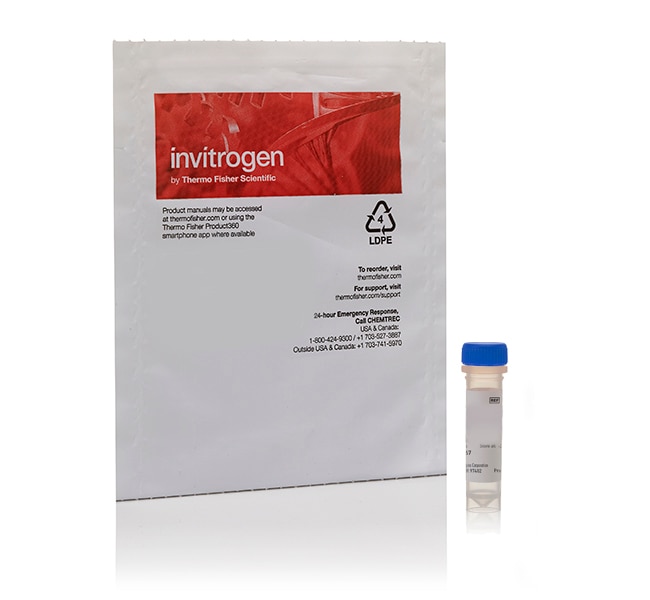
BODIPY™ TR Ceramide
BODIPY TR ceramide is a red-fluorescent dye that can be used to stain Golgi apparatus in live cells.Read more
| Catalog Number | Quantity |
|---|---|
| D7540 | 250 μg |
Catalog number D7540
Price (MXN)
-
Quantity:
250 μg
BODIPY TR ceramide is a red-fluorescent dye that can be used to stain Golgi apparatus in live cells.
For Research Use Only. Not for use in diagnostic procedures.
Specifications
Chemical Name or MaterialSphingolipids
Recommended StorageStore in freezer (-5 to -30°C) and protect from light.
Physical FormSolid
Product LineBODIPY
Quantity250 μg
Unit SizeEach
Citations & References (55)
Citations & References
Abstract
Role of the CDC25 homology domain of phospholipase Cepsilon in amplification of Rap1-dependent signaling.
Journal:J Biol Chem
PubMed ID:11395506
Phospholipase Cepsilon (PLCepsilon) is a novel class of phosphoinositide-specific PLC characterized by possession of CDC25 homology and Ras/Rap1-associating domains. We and others have shown that human PLCepsilon is translocated from the cytoplasm to the plasma membrane and activated by direct association with Ras at its Ras/Rap1-associating domain. In addition, translocation
The caveolae-mediated sv40 entry pathway bypasses the golgi complex en route to the endoplasmic reticulum.
Journal:Virol J
PubMed ID:15840166
'BACKGROUND: Simian virus 40 (SV40) enters cells via an atypical caveolae-mediated endocytic pathway, which delivers the virus to a new intermediary compartment, the caveosome. The virus then is believed to go directly from the caveosome to the endoplasmic reticulum. Cholera toxin likewise enters via caveolae and traffics to caveosomes. But,
Two-photon fluorescence absorption and emission spectra of dyes relevant for cell imaging.
Journal:J Microsc
PubMed ID:12423261
'Two-photon absorption and emission spectra for fluorophores relevant in cell imaging were measured using a 45 fs Ti:sapphire laser, a continuously tuneable optical parametric amplifier for the excitation range 580-1150 nm and an optical multichannel analyser. The measurements included DNA stains, fluorescent dyes coupled to antibodies as well as organelle
Cholesterol distribution in the Golgi complex of DITNC1 astrocytes is differentially altered by fresh and aged amyloid beta-peptide-(1-42).
Journal:J Biol Chem
PubMed ID:12584199
'The Golgi complex plays an important role in cholesterol trafficking in cells, and amyloid beta-peptides (Abetas) alter cholesterol trafficking. The hypothesis was tested that fresh and aged Abeta-(1-42) would differentially modify Golgi cholesterol content in DINTC1 astrocytes and that the effects of Abeta-(1-42) would be associated with the region of
Association between the 15-kDa selenoprotein and UDP-glucose:glycoprotein glucosyltransferase in the endoplasmic reticulum of mammalian cells.
Journal:J Biol Chem
PubMed ID:11278576
'Mammalian selenocysteine-containing proteins characterized with respect to function are involved in redox processes and exhibit distinct expression patterns and cellular locations. A recently identified 15-kDa selenoprotein (Sep15) has no homology to previously characterized proteins, and its function is not known. Here we report the intracellular localization and identification of a