Search



Citations & References (53)
Invitrogen™
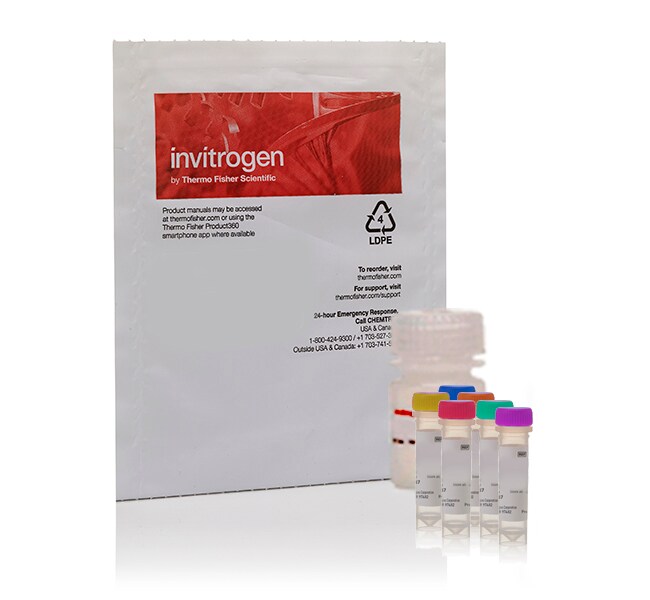
EnzChek™ Caspase-3 Activity Assay Kits
Detect apoptosis in cell extracts and purified enzyme preparations with EnzChek Caspase-3 Activity Assay Kits with Z-DEVD-AMC substrate or Z-DEVD-R110 substrates.
Have Questions?
Change view

| Catalog Number | Label or Dye |
|---|---|
| E13183 | AMC (7-amino-4-methylcoumarin) |
| E13184 | Rhodamine 110 |
Catalog number E13183
Price (USD)
560.00
Each
Label or Dye:
AMC (7-amino-4-methylcoumarin)
Price (USD)
560.00
Each
Enable simple and reliable detection of caspase-3-activity-mediated apoptosis with the EnzChek Caspase-3 Activity Assay Kit, which takes advantage of specially designed substrates that fluoresce upon cleavage by the caspase-3 enzyme. The EnzChek Caspase-3 Activity Assay Kit is available with either the Z-DEVD-AMC or Z-DEVD-R110 substrate, which yields a bright fluorescent product upon proteolytic cleavage by caspase 3/7.
The EnzChek Caspase-3 Activity Assay Kit enables detection of apoptosis by providing a simple and reliable method for assaying caspase-3/7 activity. The kit can be used to continuously measure the activity of caspase-3/7 in cell extracts and purified enzyme preparations using a fluorometer or fluorescence microplate reader.
Key features of the EnzChek Caspase-3 Activity Assay Kit includes:
- Fluorescent assay using standard fluorescein (FITC) excitation/emission settings
- Format allows for continuous measurement of caspase-3/7 activity in cell extracts
- Fluorescent and enzymatic controls included
The aminomethylcoumarin (AMC)-derived substrate (Z-aspartic acid-glutamic acid-valine-aspartic acid (DEVD)-AMC) that is included in the EnzChek Caspase-3 Activity Assay Kit is weakly fluorescent in the UV range (excitation/emission maxima ∼330/390 nm), but yields a bright, blue-fluorescent product (excitation/emission maxima ∼342/441 nm) upon proteolytic cleavage. The kit can be used to continuously measure the activity of caspase-3 and closely related proteases in cell extracts and purified enzyme preparations using a fluorometer or fluorescence microplate reader.
The rhodamine 110-derived substrate (Z-DEVD-R110) used in the EnzChek Caspase-3 Activity Assay Kit is a non-fluorescent bisamide compound that, upon enzymatic cleavage, is converted in a two-step process to the fluorescent monoamide and then to the even more fluorescent R110 product. Both of these hydrolysis products exhibit spectral properties similar to those of fluorescein, with peak excitation and emission wavelengths of 496 nm and 520 nm, respectively.
In addition to the substrates, the EnzChek Caspase Activity Assay Kit contains the reversible aldehyde inhibitor Ac-DEVD-CHO, as well as an AMC or R110 reference standard. The Ac-DEVD-CHO inhibitor confirms that the fluorescence signals in both induced and control cell populations are due to the activity of the caspase-3/7 protease. The reference standard allows for quantification of the amount of AMC or R110 released in the reaction.
For Research Use Only. Not for use in diagnostic procedures.
Specifications
DescriptionEnzChek Caspase-3 Assay Kit #1, Z-DEVD-AMC substrate
Excitation/Emission342/441 (cleaved substrate)
For Use With (Application)Apoptosis and Autophagy
For Use With (Equipment)Fluorometer, Microplate Reader
Label TypeOther Label(s) or Dye(s)
Label or DyeAMC (7-amino-4-methylcoumarin)
No. of Reactions500 Assays (reaction volume 100μL per assay)
Product LineEnzChek
Product TypeCaspase Assay Kit
Quantity500 Assays
Shipping ConditionRoom Temperature
Detection MethodFluorescence
Emission Wavelength Range441 nm
Excitation Wavelength Range342 nm
FormatCuvettes, 96-well Plate
Unit SizeEach
Contents & Storage
Store in freezer (-5°C to -30°C) and protect from light.
Frequently asked questions (FAQs)
I am planning to use the EnzChek Caspase-3 Assay Kit #1 with Z-DEVD-AMC substrate. What are the fluorescence excitation/emission maxima of the cleaved substrate?
Citations & References (53)
Citations & References
Abstract
Journal:
PubMed ID:9078237
Jun NH2-terminal kinase (JNK) prevents nuclear beta-catenin accumulation and regulates axis formation in Xenopus embryos.
Journal:Proc Natl Acad Sci U S A
PubMed ID:17060633
'Jun NH(2)-terminal kinases (JNKs) regulate convergent extension movements in Xenopus embryos through the noncanonical Wnt/planar cell polarity pathway. In addition, there is a high level of maternal JNK activity spanning from oocyte maturation until the onset of gastrulation that has no defined functions. Here, we show that maternal JNK activation
VDAC-dependent permeabilization of the outer mitochondrial membrane by superoxide induces rapid and massive cytochrome c release.
Journal:J Cell Biol
PubMed ID:11739410
'Enhanced formation of reactive oxygen species (ROS), superoxide (O2*-), and hydrogen peroxide (H2O2) may result in either apoptosis or other forms of cell death. Here, we studied the mechanisms underlying activation of the apoptotic machinery by ROS. Exposure of permeabilized HepG2 cells to O2*- elicited rapid and massive cytochrome c
One-step cellular caspase-3/7 assay.
Journal:Biotechniques
PubMed ID:12765032
Protease involvement in fodrin cleavage and phosphatidylserine exposure in apoptosis.
Journal:J Biol Chem
PubMed ID:8940103
'A detailed kinetic analysis of three extranuclear end points of apoptosis, phosphatidylserine exposure, alpha-fodrin degradation, and plasma membrane blebbing, was performed and compared with nuclear fragmentation and the activation of the interleukin-1beta-converting enzyme (ICE)-like proteases in Jurkat T lymphocytes stimulated by anti-Fas monoclonal antibody (anti-Fas mAb) and in monocytic U937