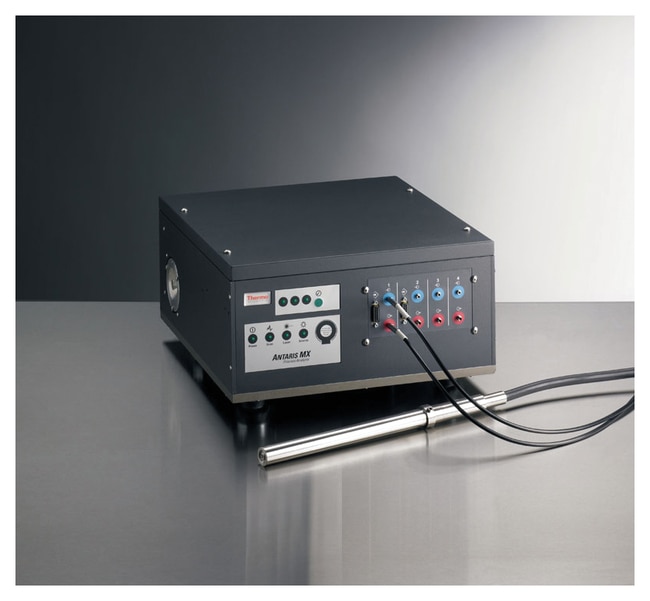
Antaris™ MX FT-NIR Prozessanalysator
Thermo Scientific™

Antaris™ MX FT-NIR Prozessanalysator

Der Thermo Scientific Antaris MX FT-NIR Prozessanalysator liefert eine einzigartige Qualitätskontrolle und Prozessfernüberwachung in Echtzeit durch den Einsatz von Glasfaseroptik und integrierter Kommunikation.
Have Questions?
KatalognummerArt des AnalysatorsQuellentypSpektralbereich
IQLAADGABCFADUMAAZFourier Transform-Nah-InfrarotHalogen-NIR-Quelle mit hoher Intensität und langer Lebensdauer; Ersatzquelle im Lieferumfang enthalten, garantierte Filament-Vorjustage12.000 - 3.800 cm -1 ( 833 - 2500 nm)
Katalognummer IQLAADGABCFADUMAAZ
Preis (EUR)
-
Angebot anfordern
Art des Analysators:
Fourier Transform-Nah-Infrarot
Quellentyp:
Halogen-NIR-Quelle mit hoher Intensität und langer Lebensdauer; Ersatzquelle im Lieferumfang enthalten, garantierte Filament-Vorjustage
Spektralbereich:
12.000 - 3.800 cm -1 ( 833 - 2500 nm)

Der Thermo Scientific Antaris MX FT-NIR Prozessanalysator liefert eine einzigartige Qualitätskontrolle und Prozessfernüberwachung in Echtzeit durch den Einsatz von Glasfaseroptik und integrierter Kommunikation.

Der Antaris MX FT-NIR Prozessanalysator ist eine komplette, einsatzbereite Lösung für die Materialanalyse direkt vor Ort und für Applikationen in der Online-Prozessüberwachung. Das Antaris MX ist das einzige Nahinfrarotgerät, das echte simultane Messungen an bis zu vier Stellen ermöglicht. Ein zusätzlicher interner Referenzkanal des Analysators sorgt bei jeder Datenaufnahme für eine bisher unerreichte Stabilität und macht ein Entfernen der Glasfasersonden von der Prozessanlage bei der Backgroundaufnahme oder Qualifizierung überflüssig

Das Antaris MX ermöglicht die Überwachung eines einzelnen Prozesses an mehreren Punkten oder die gleichzeitige Überwachung mehrerer Prozesse mit einem einzigen bedienerfreundlichen NIR Analysator.
  • ValPro™ Instrumentenqualifizierungspaket
  • Automatisierte interne Instrumentenqualifizierung, ohne Sonden aus dem Prozess zu entnehmen
  • Vereinfachen Sie die Einhaltung von Industrienormen mit allen Werkzeugen, die Sie für DQ, IQ, OQ und PQ benötigen Permanenter interner Background Sonden müssen zur Referenzmessung nicht entfernt werden SMA905 Standardanschlüsse für Lichtleiteroptik ermöglichen es Ihnen, die für Ihren Prozess am besten geeignete Sonde auszuwählen
  • OPC, 4-20 mA und digitaler E/A für Prozesskommunikation
Der Antaris MX FT-NIR Prozessanalysator wird als konfiguriertes System vertrieben, das für die Erfüllung Ihrer speziellen Applikationsanforderungen entwickelt wurde. Weitere Informationen erhalten Sie bei Ihrem lokalen Thermo Scientific Ansprechpartner.
  • Flüssigkeitsanalyse im Prozess
  • Feststoffanalyse im Prozess
  • Flüssigkeitsanalyse im Labor
  • Feststoffanalyse im Labor
Specifications
Art des AnalysatorsFourier Transform-Nah-Infrarot
BeschreibungAntaris MX FT-NIR Process Analyzer
NachweisHigh sensitivity, high stability matched InGaAs
Höhe (angloamerikanisch)18,97 m x 15,98 m x 9,72 m
Höhe (metrisch)24,7 cm
SchnittstelleDirect PC to ethernet allows file system and OPC communications
InterferometerProven, frictionless, stable, long-life Michelson
Betriebstemperaturbereich15 ° - 35 ° C (59 ° - 95 ° F)
Photometrische LinearitätSlope 1.0 ±0.05 and an intercept of 0.0 ±0.05
Auflösung4 cm-1 across spectral range (0.6 nm at 1250 nm), 2 cm-1 option across spectral range (0.3 nm at 1250 nm)
MessverfahrenFiber optic multiplexing
Gekapselt und mit Trockenmittel geschütztja
QuellentypHalogen-NIR-Quelle mit hoher Intensität und langer Lebensdauer; Ersatzquelle im Lieferumfang enthalten, garantierte Filament-Vorjustage
Spektralbereich12.000 - 3.800 cm -1 ( 833 - 2500 nm)
SystemstatusanzeigenIndicator lights report scan, laser, power, and source status continuously
Spannung90 bis 264 VAC
Genauigkeit der Wellenzahl± 0,1 cm ⁻ ¹ ( 0,02 nm bei 1250 nm)
Wiederholbarkeit der Wellenzahl(System to System) Better than 0.05 cm-1 (0.008 at 1250 nm)
Reproduzierbarkeit der Wellenzahl(Single System) 10 measurement standard deviation <0.006cm-1
Gewicht (angloamerikanisch)105,16 £
Gewicht (metrisch)25,8 kg
Unit SizeEach

Häufig gestellte Fragen (FAQ)

How are probes used for in-line NIR analysis?

Fiber optic probes can be used for analyzing liquid samples in transmission or solid samples in reflection. For samples that have bubbles or solids or change state between liquid and solid, a transflectance probe works the best. A fitting attached to the probe mates it with a port on a tank, pipe, reactor, hopper, or above a conveyor. The common fittings used with probes are Swagelok, sanitary tri-clamp or bolt-on.

How can I use an Antaris FT-NIR analyzer for in-line process analysis?

If the process environment has water hose down, CIP, dust, high temperature, corrosive or explosive chemicals, the Antaris FT-NIR analyzer needs to be placed in a safe area or enclosed in an environmentally stabilized enclosure. Fiber optics run from the NIR analyzer to probes or flow cells installed in production process pipes, tanks, hoppers, conveyors, reactors, etc. The fiber optics carry the NIR source light to the probe sampling window and then carry the light after it has interacted with the sample back to the NIR analyzer detector. The end of the probe will have a window or an air gap for reflection or transmission analysis. The product being analyzed must be self-cleaning or the probe engineered to automatically clean itself by high pressure air. The computer that controls the NIR analyzer is also located in the safe area with Thermo Scientific RESULT Software exporting NIR results to text or Microsoft Excel files, LIMS, OPC or by 4-20 mA.

Can current calibrations from a different manufacturer be transferred to the Antaris FT-NIR analyzer?

Yes, using the Thermo Scientific Standards converter utility program, spectra from other NIR manufacturers can be converted to a format directly compatible with the Antaris FT-NIR analyzer. The utility program converts spectra from wavelength to wave number as well as converts to a standard absorbance format. Then it automatically transfers the converted spectra and all associated wet chemistry data into Thermo Scientific TQ Analyst calibration development software. The method developer then sets the spectral processing and regions in TQ Analyst and calibrates the method into Antaris format.

What is Raman spectroscopy?

In Raman spectroscopy, an unknown sample of material is illuminated with monochromatic (single wavelength or single frequency) laser light, which can be absorbed, transmitted, reflected, or scattered by the sample. Light scattered from the sample is due to either elastic collisions of the light with the sample's molecules (Rayleigh scatter) or inelastic collisions (Raman scatter). Whereas Rayleigh scattered light has the same frequency (wavelength) of the incident laser light, Raman scattered light returns from the sample at different frequencies corresponding to the vibrational frequencies of the bonds of the molecules in the sample.

If you wish to learn more about Raman spectroscopy, visit our online Raman Spectroscopy Academy (https://www.thermofisher.com/us/en/home/industrial/spectroscopy-elemental-isotope-analysis/spectroscopy-elemental-isotope-analysis-learning-center/molecular-spectroscopy-information/raman-technology.html), where you will find basic Raman tutorials, advanced Raman webinars on sample applications, and a helpful instrument guide.