Search
 Element Search
 Structure Search


Thermo Scientific Chemicals
Polyethylene glycol (PEG), 50% soln.
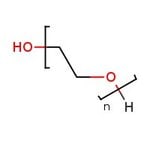
CAS: 25322-68-3 | (C2H4O)n | 62.07 g/mol
Have Questions?
Change view


Catalog number J61495.AK
also known as J61495-AK
Price (USD)
103.65
Special offer
Online exclusive
Ends: 30-Jun-2026
122.00Save 18.35 (15%)
Each
Quantity:
250 mL
Price (USD)
103.65
Special offer
Online exclusive
Ends: 30-Jun-2026
122.00Save 18.35 (15%)
Each
Chemical Identifiers
CAS25322-68-3
Molecular Formula(C2H4O)n
InChI KeyLYCAIKOWRPUZTN-UHFFFAOYSA-N
SMILES[H]OCCO
Specifications Specification Sheet
Specification SheetFormLiquid
CompositionPEG: 50%
Appearance (Color)Clear, colorless
CompositionLithium Acetate Dihydrate: 100 mM
Polyethylene glycol is used as a thickening agent and gel binder in the pharmaceutical industry. It is used as a analytical reagents, substrates, flocculants, dispersants, lubricants, emulsifiers, moisturizers, food additives.
This Thermo Scientific Chemicals brand product was originally part of the Alfa Aesar product portfolio. Some documentation and label information may refer to the legacy brand. The original Alfa Aesar product / item code or SKU reference has not changed as a part of the brand transition to Thermo Scientific Chemicals.
Applications
Polyethylene glycol is used as a thickening agent and gel binder in the pharmaceutical industry. It is used as a analytical reagents, substrates, flocculants, dispersants, lubricants, emulsifiers, moisturizers, food additives.
Solubility
Soluble in water.
Notes
Contains 50% PEG 3350 in 0.1M Lithium Acetate solution, pH 4.9.
Polyethylene glycol is used as a thickening agent and gel binder in the pharmaceutical industry. It is used as a analytical reagents, substrates, flocculants, dispersants, lubricants, emulsifiers, moisturizers, food additives.
Solubility
Soluble in water.
Notes
Contains 50% PEG 3350 in 0.1M Lithium Acetate solution, pH 4.9.
RUO – Research Use Only
General References:
- Neil P. Desai; Jeffrey A. Hubbell. Solution technique to incorporate polyethylene oxide and other water-soluble polymers into surfaces of polymeric biomaterials. Biomaterials. 1991, 12 (2), 144-153.
- Jin Ho Lee; Jindrich Kopecek and Joseph D. Protein-resistant surfaces prepared by PEO-containing block copolymer surfactants. Journal of Biomedical Materials Research. 1989, 23, (3), 351-368.