Search
 Element Search
 Structure Search


Thermo Scientific Chemicals
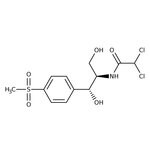
Thiamphenicol
The methyl-sulfonyl analogue of chloramphenicol | CAS: 15318-45-3 | C12H15Cl2NO5S | 356.214 g/mol
Have Questions?
Change view


Catalog number J63575.03
also known as J63575-03
Price (USD)
36.00
Each
Quantity:
1 g
Price (USD)
36.00
Each
Chemical Identifiers
CAS15318-45-3
IUPAC Name2,2-dichloro-N-[(1R,2R)-1,3-dihydroxy-1-(4-methanesulfonylphenyl)propan-2-yl]acetamide
Molecular FormulaC12H15Cl2NO5S
InChI KeyOTVAEFIXJLOWRX-NXEZZACHSA-N
SMILESCS(=O)(=O)C1=CC=C(C=C1)[C@@H](O)[C@@H](CO)NC(=O)C(Cl)Cl
View more
Specifications Specification Sheet
Specification SheetAppearance (Color)White to yellow
Sulfated Ash≤0.5%
Assay from Suppliers CofA≥97.0%
FormPowder or crystals or crystalline powder
Loss on Drying≤1.0%
Thiamphenicol is used to treat chancroid in men and uncomplicated gonorrhea. It is used in studies of bacterial protein synthesis at the level of peptidyl transferase activity associated with the 23S rRNA of the 50S ribosomal subunit. It is used to study chloraniphenicol-thiamphenicol-resistance and the use of fluorinated analogs when resistance is encountered. Its main advantage over chloramphenicol is that it has never been associated with aplastic anaemia.
This Thermo Scientific Chemicals brand product was originally part of the Alfa Aesar product portfolio. Some documentation and label information may refer to the legacy brand. The original Alfa Aesar product / item code or SKU reference has not changed as a part of the brand transition to Thermo Scientific Chemicals.
Applications
Thiamphenicol is used to treat chancroid in men and uncomplicated gonorrhea. It is used in studies of bacterial protein synthesis at the level of peptidyl transferase activity associated with the 23S rRNA of the 50S ribosomal subunit. It is used to study chloraniphenicol-thiamphenicol-resistance and the use of fluorinated analogs when resistance is encountered. Its main advantage over chloramphenicol is that it has never been associated with aplastic anaemia.
Solubility
Soluble in acetonitrile or DMF. Slightly soluble in water
Notes
Research Use only: Not intended for animal or human diagnostic or therapeutic use.
Thiamphenicol is used to treat chancroid in men and uncomplicated gonorrhea. It is used in studies of bacterial protein synthesis at the level of peptidyl transferase activity associated with the 23S rRNA of the 50S ribosomal subunit. It is used to study chloraniphenicol-thiamphenicol-resistance and the use of fluorinated analogs when resistance is encountered. Its main advantage over chloramphenicol is that it has never been associated with aplastic anaemia.
Solubility
Soluble in acetonitrile or DMF. Slightly soluble in water
Notes
Research Use only: Not intended for animal or human diagnostic or therapeutic use.
RUO – Research Use Only
General References:
- Tomoko Nagata.; Hisao Oka. Detection of Residual Chloramphenicol, Florfenicol, and Thiamphenicol in Yellowtail Fish Muscles by Capillary Gas Chromatography-Mass Spectrometry.J. Agric. Food Chem.1996, (5), 1280-1284.
- Franklin A Davis.; Ping Zhou. Asymmetric synthesis of the antibiotic (+)-thiamphenicol using cis-N-(p-toluenesulfinyl)aziridine 2-carboxylic acids.Tetrahedron Letters.1994, (41), 7525-7528.