Search
 Element Search
 Structure Search


Thermo Scientific Chemicals
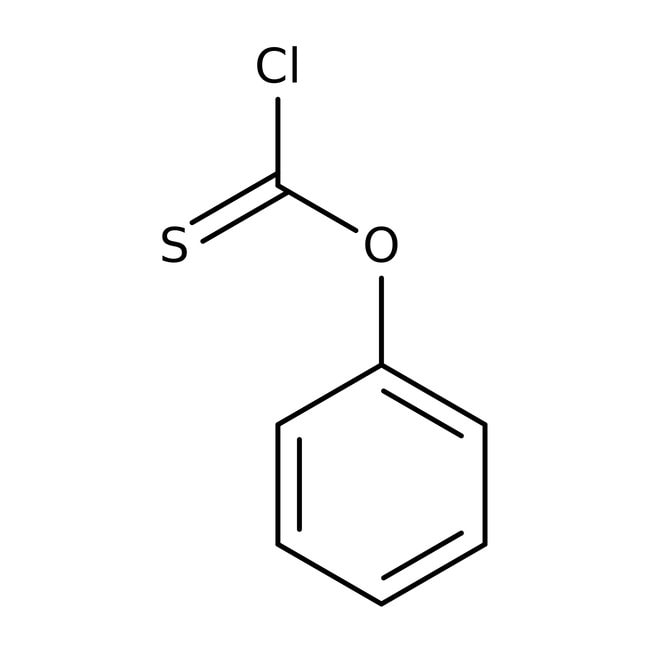
Phenyl chlorothionoformate, 98+%
CAS: 1005-56-7 | C7H5ClOS | 172.63 g/mol
Have Questions?
Change view


Catalog number L00838.14
also known as L00838-14
Price (USD)
278.65
Online Exclusive
309.00Save 30.35 (10%)
Each
Quantity:
25 g
Price (USD)
278.65
Online Exclusive
309.00Save 30.35 (10%)
Each
Chemical Identifiers
CAS1005-56-7
IUPAC Namephenyl chloromethanethioate
Molecular FormulaC7H5ClOS
InChI KeyKOSYAAIZOGNATQ-UHFFFAOYSA-N
SMILESClC(=S)OC1=CC=CC=C1
View more
Specifications Specification Sheet
Specification SheetAssay (GC)≥98.0%
FormLiquid
Refractive Index1.5800-1.5830 @ 20?C
Appearance (Color)Clear yellow
Phenyl chlorothionoformate has been used in stereo directed synthesis of optically active, (-)-mintlactone, synthesis of peptide α-thioesters having a variety of C-terminal amino acids, synthesis of scyllo-inositol derivatives, thionocarbonylation of unprotected thymine nucleosides, preparation of phenoxythiocarbonyl esters of protected ribonucleosides. It is also used as a reagent in the thionocarbonylation of unprotected thymine nucleosides. It forms phenoxythiocarbonyl esters of protected ribonucleosides which can be reduced by tributyltin hydride to deoxyribonucleosides.
This Thermo Scientific Chemicals brand product was originally part of the Alfa Aesar product portfolio. Some documentation and label information may refer to the legacy brand. The original Alfa Aesar product / item code or SKU reference has not changed as a part of the brand transition to Thermo Scientific Chemicals.
Applications
Phenyl chlorothionoformate has been used in stereo directed synthesis of optically active, (-)-mintlactone, synthesis of peptide α-thioesters having a variety of C-terminal amino acids, synthesis of scyllo-inositol derivatives, thionocarbonylation of unprotected thymine nucleosides, preparation of phenoxythiocarbonyl esters of protected ribonucleosides. It is also used as a reagent in the thionocarbonylation of unprotected thymine nucleosides. It forms phenoxythiocarbonyl esters of protected ribonucleosides which can be reduced by tributyltin hydride to deoxyribonucleosides.
Solubility
Soluble in water.
Notes
Moisture, Heat Sensitive. Store in cool place. Keep container tightly closed in a dry and well-ventilated place. Keep away from oxidizing agents. Stable under recommended storage conditions.
Phenyl chlorothionoformate has been used in stereo directed synthesis of optically active, (-)-mintlactone, synthesis of peptide α-thioesters having a variety of C-terminal amino acids, synthesis of scyllo-inositol derivatives, thionocarbonylation of unprotected thymine nucleosides, preparation of phenoxythiocarbonyl esters of protected ribonucleosides. It is also used as a reagent in the thionocarbonylation of unprotected thymine nucleosides. It forms phenoxythiocarbonyl esters of protected ribonucleosides which can be reduced by tributyltin hydride to deoxyribonucleosides.
Solubility
Soluble in water.
Notes
Moisture, Heat Sensitive. Store in cool place. Keep container tightly closed in a dry and well-ventilated place. Keep away from oxidizing agents. Stable under recommended storage conditions.
RUO – Research Use Only
General References:
- DN Kevill.; MJ D'souza. Correlation of the rates of solvolysis of phenyl chlorothionoformate and phenylchlorodithioformate. Canadian journal of chemistry. 199977(5-6) , 1118-1122.
- DS Millan.; RH Prager. The dealkylation of tertiary aliphatic amines with phenyl chlorothionoformate. Tetrahedron letters. 199839(24) , 4387-4390.
- Aryl chlorothionoformates react with OH groups to give thiocarbonate esters. These have a much greater tendency to undergo cyclic elimination than their oxygen counterparts, with dehydration as the net result. Thus, e.g. oximes are dehydrated to nitriles under mild conditions: Chem. Commun., 1014 (1970):
- Similarly, amides are dehydrated to nitriles, and formamides to isonitriles under mild conditions: Tetrahedron Lett., 40, 747 (1999).
- Alcohols are converted to alkenes in better yields than in the Chugaev (xanthate pyrolysis) method, succeeding with hindered alcohols which do not readily form xanthates: J. Chem. Soc., Chem. Commun., 1215 (1972); Helv. Chim. Acta, 55, 2277 (1972). Secondary alcohols give thiocarbonate esters which can be reduced to alkanes by tributyltin hydride, in a useful deoxygenation sequence. For use in an enantiospecific synthesis of the antiviral agent ganciclovir phosphonate, see: J. Med. Chem., 37, 1371 (1994).
- Reagent for conversion of imidazoles to imidazole-2-thiones: Synlett, 239 (1995).
- Reagent, alternative to chloroformates, for dealkylation of tertiary amines: Austral. J. Chem., 52, 841 (1999).