Search
 Element Search
 Structure Search


Thermo Scientific Chemicals
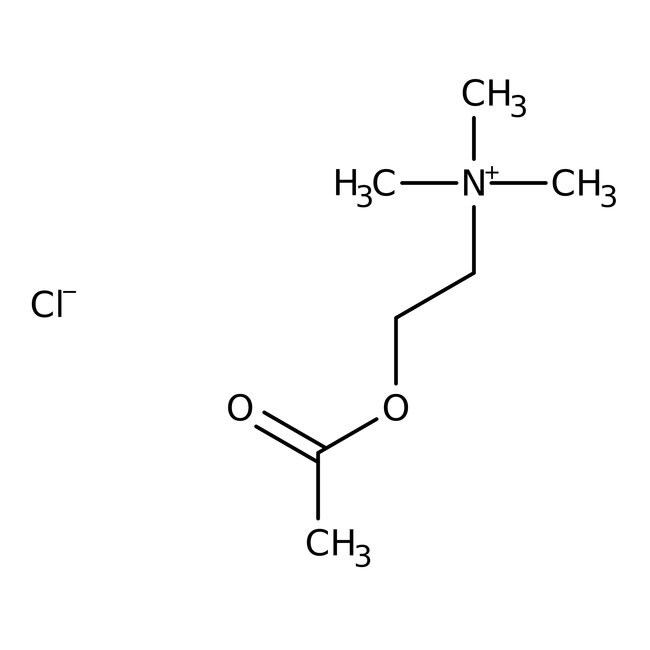
Acetylcholine chloride, 98+%
CAS: 60-31-1 | C7H16ClNO2 | 181.66 g/mol
Have Questions?
Change view


Catalog number L02168.14
also known as L02168-14
Price (USD)
64.50
Each
Quantity:
25 g
Price (USD)
64.50
Each
Chemical Identifiers
CAS60-31-1
IUPAC Name[2-(acetyloxy)ethyl]trimethylazanium chloride
Molecular FormulaC7H16ClNO2
InChI KeyJUGOREOARAHOCO-UHFFFAOYSA-M
SMILES[Cl-].CC(=O)OCC[N+](C)(C)C
View more
Specifications Specification Sheet
Specification SheetAppearance (Color)White
FormCrystals or powder or crystalline powder and/or fused/lumpy solid
Assay (Titration ex Chloride)≥98.0% to ≤102.0% (dry wt. basis)
Identification (FTIR)Conforms
Loss on Drying≤1.0 % (105°C, 3 hrs)
View more
Acetylcholine chloride acts as an endogenous neurotransmitter at cholinergic synapses. The compound has been shown to have ophthalmological uses and can be broken down quickly by choliesterases. Acetylcholine influences many basic cells functions, such as mitosis, cells differentiation, cytoskeletal organization, and cell to cell contact, among other functions. It reduces mortality and plasma proinflammatory cytokines in mice with experimentally-induced sepsis.The cholinergicanti-infl ammatory mechanism is probably mediated by interaction of acetylcholine with α7n cholinoreceptor on monocytes, macrophages, and neutrophils, which decreases the levels of proinflammatory cytokines such as TNF-α, IL-1β, and IL-6.
This Thermo Scientific Chemicals brand product was originally part of the Alfa Aesar product portfolio. Some documentation and label information may refer to the legacy brand. The original Alfa Aesar product / item code or SKU reference has not changed as a part of the brand transition to Thermo Scientific Chemicals.
Applications
Acetylcholine chloride acts as an endogenous neurotransmitter at cholinergic synapses. The compound has been shown to have ophthalmological uses and can be broken down quickly by choliesterases. Acetylcholine influences many basic cells functions, such as mitosis, cells differentiation, cytoskeletal organization, and cell to cell contact, among other functions. It reduces mortality and plasma proinflammatory cytokines in mice with experimentally-induced sepsis.The cholinergicanti-infl ammatory mechanism is probably mediated by interaction of acetylcholine with α7n cholinoreceptor on monocytes, macrophages, and neutrophils, which decreases the levels of proinflammatory cytokines such as TNF-α, IL-1β, and IL-6.
Solubility
Soluble in water (600 g/L at 20°C), alcohol, DMSO (36 mg/ml at 25°C), and ethanol (36 mg/ml at 25°C). Insoluble in ether.
Notes
Store away from moisture. Store under dry inert gas. Incompatible with heat,oxidizing agents.
Acetylcholine chloride acts as an endogenous neurotransmitter at cholinergic synapses. The compound has been shown to have ophthalmological uses and can be broken down quickly by choliesterases. Acetylcholine influences many basic cells functions, such as mitosis, cells differentiation, cytoskeletal organization, and cell to cell contact, among other functions. It reduces mortality and plasma proinflammatory cytokines in mice with experimentally-induced sepsis.The cholinergicanti-infl ammatory mechanism is probably mediated by interaction of acetylcholine with α7n cholinoreceptor on monocytes, macrophages, and neutrophils, which decreases the levels of proinflammatory cytokines such as TNF-α, IL-1β, and IL-6.
Solubility
Soluble in water (600 g/L at 20°C), alcohol, DMSO (36 mg/ml at 25°C), and ethanol (36 mg/ml at 25°C). Insoluble in ether.
Notes
Store away from moisture. Store under dry inert gas. Incompatible with heat,oxidizing agents.
RUO – Research Use Only
General References:
- John K. Herdklotz; Ronald L. Sass. The crystal structure of acetylcholine chloride: A new conformation for acetylcholine.Biochemical and Biophysical Research Communication.1970, 40 583-588.
- Rafael Lorente De Nó. Effects of choline and acetylcholine chloride upon peripheral nerve fibers.Journal of Cellular and Comparative Physiology.1944, 24 85-97.