Search
 Element Search
 Structure Search

Thermo Scientific Chemicals
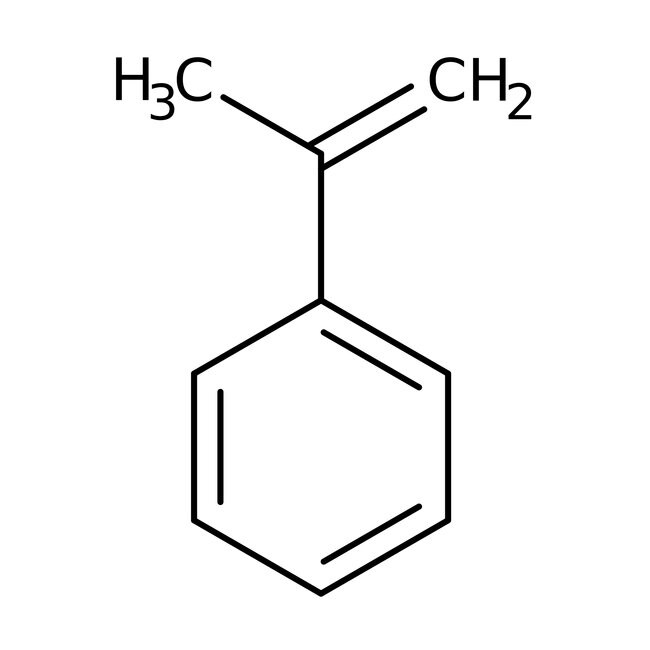
alpha-Methylstyrene, 99%, stab. with 10-20 ppm 4-tert-butylcatechol
CAS: 98-83-9 | C9H10 | 118.18 g/mol
Have Questions?
Change view

Catalog number L03609.AE
also known as L03609-AE
Price (USD)
38.20
Each
Quantity:
100 mL
Price (USD)
38.20
Each
Chemical Identifiers
CAS98-83-9
IUPAC Name(prop-1-en-2-yl)benzene
Molecular FormulaC9H10
InChI KeyXYLMUPLGERFSHI-UHFFFAOYSA-N
SMILESCC(=C)C1=CC=CC=C1
View more
Specifications Specification Sheet
Specification SheetAppearance (Color)Clear colorless to pale yellow
FormLiquid
Assay (GC)≥98.5%
Identification (FTIR)Conforms
Refractive Index1.5360-1.5400 @ 20°C
View more
α-Methylstyrene (AMS) is used in the synthesis of (acrylonitrile-styrene-acrylic copolymer)/(α-methylstyrene-acrylonitrile copolymer). It is used in the manufacture of plasticizers, resins and polymers.
This Thermo Scientific Chemicals brand product was originally part of the Alfa Aesar product portfolio. Some documentation and label information may refer to the legacy brand. The original Alfa Aesar product / item code or SKU reference has not changed as a part of the brand transition to Thermo Scientific Chemicals.
Applications
α-Methylstyrene (AMS) is used in the synthesis of (acrylonitrile-styrene-acrylic copolymer)/(α-methylstyrene-acrylonitrile copolymer). It is used in the manufacture of plasticizers, resins and polymers.
Solubility
Soluble in water.( 0,1 g/L) at 25°C.
Notes
Store at 4°C. Incompatible materials are Strong oxidizing agents, Peroxides, Organometallic compounds, Metallic salts.
α-Methylstyrene (AMS) is used in the synthesis of (acrylonitrile-styrene-acrylic copolymer)/(α-methylstyrene-acrylonitrile copolymer). It is used in the manufacture of plasticizers, resins and polymers.
Solubility
Soluble in water.( 0,1 g/L) at 25°C.
Notes
Store at 4°C. Incompatible materials are Strong oxidizing agents, Peroxides, Organometallic compounds, Metallic salts.
WARNING: Cancer – www.P65Warnings.ca.gov
RUO – Research Use Only
General References:
- Ray L. Sweany; Jack Halpern. Hydrogenation of .alpha.-methylstyrene by hydridopentacarbonylmanganese (I). Evidence for a free-radical mechanism.J. Am. Chem. Soc.1977, 99 (25), 8335-8337.
- Toshinobu Higashimura; Masami Kamigaito; Makoto Kato; Toshiyuki Hasebe; Mitsuo Sawamoto.Macromolecules.1977, 26 (11), 2670-2673.
- For asymmetric ene-reaction with methyl glyoxylate, catalyzed by a chiral binaphthyl (see (R)-(+)-1,1'-Bi(2-naphthol) , L08305) Ti(O-i-Pr)4 complex to give methyl (2R)-3-hydroxy-4-phenyl-4-pentenoate, see: Org. Synth. Coll., 9, 596 (1998):
- In the presence of trichloroacetic acid, has been reported for the protection of 5-substituted tetrazoles as their N-cumyl derivatives. Deprotection was effected by catalytic transfer hydrogenolysis: J. Org. Chem., 64, 9301 (1999).