Search
 Element Search
 Structure Search


Thermo Scientific Chemicals
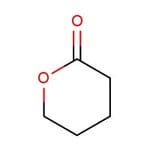
delta-Valerolactone, 98%, may contain polymer
CAS: 542-28-9 | C5H8O2 | 100.12 g/mol
Have Questions?
Change view


Catalog number L04794.14
also known as L04794-14
Price (USD)
45.65
Special offer
Online exclusive
Ends: 30-Jun-2026
53.80Save 8.15 (15%)
Each
Quantity:
25 g
Price (USD)
45.65
Special offer
Online exclusive
Ends: 30-Jun-2026
53.80Save 8.15 (15%)
Each
Chemical Identifiers
CAS542-28-9
IUPAC Nameoxan-2-one
Molecular FormulaC5H8O2
InChI KeyOZJPLYNZGCXSJM-UHFFFAOYSA-N
SMILESO=C1CCCCO1
View more
Specifications Specification Sheet
Specification SheetAppearance (Color)Clear colorless to pale yellow
FormLiquid
Assay (GC)≥97.5%
CommentProduct may contain variable amounts of polymerized product. Depolymerisation is possible by distillation.
Identification (FTIR)Conforms
View more
δ-Valerolactone is employed as a chemical intermediate in the synthesis of polymers. It is also used to synthesize the copolyesters by lipase-catalyzed ring opening polymerization.
This Thermo Scientific Chemicals brand product was originally part of the Alfa Aesar product portfolio. Some documentation and label information may refer to the legacy brand. The original Alfa Aesar product / item code or SKU reference has not changed as a part of the brand transition to Thermo Scientific Chemicals.
Applications
δ-Valerolactone is employed as a chemical intermediate in the synthesis of polymers. It is also used to synthesize the copolyesters by lipase-catalyzed ring opening polymerization.
Solubility
Miscible with water.
Notes
Store in a tightly closed container. Avoid breathing dust, vapor, mist, or gas.
δ-Valerolactone is employed as a chemical intermediate in the synthesis of polymers. It is also used to synthesize the copolyesters by lipase-catalyzed ring opening polymerization.
Solubility
Miscible with water.
Notes
Store in a tightly closed container. Avoid breathing dust, vapor, mist, or gas.
RUO – Research Use Only
General References:
- Rajashekhar, B.; Chakraborty, D. Co(II) and Mn(II) catalyzed bulk ring-opening polymerization of cyclic esters. Polym. Bull. 2014, 71 (9), 2185-2203.
- Suess, B.; Brockhoff, A.; Meyerhof, W.; Hofmann, T. Structures, orosensory activity, and T1R1/T1R3 receptor activation of amides generated by lactone aminolysis using food-related processing conditions. Eur Food Res. Technol. 2013, 237 (1), 57-70.