Search
 Element Search
 Structure Search


Thermo Scientific™
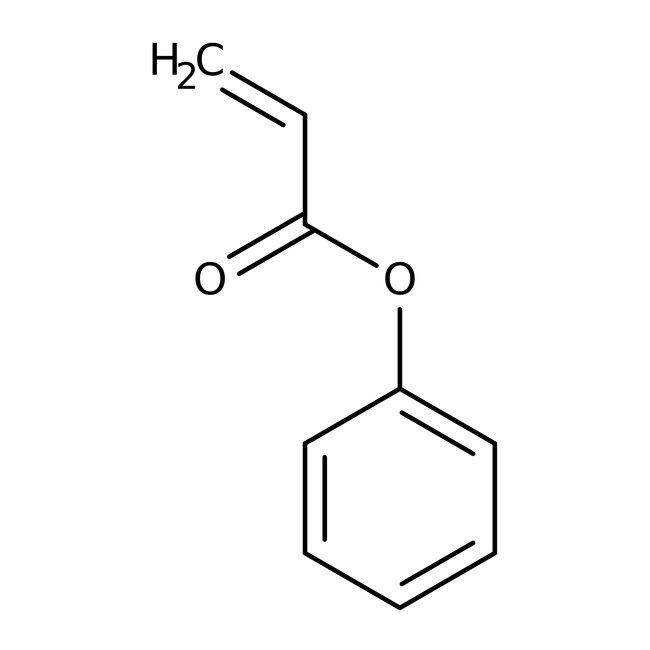
Phenyl acrylate, 97%
CAS: 937-41-7 | C9H8O2 | 148.161 g/mol
Have Questions?
Change view

Catalog number L11819.06
also known as L11819-06
Price (USD)
76.65
Online exclusive
84.90Save 8.25
Each
Quantity:
5 g
Price (USD)
76.65
Online exclusive
84.90Save 8.25
Each
Chemical Identifiers
CAS937-41-7
IUPAC Namephenyl prop-2-enoate
Molecular FormulaC9H8O2
InChI KeyWRAQQYDMVSCOTE-UHFFFAOYSA-N
SMILESC=CC(=O)OC1=CC=CC=C1
View more
Specifications Specification Sheet
Specification SheetAppearance (Color)Clear colorless to pale yellow
FormLiquid
Assay (GC)≥96.0%
Refractive Index1.5190-1.5220 @ 20°C
Solution TestClear (10% in Diethyl ether)
View more
Phenyl acrylate reacts with benzaldehyde to produce 2-(hydroxy-phenyl-methyl)-acrylic acid phenyl ester.
This Thermo Scientific Chemicals brand product was originally part of the Alfa Aesar product portfolio. Some documentation and label information may refer to the legacy brand. The original Alfa Aesar product / item code or SKU reference has not changed as a part of the brand transition to Thermo Scientific Chemicals.
Applications
Phenyl acrylate reacts with benzaldehyde to produce 2-(hydroxy-phenyl-methyl)-acrylic acid phenyl ester.
Solubility
Insoluble in water.
Notes
Incompatible with strong oxidizing agents. Store at 4°C. Keep container tightly closed. Store in cool, dry conditions in well sealed containers.
Phenyl acrylate reacts with benzaldehyde to produce 2-(hydroxy-phenyl-methyl)-acrylic acid phenyl ester.
Solubility
Insoluble in water.
Notes
Incompatible with strong oxidizing agents. Store at 4°C. Keep container tightly closed. Store in cool, dry conditions in well sealed containers.
RUO – Research Use Only
General References:
- S.-K. L. Li.; J. E. Guillet. Studies of the Photo-Fries Reaction in Solid Poly(phenyl acrylate). Macromolecules. 1977, 10 (4), 840-844.
- Makoto Azukizawa.; Bunichiro Yamada.; David J. T. Hill.; Peter J. Pomery. Radical polymerization of phenyl acrylate as studied by ESR spectroscopy: concurrence of propagating and mid-chain radicals. Macromolecular Chemistry and Physics. 2000, 201 (7), 774-781.
- Aryl acrylates undergo the Baylis-Hillman reaction with aldehydes in the presence of 1,4-Diazabicyclo[2.2.2]octane, A14003 much more rapidly than alkyl acrylates. Reaction with a second molecule of aldehyde can occur to give a cyclic acetal product: Tetrahedron Lett., 37, 1715 (1996):