Search
 Element Search
 Structure Search


Thermo Scientific Chemicals
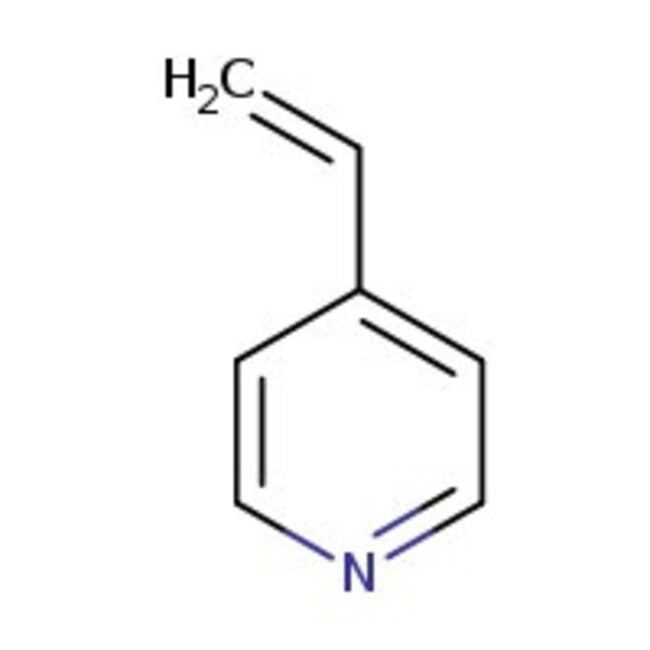
4-Vinylpyridine, 95%, stab. with 80 to 150ppm hydroquinone
CAS: 100-43-6 | C7H7N | 105.14 g/mol
Have Questions?
Change view


Catalog number L13316.AC
also known as L13316-AC
Price (USD)
31.65
Special offer
Online exclusive
Ends: 30-Jun-2026
36.70Save 5.05 (14%)
Each
Quantity:
25 mL
Price (USD)
31.65
Special offer
Online exclusive
Ends: 30-Jun-2026
36.70Save 5.05 (14%)
Each
Chemical Identifiers
CAS100-43-6
IUPAC Name4-ethenylpyridine
Molecular FormulaC7H7N
InChI KeyKFDVPJUYSDEJTH-UHFFFAOYSA-N
SMILESC=CC1=CC=NC=C1
View more
Specifications Specification Sheet
Specification SheetCommentMay contain polymerised material and darken on storage
StabilizerHydroquinone (80-150 ppm)
Appearance (Color)Clear colorless to yellow to red/brown
Assay (GC)≥94.0%
Identification (FTIR)Conforms
View more
4-Vinylpyridine acts as a co-monomer in styrene-butadiene polymers to promote adhesion between the rubber compound and supporting fibers (or cords) in tires, belts and hoses. It serves as an intermediate for manufacturing chemicals and pharmaceuticals. Further, it is used as a reagent for the modification of cysteine. In addition to this, it is used to make poly(4-vinylpyridine) and elastomers.
This Thermo Scientific Chemicals brand product was originally part of the Alfa Aesar product portfolio. Some documentation and label information may refer to the legacy brand. The original Alfa Aesar product / item code or SKU reference has not changed as a part of the brand transition to Thermo Scientific Chemicals.
Applications
4-Vinylpyridine acts as a co-monomer in styrene-butadiene polymers to promote adhesion between the rubber compound and supporting fibers (or cords) in tires, belts and hoses. It serves as an intermediate for manufacturing chemicals and pharmaceuticals. Further, it is used as a reagent for the modification of cysteine. In addition to this, it is used to make poly(4-vinylpyridine) and elastomers.
Solubility
Miscible with water, chloroform, ethanol, dilute acids, alcohol, hydrocarbons, esters and ketones.
Notes
Light sensitive. Incompatible with strong acids, strong oxidizing agents, ultraviolet radiation and free radical initiators.
4-Vinylpyridine acts as a co-monomer in styrene-butadiene polymers to promote adhesion between the rubber compound and supporting fibers (or cords) in tires, belts and hoses. It serves as an intermediate for manufacturing chemicals and pharmaceuticals. Further, it is used as a reagent for the modification of cysteine. In addition to this, it is used to make poly(4-vinylpyridine) and elastomers.
Solubility
Miscible with water, chloroform, ethanol, dilute acids, alcohol, hydrocarbons, esters and ketones.
Notes
Light sensitive. Incompatible with strong acids, strong oxidizing agents, ultraviolet radiation and free radical initiators.
RUO – Research Use Only
General References:
- In the presence of NaOEt, thiols are protected as their S-2-(4-pyridyl)ethyl thioethers: J. Org. Chem., 51, 4914 (1986). Cleavage can be effected by methylation-hydrolysis: Tetrahedron Lett ., 25, 1223 (1984). Compare also 4-(2-Hydroxyethyl) pyridine, L13780.
- Hofman, A. H.; van Ekenstein, G. O. R. A.; Woortman, A. J.; ten Brinke, G.; Loos, K. Poly(4-vinylpyridine)-block-poly(N-acryloylpiperidine) diblock copolymers: synthesis, self-assembly and interaction. Polym. Chem. 2015, 6 (39), 7015-7026.
- Grochowicz, M.; Szajnecki, Ł.; Gawdzik, B. 4-Vinylpyridine-Trimethylolpropane Trimethacrylate Composite Polymer Particles and Their Application as Adsorbents. Adsorpt. Sci. Technol. 2015, 33 (6-8), 609-616.