Search
 Element Search
 Structure Search

Thermo Scientific Chemicals
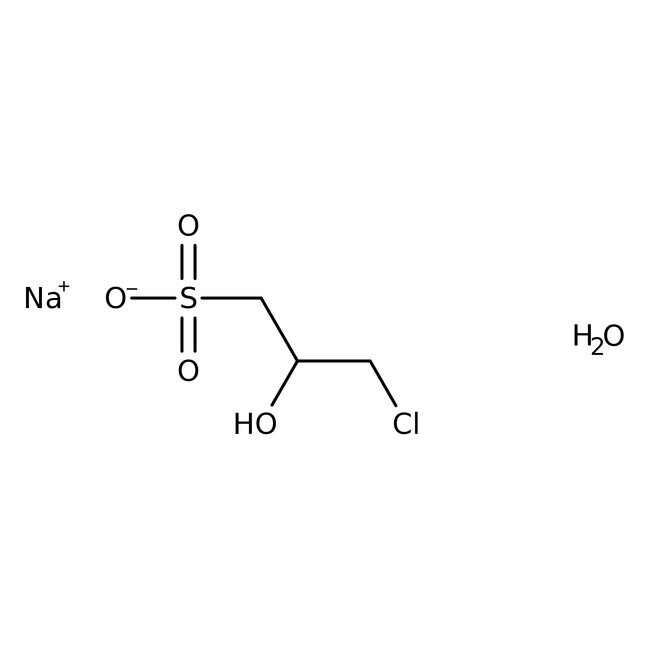
Sodium 3-chloro-2-hydroxypropanesulfonate hemihydrate, 98%
CAS: 143218-48-8 | C3H8ClNaO5S | 214.592 g/mol
Have Questions?
Change view


Catalog number L14018.36
also known as L14018-36
Price (USD)
85.65
Special offer
Online exclusive
Ends: 30-Jun-2026
101.00Save 15.35 (15%)
Each
Quantity:
500 g
Price (USD)
85.65
Special offer
Online exclusive
Ends: 30-Jun-2026
101.00Save 15.35 (15%)
Each
Chemical Identifiers
CAS143218-48-8
IUPAC Namesodium 3-chloro-2-hydroxypropane-1-sulfonate hydrate
Molecular FormulaC3H8ClNaO5S
InChI KeyZPFGAXXLEFTBEU-UHFFFAOYNA-M
SMILESO.[Na+].OC(CCl)CS([O-])(=O)=O
View more
Specifications Specification Sheet
Specification SheetAppearance (Color)White
Water Content (Karl Fischer Titration)2.24-6.43% (0.25-0.75 waters)
Assay (ex Sulphated Ash)≥97.5%
FormCrystals or powder or crystalline powder
Sodium 3-chloro-2-hydroxypropanesulfonate hemihydrate is used to prepare negatively charged probe particles to investigate effect of nanoporosity of cellulosic fibers on their streaming potential and their interactions with cationic polyelectrolytes, to prepare surface-derivatized microcrystalline cellulose (MCC) particles having either a strong positive or a strong negative zeta potential.
This Thermo Scientific Chemicals brand product was originally part of the Alfa Aesar product portfolio. Some documentation and label information may refer to the legacy brand. The original Alfa Aesar product / item code or SKU reference has not changed as a part of the brand transition to Thermo Scientific Chemicals.
Applications
Sodium 3-chloro-2-hydroxypropanesulfonate hemihydrate is used to prepare negatively charged probe particles to investigate effect of nanoporosity of cellulosic fibers on their streaming potential and their interactions with cationic polyelectrolytes, to prepare surface-derivatized microcrystalline cellulose (MCC) particles having either a strong positive or a strong negative zeta potential.
Solubility
Soluble in water.
Notes
Store in cool place. Keep container tightly closed in a dry and well-ventilated place. Incompatible with oxidizing agents.
Sodium 3-chloro-2-hydroxypropanesulfonate hemihydrate is used to prepare negatively charged probe particles to investigate effect of nanoporosity of cellulosic fibers on their streaming potential and their interactions with cationic polyelectrolytes, to prepare surface-derivatized microcrystalline cellulose (MCC) particles having either a strong positive or a strong negative zeta potential.
Solubility
Soluble in water.
Notes
Store in cool place. Keep container tightly closed in a dry and well-ventilated place. Incompatible with oxidizing agents.
RUO – Research Use Only
General References:
- Yun Wang.; Martin A. Hubbe.;Orlando J. Rojas.; Dimitris S. Argyropoulos.; Xingwu Wang.; Takao Sezaki. Charge and the dry-strength performance of polyampholytes Part 3: Streaming potential analysis. Colloids Surf. A. Physicochem. Eng. Asp. 2007, 301 (1), 23-32.
- Martin A. Hubbe.; Orlando J. Rojas.; Lucian A. Lucia.; Tae Min Jung. Consequences of the nanoporosity of cellulosic fibers on their streaming potential and their interactions with cationic polyelectrolytes. Cellulose. 2007, 14 (6), 655-71.