Search
 Element Search
 Structure Search


Thermo Scientific Chemicals
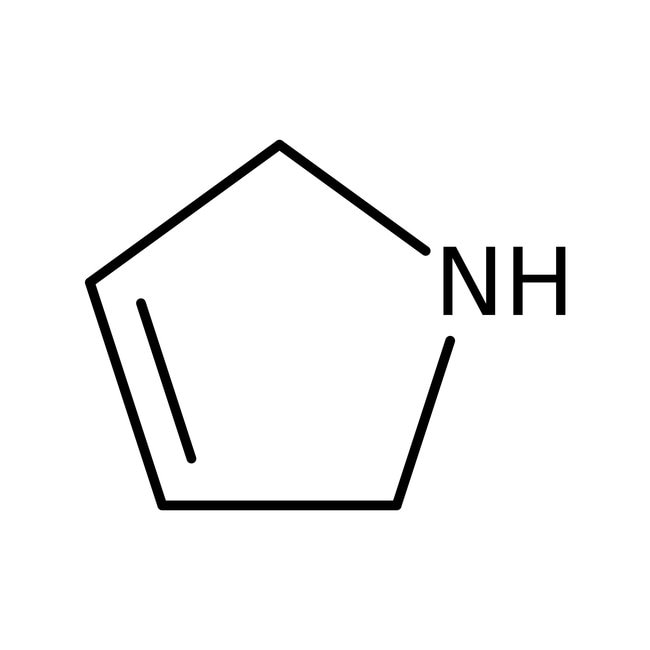
3-Pyrroline, 96%
CAS: 109-96-6 | C4H7N | 69.107 g/mol
Have Questions?
Change view


Catalog number L16349.06
also known as L16349-06
Price (USD)
360.65
Online Exclusive
400.00Save 39.35 (10%)
Each
Quantity:
5 g
Price (USD)
360.65
Online Exclusive
400.00Save 39.35 (10%)
Each
Chemical Identifiers
CAS109-96-6
IUPAC Name2,5-dihydro-1H-pyrrole
Molecular FormulaC4H7N
InChI KeyJVQIKJMSUIMUDI-UHFFFAOYSA-N
SMILESC1NCC=C1
View more
Specifications Specification Sheet
Specification SheetAppearance (Color)Clear colorless to pale yellow
FormLiquid
Assay (GC)≥92.0%
Refractive Index1.4630-1.4715 @ 20°C
3-Pyrroline is suitable for use in a study to investigate the core-level binding energies of simple unsaturated organic molecules bonded to the Si(001) surface by X-ray photoelectron spectroscopy (XPS). It may be used in the synthesis of renin inhibitors2 and vasodilators.
This Thermo Scientific Chemicals brand product was originally part of the Alfa Aesar product portfolio. Some documentation and label information may refer to the legacy brand. The original Alfa Aesar product / item code or SKU reference has not changed as a part of the brand transition to Thermo Scientific Chemicals.
Applications
3-Pyrroline is suitable for use in a study to investigate the core-level binding energies of simple unsaturated organic molecules bonded to the Si(001) surface by X-ray photoelectron spectroscopy (XPS). It may be used in the synthesis of renin inhibitors2 and vasodilators.
Solubility
Fully misicble in water.
Notes
Air Sensitive & Hygroscopic. Store in cool place. Keep container tightly closed in a dry and well-ventilated place. Store away from strong oxidizing agents, air, water, moisture, acids, heat.
3-Pyrroline is suitable for use in a study to investigate the core-level binding energies of simple unsaturated organic molecules bonded to the Si(001) surface by X-ray photoelectron spectroscopy (XPS). It may be used in the synthesis of renin inhibitors2 and vasodilators.
Solubility
Fully misicble in water.
Notes
Air Sensitive & Hygroscopic. Store in cool place. Keep container tightly closed in a dry and well-ventilated place. Store away from strong oxidizing agents, air, water, moisture, acids, heat.
RUO – Research Use Only
General References:
- S H Rosenberg et. al. Water-soluble renin inhibitors: design of a subnanomolar inhibitor with a prolonged duration of action. Journal of Medicinal Chemistry. 1990, 33 (7), 1962-1969.
- Liu H,; HamersR. An X-ray photoelectron spectroscopy study of the bonding of unsaturated organic molecules to the Si (001) surface. J. Surface Science. 1998, 416 (3), 354-362.