Search
 Element Search
 Structure Search


Thermo Scientific Chemicals
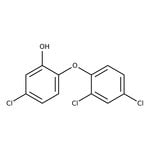
5-Chloro-2-(2,4-dichlorophenoxy)phenol, 99%
CAS: 3380-34-5 | C12H7Cl3O2 | 289.536 g/mol
Have Questions?
Change view


Catalog number L18655.22
also known as L18655-22
Price (USD)
-
Quantity:
100 g
Chemical Identifiers
CAS3380-34-5
IUPAC Name5-chloro-2-(2,4-dichlorophenoxy)phenol
Molecular FormulaC12H7Cl3O2
InChI KeyXEFQLINVKFYRCS-UHFFFAOYSA-N
SMILESOC1=CC(Cl)=CC=C1OC1=CC=C(Cl)C=C1Cl
View more
Specifications Specification Sheet
Specification SheetAppearance (Color)White
Melting Point (clear melt)54.5-60.5?C
FormCrystals or powder or crystalline powder
Identification (FTIR)Conforms
Assay (GC)≥98.5%
This Thermo Scientific Chemicals brand product was originally part of the Alfa Aesar product portfolio. Some documentation and label information may refer to the legacy brand. The original Alfa Aesar product / item code or SKU reference has not changed as a part of the brand transition to Thermo Scientific Chemicals.
Suitable for battery materials development.
Applications
5-Chloro-2-(2,4-dichlorophenoxy)phenol, acts as a bacteriostat and preservative for cosmetic and detergent compositions. It is also used as an antiseptic, disinfectant and anticonvulsant. It is one of the main ingredient in shampoos, deodorants, toothpastes, mouth washes and household cleaning products. It inhibits the growth of bacteria, fungi on the surfaces of the textile, thereby it imparts odor protection to wool, synthetics, blends and non-wovens.
Solubility
Soluble in ethanol, methanol, diethyl ether and sodium hydroxide solution (1M). Slightly soluble in water.
Notes
Store in cool place. Decomposes on heating. Incompatible with strong oxidizing agents.
5-Chloro-2-(2,4-dichlorophenoxy)phenol, acts as a bacteriostat and preservative for cosmetic and detergent compositions. It is also used as an antiseptic, disinfectant and anticonvulsant. It is one of the main ingredient in shampoos, deodorants, toothpastes, mouth washes and household cleaning products. It inhibits the growth of bacteria, fungi on the surfaces of the textile, thereby it imparts odor protection to wool, synthetics, blends and non-wovens.
Solubility
Soluble in ethanol, methanol, diethyl ether and sodium hydroxide solution (1M). Slightly soluble in water.
Notes
Store in cool place. Decomposes on heating. Incompatible with strong oxidizing agents.
RUO – Research Use Only
General References:
- Halden, R. U. On the Need and Speed of Regulating Triclosan and Triclocarban in the United States. Environ. Sci. Technol. 2014, 48 (7), 3603-3611.
- Gao, Y.; Ji, Y.; Li, G.; An, T. Mechanism, kinetics and toxicity assessment of OH-initiated transformation of triclosan in aquatic environments. Water Res. 2014, 49, 360-370.