Search

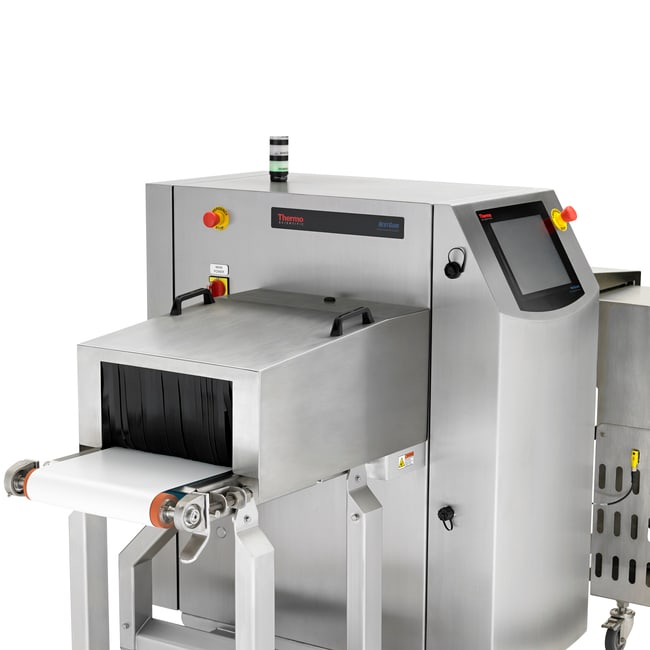


NextGuard™ X-Ray Detection Systems
Transition easily and quickly from metal detection to x-ray inspection and ensure safer products for your customers with a versatile X-ray detection system.
Have Questions?
Change view

| Catalog Number | Converyor Heights Available | Maximum Conveyable Product Weight | Radiation Safety Conformance | System/Conveyor Lengths Available |
|---|---|---|---|---|
| NEXTGUARDPRO | 800/950/1100 mm (31.5/37.4/43.3 in.) ± 75 mm (3.0 in.) | 11 kg (25 lbs.) to 50 kg (110 lbs.) | FDA CFR 21 part 1020.40, RED act (Canada) and others. Note Canada, UK, Spain and France require additional shielding | 1.5 m (59 in) standard with optional conveyor ends extending the system 200/400/600/800/1000 mm(7.9/15.8/23.6/31.5/39.4 in) on either the infeed or outfeed ends. |
| NEXTGUARDC330 | 800 mm (31.5 in.), 900 mm (35.4 in.), 1000 mm (39.4 in.), 1100 mm (43.3 in.) all ± 80 mm | 10 kg (22 lbs.) | FDA CFR 21 part 1020.40, RED act (Canada), IRR99 (UK), NCF 74-100 (France), UNE 73-302 (Spain), GB18871-2002 (China) and others. Note UK, Canada and Spainrequire optional extended guarding and France requires optional extended shielding | Standard Length 1 m (3.3 ft.), C330: Extended 1.4 m (4.6 ft.) |
| NEXTGUARDC500 | 800 mm (31.5 in.), 900 mm (35.4 in.), 1000 mm (39.4 in.), 1100 mm (43.3 in.) all ± 80 mm | 11 kg (25 lbs.) | FDA CFR 21 part 1020.40, RED act (Canada), IRR99 (UK), NCF 74-100 (France), UNE 73-302 (Spain), GB18871-2002 (China) and others. Note UK, Canada and Spainrequire optional extended guarding and France requires optional extended shielding | 1.2 m (47.4 ft.) |
Catalog number NEXTGUARDPRO
Price (USD)
-
Converyor Heights Available:
800/950/1100 mm (31.5/37.4/43.3 in.) ± 75 mm (3.0 in.)
Maximum Conveyable Product Weight:
11 kg (25 lbs.) to 50 kg (110 lbs.)
Radiation Safety Conformance:
FDA CFR 21 part 1020.40, RED act (Canada) and others. Note Canada, UK, Spain and France require additional shielding
System/Conveyor Lengths Available:
1.5 m (59 in) standard with optional conveyor ends extending the system 200/400/600/800/1000 mm(7.9/15.8/23.6/31.5/39.4 in) on either the infeed or outfeed ends.
Find metallic and non-metallic foreign objects and eliminate wet product effects common with metal detectors with the Thermo Scientific™ NextGuard™ X-ray Detection Systems. Designed for a wide variety of food applications, NextGuard systems offer enhanced capabilities to inspect packaged products for missing pieces or components, under and over-fills, and other quality problems with easily customizable vision software. Both the Conveyor and C500 models are easy-to-use, cost effective and thoughtfully designed systems that eliminate common barriers when migrating from metal detection to x-ray inspection.
New and improved NextGuard X-ray Detection System Features:
- Product verification software option allows users to execute a wide range of size, position and count inspections.
- Pack division software allows for precise detection of a missing product, or partial missing product, within packaging for products that are in a stacked format.
- Additional algorithms target the detection of less dense contaminants such as glass or rocks in complex, textured products such as nuts or tea bag boxes.
- Optional mass estimation software uses the density information in the X-ray image to estimate weight and detect under/over filled products.
- Configurable for dual rejection, separating contaminated products from other quality errors.
- Standard system processor is now six times faster than the first generation NextGuard system, supporting high-speed contaminant detection and inspection as well as improved user responsiveness.
- Optional 0.4mm-pixel detector offers 3.2 times better resolution for improved metal detection in lightweight, homogeneous products such as powders or cheese.
Additional Benefits:
- Compact size for easy installation and use
- Unique non-linear detector to eliminate inspection blind spots
- Removable conveyor for simple directional change and maintenance
- Intuitive Thermo Scientific™ VersaWeigh™ user interface and software
- Modular design for high reliability and quick diagnosis and repair
- Source and detector lifetime indicators to minimize expensive downtime
- Built-in remote monitoring for quick problem determination
Options to Customize Your System:
- Complete rejection systems or rejection mechanisms for use on downstream conveyor
- Stainless steel air conditioner for washdown environments
- Alarm horn, no lead curtains, casters, guiderails
- Radiation safety meters
- CE, cCSAus
- Spare parts kits
Specifications
Converyor Heights Available800/950/1100 mm (31.5/37.4/43.3 in.) ± 75 mm (3.0 in.)
Maximum Conveyable Product Weight11 kg (25 lbs.) to 50 kg (110 lbs.)
Radiation Safety ConformanceFDA CFR 21 part 1020.40, RED act (Canada) and others. Note Canada, UK, Spain and France require additional shielding
System/Conveyor Lengths Available1.5 m (59 in) standard with optional conveyor ends extending the system 200/400/600/800/1000 mm(7.9/15.8/23.6/31.5/39.4 in) on either the infeed or outfeed ends.
Weight (English)Contact factory
Unit SizeEach