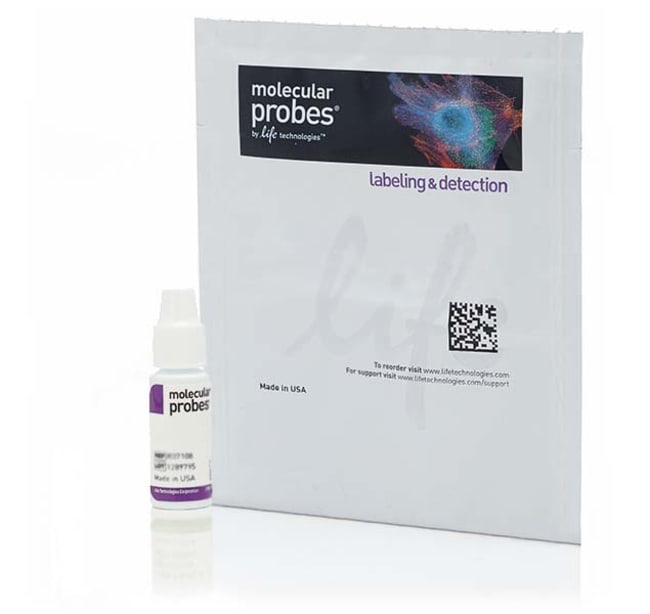

Medio de montaje antidecoloración Prolongue™ Gold con DAPI
Invitrogen™

Medio de montaje antidecoloración Prolongue™ Gold con DAPI

Green features
El medio de montaje antidecoloración ProLong Gold es un medio de montaje líquido que se aplica directamente en muestras deMás información
Have Questions?
Cambiar vistabuttonViewtableView
Número de catálogoCantidad
P369355 x 2 mL
P369412 ml
P3693110 ml
Número de catálogo P36935
Precio (MXN)
7,350.06
Each
Añadir al carro de la compra
Cantidad:
5 x 2 mL
Precio (MXN)
7,350.06
Each
Añadir al carro de la compra
El medio de montaje antidecoloración ProLong Gold es un medio de montaje líquido que se aplica directamente en muestras de células o tejido marcadas con fluorescencia en portaobjetos de microscopio. Está formulado sin tinción de ADN, con la tinción de ADN azul DAPI o con la tinción de ADN rojo oscuro SYTOX Deep Red. El medio de montaje ProLong contiene componentes químicos diseñados para evitar que los tintes fluorescentes se decoloren (fotodecoloración) durante experimentos de microscopía de fluorescencia y lo consigue sin mitigar la señal de fluorescencia inicial. Es un medio de montaje de curado que forma una trayectoria óptica cuasi perfecta (RI de 1,47) y permite el almacenamiento durante más tiempo de la muestra. Este medio está listo para su uso (no requiere almacenamiento a temperatura ambiente ni mezclas); solo tiene que aplicar una gota a la muestra, añadir un cubreobjetos, aplicar curado y obtener la imagen.

El medio de montaje antidecoloración ProLong Gold no se recomienda para el montaje de muestras que contienen proteínas fluorescentes, como GFP. Para una mejor protección contra la decoloración de proteínas y colorantes fluorescentes, se recomienda emplear el medio de montaje antidecoloración ProLong Diamond. Obtenga más información sobre las diferencias principales entre los medios de montaje ProLong Gold y ProLong Diamond.

Atributos clave:

• Protege los tintes de la decoloración durante la adquisición de imágenes
• Líquido de curado listo para su uso para almacenamiento durante más tiempo
• Las muestras montadas son estables durante meses
• Mantiene la señal de fluorescencia (apenas se produce supresión)
• Ideal para colorantes Alexa Fluor

Para los medios de montaje con índice de refracción 1,52, optimizados para la adquisición de imágenes objetivo de inmersión en aceite, intente curar el medio de montaje antidecoloración ProLong Glass o el medio de montaje antidecoloración suave SlowFade Glass sin curado.

El medio de montaje antidecoloración ProLong Gold ya viene mezclado y listo para usarlo en un frasco cuentagotas o un frasco de 10 ml con o sin tinción de ADN. La tinción DAPI se excita mediante iluminación UV a 360 nm cuando se une a ADN, con una emisión máxima a 460 nm y se detecta utilizando un filtro tradicional DAPI. La tinción SYTOX Deep Red se excita con luz roja a 660 nm cuando se une a ADN, con una emisión máxima a 682 nm y se detecta con un filtro tradicional Cy5/rojo oscuro.

Protección contra la fotodecoloración sin supresión
Muchos medios de montaje pueden destruir la intensidad de la señal de fluorescencia inicial hasta en un 80 %. Para crear la serie de medios de montaje Molecular Probes Gold, nuestros científicos desarrollaron una fórmula de aditivos químicos que minimizan la supresión de la señal inicial para la gama de colores y tintes más amplia.

Señales estables durante la obtención de imágenes y para el almacenamiento a largo plazo
Aunque los medios de montaje basados en epoxi que se usan en nuestra serie FluoCells de células preparadas pueden ser estables durante años y ofrecer el máximo nivel de protección contra la decoloración, son complicados de utilizar al requerir una serie de pasos en disolventes orgánicos antes del montaje. El medio de montaje antidecoloración ProLong Gold es la siguiente mejor opción para archivar muestras. Además, es la mejor opción para conservar la intensidad de la señal durante sesiones de obtención de imágenes prolongadas, como el barrido repetido durante la iluminación de barrido láser confocal. Es fácil de usar — solo tiene que secar al aire las muestras teñidas para eliminar el exceso de agua y realizar el montaje. Para visualizar la muestra inmediatamente, elija nuestro medio de montaje sin curado, el medio de montaje SlowFade Gold.

Logre una excelente equivalencia del índice de refracción sin resinas acrílicas
Para las modernas aplicaciones de obtención de imágenes de alta resolución, la equivalencia del índice de refracción es esencial. El medio de montaje antidecoloración ProLong Gold curará con una refracción de 1,47. Además, la propiedad de curado significa que se puede
Para uso exclusivo en investigación. No apto para uso en procedimientos diagnósticos.
Especificaciones
Características ecológicasEmbalaje sostenible menos peligroso
Cantidad5 x 2 mL
Condiciones de envíoTemperatura ambiente
Línea de productosProLong
Tipo de productoDAPI
Tipo de reactivoSolución antidecoloración
Volumen (métrico)2 mL
Unit SizeEach
Contenido y almacenamiento
Se recomienda el almacenamiento a temperatura ambiente, pero también se puede almacenar congelado (entre -5 y -30 °C). Proteja el producto de la luz.

Preguntas frecuentes

What is the difference between ProLong and SlowFade antifade reagents?

Our ProLong antifade reagents dispense as a liquid that will solidify upon the evaporation of water. SlowFade antifade reagents remain liquid. If you are going to image right away and then dispose of your sample, you do not need a mountant that hardens, such as the SlowFade reagents. If you wish to archive your slide for more than a day, you will want a mounting medium that hardens (or “cures”). This hardening will limit the off-rates of various dye-conjugated antibodies and provides a better refractive index. Also, there will be a lower diffusion rate of free radicals, limiting photobleaching.

Find additional tips, troubleshooting help, and resources within our Cell Analysis Support Center.

If I use ProLong Gold Antifade Mountant to mount my slides, should I seal the edges?

ProLong Gold Antifade Mountant hardens overnight at room temperature. For short-term storage (a couple of weeks) you do not need to seal the edges of the coverslip, and the sample should be stable. Beyond that time, though, some dye conjugates will have an off-rate into the medium, so cold storage is recommended. Sealing the edges will prevent long-term discoloration (golden color) from developing around the edges of the coverslip as the anti-oxidants oxidize.

The edges may be sealed with melted paraffin, VALAP (1:1:1 vaseline, lanolin, paraffin) or epoxy glue. Nail polish is not recommended as various components of nail polish may diffuse into the mountant and quench fluorescent dyes.

Find additional tips, troubleshooting help, and resources within our Cell Imaging Support Center.

Some antifade mounting media stay as liquid whereas others harden. What is the benefit of having one that hardens?

If you are going to image right away and then dispose of your sample, you probably want a mountant that does not harden. If you wish to archive your slide for more than a day, you want a mountant that hardens (or "cures"). This hardening will slow or prevent off-rate of your dye or conjugate and often produces a better refractive index. Secondary sealing is usually not necessary. Also there will be lower diffusion of free radicals, thus limiting photobleaching.

Find additional tips, troubleshooting help, and resources within our Cell Analysis Support Center.

I mounted my cells in ProLong antifade mounting medium, but now I want to go back and re-label them. Is there a way I can unmount the coverslip after it has cured (hardened)?

Yes. Put the slide in a Coplin jar or beaker filled with warm (37oC) PBS buffer and let it sit, no agitation is required. The hardened ProLong mountant will swell and may slide off or be easily dislodged. If cells are adherent to the coverslip, make certain the coverslip side containing the cell or tissue sample does not land face down in the container or become scratched upon handling. Remove the coverslip, wash a couple of times, and proceed with re-staining and re-mounting in new ProLong mountant.

Find additional tips, troubleshooting help, and resources within our Cell Analysis Support Center.

I am using ProLong antifade mounting medium. Do I need to let it cure before imaging? Do I need to seal the edges of the coverslip?

You can image before it cures (hardens), and it will still slow photobleaching, but you have to let it cure overnight to get the best refractive index (resolution). There is no need to seal the edges. In fact, if you seal before it cures, it won't cure correctly. If you are archiving the slide for more than a month, though, seal the edges with resin, paraffin or VALAP (1:1:1 vaseline, lanolin, paraffin) after it cures or there may be slight discoloration along the edges over time.

Find additional tips, troubleshooting help, and resources within our Cell Analysis Support Center.

Citations & References (30)

Citations & References
Abstract
Super-resolution imaging reveals three-dimensional folding dynamics of the ß-globin locus upon gene activation.
Authors:van de Corput MP, de Boer E, Knoch TA, van Cappellen WA, Quintanilla A, Ferrand L, Grosveld FG,
Journal:J Cell Sci
PubMed ID:22767512
The chromatin architecture is constantly changing because of cellular processes such as proliferation, differentiation and changes in the expression profile during gene activation or silencing. Unravelling the changes that occur in the chromatin structure during these processes has been a topic of interest for many years. It is known that ... More
Resolution of de novo HIV production and trafficking in immature dendritic cells.
Authors:Turville SG, Aravantinou M, Stössel H, Romani N, Robbiani M,
Journal:Nat Methods
PubMed ID:18059278
'The challenge in observing de novo virus production in human immunodeficiency virus (HIV)-infected dendritic cells (DCs) is the lack of resolution between cytosolic immature and endocytic mature HIV gag protein. To track HIV production, we developed an infectious HIV construct bearing a diothiol-resistant tetracysteine motif (dTCM) at the C terminus ... More
Androgen induces expression of the multidrug resistance protein gene MRP4 in prostate cancer cells.
Authors:Cai C, Omwancha J, Hsieh CL, Shemshedini L
Journal:Prostate Cancer Prostatic Dis
PubMed ID:17003774
'Multidrug resistance-associated proteins (MRPs) may mediate multidrug resistance in tumor cells. Using a gene array analysis, we have identified MRP4 as an androgen receptor (AR)-regulated gene. Dihydrotestosterone induced MRP4 expression in both androgen-dependent and -independent LNCaP cells, whereas there was little detectable expression in PC-3 or normal prostate epithelial cells. ... More
H2AX phosphorylation within the G1 phase after UV irradiation depends on nucleotide excision repair and not DNA double-strand breaks.
Authors:Marti TM, Hefner E, Feeney L, Natale V, Cleaver JE
Journal:Proc Natl Acad Sci U S A
PubMed ID:16788066
'The variant histone H2AX is phosphorylated in response to UV irradiation of primary human fibroblasts in a complex fashion that is radically different from that commonly reported after DNA double-strand breaks. H2AX phosphorylation after exposure to ionizing radiation produces foci, which are detectable by immunofluorescence microscopy and have been adopted ... More
AZD2171: a highly potent, orally bioavailable, vascular endothelial growth factor receptor-2 tyrosine kinase inhibitor for the treatment of cancer.
Authors:Wedge SR, Kendrew J, Hennequin LF, Valentine PJ, Barry ST, Brave SR, Smith NR, James NH, Dukes M, Curwen JO, Chester R, Jackson JA, Boffey SJ, Kilburn LL, Barnett S, Richmond GH, Wadsworth PF, Walker M, Bigley AL, Taylor ST, Cooper L, Beck S, Jürgensmeier JM, Ogilvie DJ,
Journal:Cancer Res
PubMed ID:15899831
'Inhibition of vascular endothelial growth factor-A (VEGF) signaling is a promising therapeutic approach that aims to stabilize the progression of solid malignancies by abrogating tumor-induced angiogenesis. This may be accomplished by inhibiting the kinase activity of VEGF receptor-2 (KDR), which has a key role in mediating VEGF-induced responses. The novel ... More