Search


Citations & References (9)
Invitrogen™
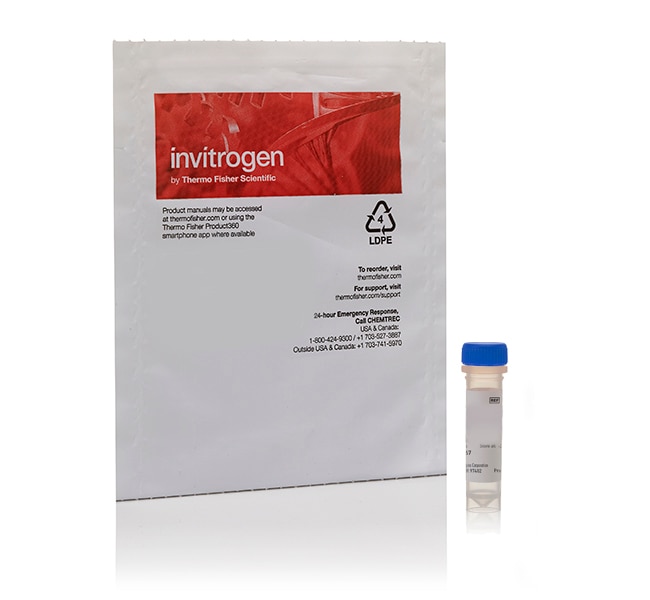
Qdot™ 605 Streptavidin Conjugate
Qdot™ 605 streptavidin conjugate comprises a biotin-binding protein (streptavidin) covalently attached to a fluorescent label (Qdot™ nanocrystal). Streptavidin has aRead more
Have Questions?
Change view

| Catalog Number | Quantity |
|---|---|
| Q10103MP | 50 μL |
| Q10101MP | 200 μL |
Catalog number Q10103MP
Price (USD)
284.00
Each
Quantity:
50 μL
Price (USD)
284.00
Each
Qdot™ 605 streptavidin conjugate comprises a biotin-binding protein (streptavidin) covalently attached to a fluorescent label (Qdot™ nanocrystal). Streptavidin has a very high binding affinity for biotin, and a conjugate of streptavidin is commonly used together with a conjugate of biotin for specific detection of a variety of proteins, protein motifs, nucleic acids, and other molecules (for example, a biotinylated primary antibody bound to a protein target can be detected with a fluorescently labeled streptavidin). Strategies similar to this are used in many detection protocols including western blots, flow cytometry, imaging and microscopy, and microplate assays, and are also used in purification workflows to achieve targeted fractionation. Qdot™ nanocrystal conjugates are provided as 1 μM solutions.
Important Features of Qdot™ Streptavidin Conjugates:
• Streptavidin Qdot™ 605 conjugate has emission maxima of ∼605 nm
• Approximately 5 to 10 streptavidins per Qdot™ nanocrystal
• Extremely photostable and bright fluorescence
• Efficiently excited with single-line excitation sources
• Narrow emission, large Stokes shift
• Available in multiple colors
• Ideal for western blots, flow cytometry, imaging and microscopy, microplate assays and more
Properties of Qdot™ Nanocrystals
The Qdot™ streptavidin conjugate is the size of a large macromolecule or protein (∼15–20 nm) and represents the brightest class of streptavidin detection reagents. Qdot™ streptavidin conjugates are made from a nanometer-scale crystal of a semiconductor material (CdSe), which is coated with an additional semiconductor shell (ZnS) to improve the optical properties of the material. The Qdot™ 705 and Qdot™ 800 streptavidin conjugates, which include CdSeTe, are made in a similar fashion. This core-shell material is further coated with a polymer shell that allows the materials to be conjugated to biological molecules and to retain their optical properties.
Other Fluorescent Conjugates of Streptavidin are Available
We offer several other Qdot™ colors or try the Qdot™ Streptavidin Sampler Kit, containing Qdot™ streptavidin conjugates in six colors 525, 565, 585, 605, 655, and 705. In addition to nanocrystal conjugates, we offer a wide range of streptavidins conjugated to Alexa Fluor™ dyes, Oregon Green™ dye, enzyme conjugates, and traditional fluorophores like Texas Red™ dye, fluorescein (FITC) and more.
Find Biotinylated Conjugates
We offer an extensive line of biotinylated conjugates for use in biotin-streptavidin detection strategies.
• Use the primary antibody search tool to find biotinylated primary antibodies
• Use the secondary antibody selector tool to find biotinylated secondary antibodies and biotinylated anti-dye and anti-hapten antibodies
Blocking Endogenous Biotin
Naturally occurring biotins can interfere with biotin-streptavidin detection schemes. For experiments involving fixed and permeabilized cells, try our Endogenous Biotin-Blocking Kit to minimize this interference.
For Research Use Only. Not intended for any animal or human therapeutic or diagnostic use.
Related Links:
Learn more about Avidin-Biotin Detection
To learn more about Qdot™ Nanocrystals
Important Features of Qdot™ Streptavidin Conjugates:
• Streptavidin Qdot™ 605 conjugate has emission maxima of ∼605 nm
• Approximately 5 to 10 streptavidins per Qdot™ nanocrystal
• Extremely photostable and bright fluorescence
• Efficiently excited with single-line excitation sources
• Narrow emission, large Stokes shift
• Available in multiple colors
• Ideal for western blots, flow cytometry, imaging and microscopy, microplate assays and more
Properties of Qdot™ Nanocrystals
The Qdot™ streptavidin conjugate is the size of a large macromolecule or protein (∼15–20 nm) and represents the brightest class of streptavidin detection reagents. Qdot™ streptavidin conjugates are made from a nanometer-scale crystal of a semiconductor material (CdSe), which is coated with an additional semiconductor shell (ZnS) to improve the optical properties of the material. The Qdot™ 705 and Qdot™ 800 streptavidin conjugates, which include CdSeTe, are made in a similar fashion. This core-shell material is further coated with a polymer shell that allows the materials to be conjugated to biological molecules and to retain their optical properties.
Other Fluorescent Conjugates of Streptavidin are Available
We offer several other Qdot™ colors or try the Qdot™ Streptavidin Sampler Kit, containing Qdot™ streptavidin conjugates in six colors 525, 565, 585, 605, 655, and 705. In addition to nanocrystal conjugates, we offer a wide range of streptavidins conjugated to Alexa Fluor™ dyes, Oregon Green™ dye, enzyme conjugates, and traditional fluorophores like Texas Red™ dye, fluorescein (FITC) and more.
Find Biotinylated Conjugates
We offer an extensive line of biotinylated conjugates for use in biotin-streptavidin detection strategies.
• Use the primary antibody search tool to find biotinylated primary antibodies
• Use the secondary antibody selector tool to find biotinylated secondary antibodies and biotinylated anti-dye and anti-hapten antibodies
Blocking Endogenous Biotin
Naturally occurring biotins can interfere with biotin-streptavidin detection schemes. For experiments involving fixed and permeabilized cells, try our Endogenous Biotin-Blocking Kit to minimize this interference.
For Research Use Only. Not intended for any animal or human therapeutic or diagnostic use.
Related Links:
Learn more about Avidin-Biotin Detection
To learn more about Qdot™ Nanocrystals
For Research Use Only. Not for use in diagnostic procedures.
Specifications
Concentration1 μM
Product TypeStreptavidin Conjugate (fluorescent)
Quantity50 μL
Shipping ConditionRoom Temperature
ConjugateQdot 605
FormLiquid
Product LineQdot
Unit SizeEach
Contents & Storage
1 tube — Store at 2 to 6°C; DO NOT FREEZE
Frequently asked questions (FAQs)
I am getting very high background with my Qdot streptavidin conjugate. Do you have any suggestions?
I am getting no signal with my Qdot streptavidin conjugate. What should I do?
What is the best way to remove white precipitate from my ITK Qdot nanocrystals?
I see a white precipitate in my ITK Qdot nanocrystals; should I be concerned?
Why do my Qdot nanocrystals appear to be blinking?
Citations & References (9)
Citations & References
Abstract
Helios marks strongly autoreactive CD4+ T cells in two major waves of thymic deletion distinguished by induction of PD-1 or NF-?B.
Journal:J Exp Med
PubMed ID:23337809
'Acquisition of self-tolerance in the thymus requires T cells to discriminate strong versus weak T cell receptor binding by self-peptide-MHC complexes. We find this discrimination is reported by expression of the transcription factor Helios, which is induced during negative selection but decreases during positive selection. Helios and the proapoptotic protein
B cell survival, surface BCR and BAFFR expression, CD74 metabolism, and CD8- dendritic cells require the intramembrane endopeptidase SPPL2A.
Journal:J Exp Med
PubMed ID:23267016
Druggable proteins required for B lymphocyte survival and immune responses are an emerging source of new treatments for autoimmunity and lymphoid malignancy. In this study, we show that mice with an inactivating mutation in the intramembrane protease signal peptide peptidase-like 2A (SPPL2A) unexpectedly exhibit profound humoral immunodeficiency and lack mature
'In parallel' interconnectivity of the dorsal longitudinal anastomotic vessels requires both VEGF signaling and circulatory flow.
Journal:J Cell Sci
PubMed ID:22899709
Blood vessels deliver oxygen, nutrients, hormones and immunity factors throughout the body. To perform these vital functions, vascular cords branch, lumenize and interconnect. Yet, little is known about the cellular, molecular and physiological mechanisms that control how circulatory networks form and interconnect. Specifically, how circulatory networks merge by interconnecting 'in
Single-molecule protein arrays enabled by scanning probe block copolymer lithography.
Journal:Proc Natl Acad Sci U S A
PubMed ID:22106270
The ability to control the placement of individual protein molecules on surfaces could enable advances in a wide range of areas, from the development of nanoscale biomolecular devices to fundamental studies in cell biology. Such control, however, remains a challenge in nanobiotechnology due to the limitations of current lithographic techniques.
Differential ability of surface and endosomal TLRs to induce CD8 T cell responses in vivo.
Journal:
PubMed ID:24688022
TLR activation on dendritic cells (DCs) induces DC maturation and secretion of proinflammatory cytokines, both of which are important for activation and differentiation of CD4 T cells. The importance of TLR activation on DCs for CD8 T cell responses is less clear. In this study, we tested the ability of