Search


Citations & References (2)
Invitrogen™
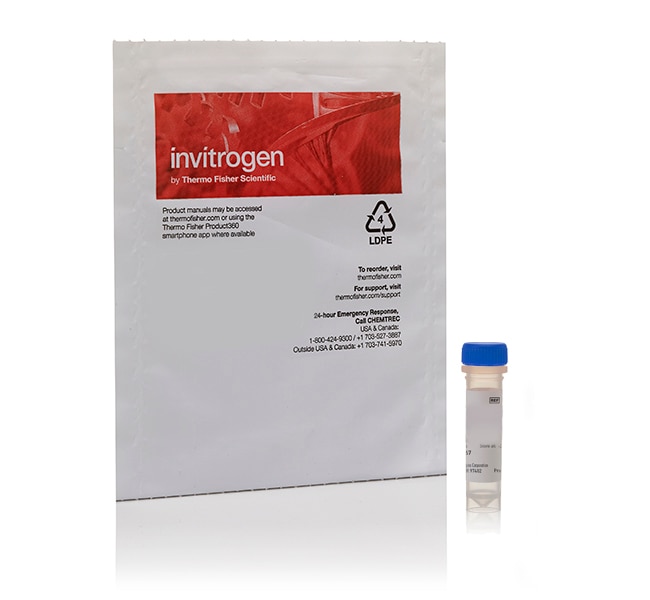
Qdot™ 625 Streptavidin Conjugate
Qdot™ 625 Streptavidin Conjugate comprises a biotin-binding protein (streptavidin) covalently attached to a fluorescent label (Qdot™ nanocrystal). Streptavidin has aRead more
Have Questions?
Change view

| Catalog Number | Quantity |
|---|---|
| Q22063 | 50 μL |
| A10196 | 200 μL |
Catalog number Q22063
Price (USD)
284.00
Each
Quantity:
50 μL
Price (USD)
284.00
Each
Qdot™ 625 Streptavidin Conjugate comprises a biotin-binding protein (streptavidin) covalently attached to a fluorescent label (Qdot™ nanocrystal). Streptavidin has a very high binding affinity for biotin, and a conjugate of streptavidin is commonly used together with a conjugate of biotin for specific detection of a variety of proteins, protein motifs, nucleic acids, and other molecules (for example, a biotinylated primary antibody bound to a protein target can be detected with a fluorescently labeled streptavidin). Strategies similar to this are used in many detection protocols including western blots, flow cytometry, imaging and microscopy, and microplate assays, and are also used in purification workflows to achieve targeted fractionation. Qdot™ nanocrystal conjugates are provided as 1 μM solutions.
Important Features of Qdot™ Streptavidin Conjugates:
• Streptavidin Qdot™ 625 conjugate has emission maxima of ∼625 nm
• Approximately 5 to 10 streptavidins per Qdot™ nanocrystal
• Extremely photostable and bright fluorescence
• Efficiently excited with single-line excitation sources
• Narrow emission, large Stokes shift
• Available in multiple colors
• Ideal for western blots, flow cytometry, imaging and microscopy, microplate assays and more
Properties of Qdot™ Nanocrystals
The Qdot™ streptavidin conjugate is the size of a large macromolecule or protein (∼15–20 nm) and represents the brightest class of streptavidin detection reagents. Qdot™ streptavidin conjugates are made from a nanometer-scale crystal of a semiconductor material (CdSe), which is coated with an additional semiconductor shell (ZnS) to improve the optical properties of the material. The Qdot™ 705 and Qdot™ 800 streptavidin conjugates, which include CdSeTe, are made in a similar fashion. This core-shell material is further coated with a polymer shell that allows the materials to be conjugated to biological molecules and to retain their optical properties.
Other Fluorescent Conjugates of Streptavidin are Available
We offer several other Qdot™ colors or try the Qdot™ Streptavidin Sampler Kit, containing Qdot™ streptavidin conjugates in six colors 525, 565, 585, 605, 655, and 705. In addition to nanocrystal conjugates, we offer a wide range of streptavidins conjugated to Alexa Fluor™ dyes, Oregon Green™ dye, enzyme conjugates, and traditional fluorophores like Texas Red™ dye, fluorescein (FITC) and more.
Find Biotinylated Conjugates
We offer an extensive line of biotinylated conjugates for use in biotin-streptavidin detection strategies.
• Use the primary antibody search tool to find biotinylated primary antibodies
• Use the secondary antibody selector tool to find biotinylated secondary antibodies and biotinylated anti-dye and anti-hapten antibodies
Blocking Endogenous Biotin
Naturally occurring biotins can interfere with biotin-streptavidin detection schemes. For experiments involving fixed and permeabilized cells, try our Endogenous Biotin-Blocking Kit to minimize this interference.
Related Links:
Learn more about Avidin-Biotin Detection
Learn more about Qdot™ Nanocrystals
Important Features of Qdot™ Streptavidin Conjugates:
• Streptavidin Qdot™ 625 conjugate has emission maxima of ∼625 nm
• Approximately 5 to 10 streptavidins per Qdot™ nanocrystal
• Extremely photostable and bright fluorescence
• Efficiently excited with single-line excitation sources
• Narrow emission, large Stokes shift
• Available in multiple colors
• Ideal for western blots, flow cytometry, imaging and microscopy, microplate assays and more
Properties of Qdot™ Nanocrystals
The Qdot™ streptavidin conjugate is the size of a large macromolecule or protein (∼15–20 nm) and represents the brightest class of streptavidin detection reagents. Qdot™ streptavidin conjugates are made from a nanometer-scale crystal of a semiconductor material (CdSe), which is coated with an additional semiconductor shell (ZnS) to improve the optical properties of the material. The Qdot™ 705 and Qdot™ 800 streptavidin conjugates, which include CdSeTe, are made in a similar fashion. This core-shell material is further coated with a polymer shell that allows the materials to be conjugated to biological molecules and to retain their optical properties.
Other Fluorescent Conjugates of Streptavidin are Available
We offer several other Qdot™ colors or try the Qdot™ Streptavidin Sampler Kit, containing Qdot™ streptavidin conjugates in six colors 525, 565, 585, 605, 655, and 705. In addition to nanocrystal conjugates, we offer a wide range of streptavidins conjugated to Alexa Fluor™ dyes, Oregon Green™ dye, enzyme conjugates, and traditional fluorophores like Texas Red™ dye, fluorescein (FITC) and more.
Find Biotinylated Conjugates
We offer an extensive line of biotinylated conjugates for use in biotin-streptavidin detection strategies.
• Use the primary antibody search tool to find biotinylated primary antibodies
• Use the secondary antibody selector tool to find biotinylated secondary antibodies and biotinylated anti-dye and anti-hapten antibodies
Blocking Endogenous Biotin
Naturally occurring biotins can interfere with biotin-streptavidin detection schemes. For experiments involving fixed and permeabilized cells, try our Endogenous Biotin-Blocking Kit to minimize this interference.
Related Links:
Learn more about Avidin-Biotin Detection
Learn more about Qdot™ Nanocrystals
For Research Use Only. Not for use in diagnostic procedures.
Specifications
Concentration1 μM
Product TypeStreptavidin Conjugate (fluorescent)
Quantity50 μL
Shipping ConditionRoom Temperature
FormLiquid
Product LineQdot, VIVID
Unit SizeEach
Contents & Storage
1 tube , store at 2 to 6 °C upon reciept.
Do Not Freeze.
Do Not Freeze.
Frequently asked questions (FAQs)
I used a neuron-specific antibody to label my neurons. I can't get enough signal from my fluorescent dye conjugated primary antibody. What can I do to improve it?
I have a very low-abundance antigen. How can I amplify my signal?
I am getting very high background with my Qdot streptavidin conjugate. Do you have any suggestions?
I am getting no signal with my Qdot streptavidin conjugate. What should I do?
What is the best way to remove white precipitate from my ITK Qdot nanocrystals?
Citations & References (2)
Citations & References
Abstract
TDAG51 mediates epithelial-to-mesenchymal transition in human proximal tubular epithelium.
Journal:Am J Physiol Renal Physiol
PubMed ID:22592641
'Epithelial-to-mesenchymal transition (EMT) contributes to renal fibrosis in chronic kidney disease. Endoplasmic reticulum (ER) stress, a feature of many forms of kidney disease, results from the accumulation of misfolded proteins in the ER and leads to the unfolded protein response (UPR). We hypothesized that ER stress mediates EMT in human
Induction of the unfolded protein response after monocyte to macrophage differentiation augments cell survival in early atherosclerotic lesions.
Journal:FASEB J
PubMed ID:20966213
Endoplasmic reticulum (ER) stress causes macrophage cell death within advanced atherosclerotic lesions, thereby contributing to necrotic core formation and increasing the risk of atherothrombotic disease. However, unlike in advanced lesions, the appearance of dead/apoptotic macrophages in early lesions is less prominent. Given that activation of the unfolded protein response (UPR)