Search


Citations & References (17)
Invitrogen™
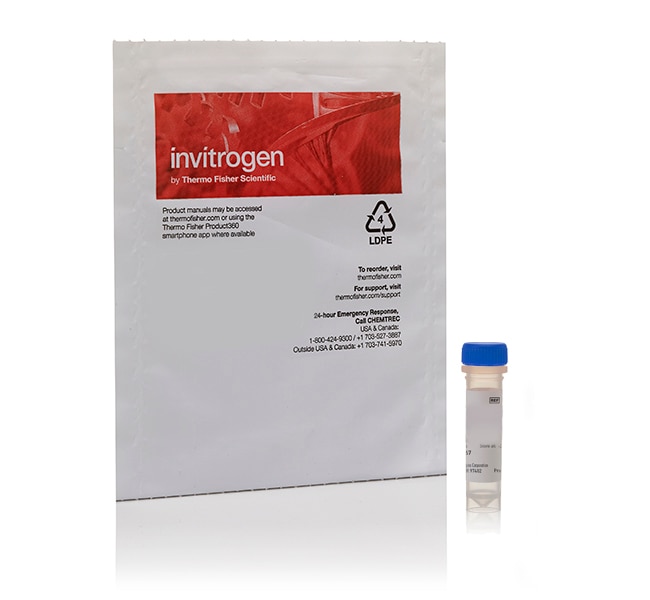
SYTO™ 61 Red Fluorescent Nucleic Acid Stain - 5 mM Solution in DMSO
For use with fluorescence microscopy and flow cytometry
| Catalog Number | Quantity |
|---|---|
| S11343 | 250 μL |
Catalog number S11343
Price (USD)
375.00
Each
Quantity:
250 μL
Price (USD)
375.00
Each
The cell-permeant SYTO 61 red fluorescent nucleic acid stain exhibits bright, red fluorescence upon binding to nucleic acids. Because the staining pattern of the SYTO dyes in live cells may vary between cell types, we offer the SYTO Red Fluorescent Nucleic Acid Stain Sampler Kit (Cat. No. S-11340) to enable researchers to find the most appropriate red-fluorescent SYTO stain for their system.
Any physiological buffer between pH 7.0–8.0, including PBS, can be used to dilute the SYTO dyes for the staining solution.
For Research Use Only. Not for use in diagnostic procedures.
Specifications
ColorRed
DescriptionSYTO™ 61 Red Fluorescent Nucleic Acid Stain - 5 mM Solution in DMSO
Detection MethodFluorescence
Dye TypeCell-Permeant
Emission645 nm
Excitation Wavelength Range628 nm
For Use With (Equipment)Fluorescence Microscope
Product LineSYTO
Quantity250 μL
Shipping ConditionRoom Temperature
Volume (Metric)250 μL
Label TypeFluorescent Dye
Product TypeNucleic Acid Stain
Sub Cellular LocalizationNucleic Acids
Unit SizeEach
Contents & Storage
Store in freezer at -5°C to -30°C and protect from light.
Frequently asked questions (FAQs)
How do SYTO dyes bind to DNA?
Citations & References (17)
Citations & References
Abstract
Multiparameter detection of apoptosis using red-excitable SYTO probes.
Journal:Cytometry A
PubMed ID:18431792
'Functional assays allowing phenotypic characterization of different cell death parameters at a single-cell level are important tools for preclinical anticancer drug screening. Currently, the selection of cytometric assays is limited by the availability of fluorescent probes with overlapping spectral characteristics. Following on our earlier reports on green and orange fluorescent
Modulation of [Ca2+]i signaling dynamics and metabolism by perinuclear mitochondria in mouse parotid acinar cells.
Journal:J Biol Chem
PubMed ID:14699167
'Parotid acinar cells exhibit rapid cytosolic calcium signals ([Ca2+]i) that initiate in the apical region but rapidly become global in nature. These characteristic [Ca2+]i signals are important for effective fluid secretion, which critically depends on a synchronized activation of spatially separated ion fluxes. Apically restricted [Ca2+]i signals were never observed
An evaluation of the performance of cDNA microarrays for detecting changes in global mRNA expression.
Journal:Nucleic Acids Res
PubMed ID:11292855
'The cDNA microarray is one technological approach that has the potential to accurately measure changes in global mRNA expression levels. We report an assessment of an optimized cDNA microarray platform to generate accurate, precise and reliable data consistent with the objective of using microarrays as an acquisition platform to populate
Differentiation of Phytophthora infestans sporangia from other airborne biological particles by flow cytometry.
Journal:Appl Environ Microbiol
PubMed ID:11772606
'The ability of two different flow cytometers, the Microcyte (Optoflow) and the PAS-III (Partec), to differentiate sporangia of the late-blight pathogen Phytophthora infestans from other potential airborne particles was compared. With the PAS-III, light scatter and intrinsic fluorescence parameters could be used to differentiate sporangia from conidia of Alternaria or
The use of fluorescence enhancement to improve the microscopic diagnosis of falciparum malaria.
Journal:Malar J
PubMed ID:17617912
'BACKGROUND: Giemsa staining of thick blood smears remains the "gold standard" for detecting malaria. However, this method is not very good for diagnosing low-level infections. A method for the simultaneous staining of Plasmodium-parasitized culture and blood smears for both bright field and fluorescence was developed and its ability to improve