Search


Citations & References (6)
Invitrogen™
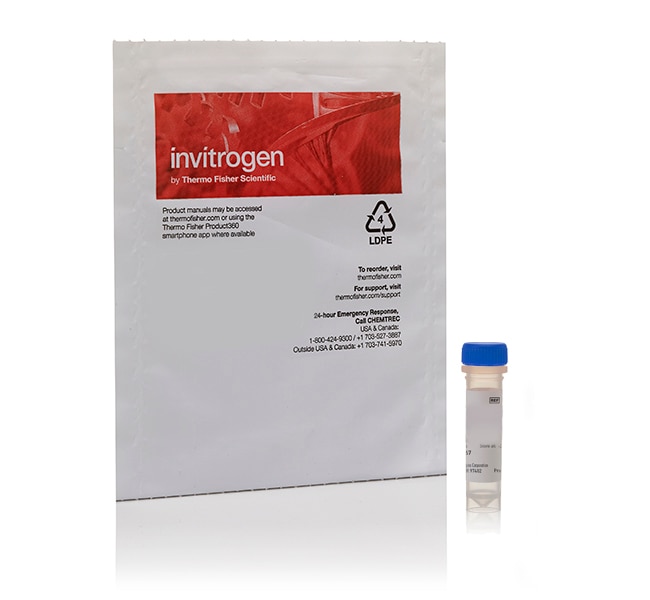
SYTO™ 40 Blue Fluorescent Nucleic Acid Stain - 5 mM Solution in DMSO
For use with fluorescence microscopy and flow cytometry
| Catalog Number | Quantity |
|---|---|
| S11351 | 250 μL |
Catalog number S11351
Price (USD)
377.00
Each
Quantity:
250 μL
Price (USD)
377.00
Each
The cell-permeant SYTO 40 blue fluorescent nucleic acid stain exhibits bright, blue fluorescence upon binding to nucleic acids. Because the staining pattern of the SYTO dyes in live cells may vary from one cell type to another, we offer the SYTO Blue Fluorescent Nucleic Acid Stain Sampler Kit (Cat. No. S-11350) to enable researchers to find the dye that works best for a particular application.
Any physiological buffer between pH 7.0–8.0, including PBS, can be used to dilute the SYTO dyes for the staining solution.
For Research Use Only. Not for use in diagnostic procedures.
Specifications
ColorRed, Blue
DescriptionSYTO™ 40 Blue Fluorescent Nucleic Acid Stain - 5 mM Solution in DMSO
Detection MethodFluorescence
Dye TypeCell-Permeant
Emission441 nm
Excitation Wavelength Range420 nm
For Use With (Equipment)Fluorescence Microscope
Product LineSYTO
Quantity250 μL
Shipping ConditionRoom Temperature
Volume (Metric)250 μL
Label TypeFluorescent Dye
Product TypeNucleic Acid Stain
Sub Cellular LocalizationNucleic Acids
Unit SizeEach
Contents & Storage
Store in freezer at -5°C to -30°C and protect from light.
Frequently asked questions (FAQs)
How do SYTO dyes bind to DNA?
Citations & References (6)
Citations & References
Abstract
Nucleic acid binding agents exert local toxic effects on neurites via a non-nuclear mechanism.
Journal:J Neurochem
PubMed ID:16441515
'The mechanism by which drugs that target nucleic acids cause neurotoxicity is not well described. We characterized the neurotoxicity of Hoechst 33342 (bis-benzimide), a common cell permeable nuclear dye, in primary neuronal cultures. The mechanism of cell death was not apoptotic, as death is rapid, not accompanied by typical nuclear
The Putative Enoyl-Coenzyme A Hydratase DspI Is Required for Production of the Pseudomonas aeruginosa Biofilm Dispersion Autoinducer cis-2-Decenoic Acid.
Journal:
PubMed ID:23935049
'In the present study, we report the identification of a putative enoyl-coenzyme A (CoA) hydratase/isomerase that is required for synthesis of the biofilm dispersion autoinducer cis-2-decenoic acid in the human pathogen Pseudomonas aeruginosa. The protein is encoded by PA14_54640 (PA0745), named dspI for dispersion inducer. The gene sequence for this
Specific and rapid enumeration of viable but nonculturable and viable-culturable gram-negative bacteria by using flow cytometry.
Journal:Appl Environ Microbiol
PubMed ID:20543046
An issue of critical concern in microbiology is the ability to detect viable but nonculturable (VBNC) and viable-culturable (VC) cells by methods other than existing approaches. Culture methods are selective and underestimate the real population, and other options (direct viable count and the double-staining method using epifluorescence microscopy and inhibitory
Close relation of arterial ICC-like cells to the contractile phenotype of vascular smooth muscle cell.
Journal:J Cell Mol Med
PubMed ID:17760838
This work aimed to establish the lineage of cells similar to the interstitial cells of Cajal (ICC), the arterial ICC-like (AIL) cells, which have recently been described in resistance arteries, and to study their location in the artery wall. Segments of guinea-pig mesenteric arteries and single AIL cells freshly isolated
Subcutaneous Injections of Nanofat Adipose-derived Stem Cell Grafting in Facial Rejuvenation.
Journal:Plast Reconstr Surg Glob Open
PubMed ID:32095390