Search


Citations & References (28)
Invitrogen™
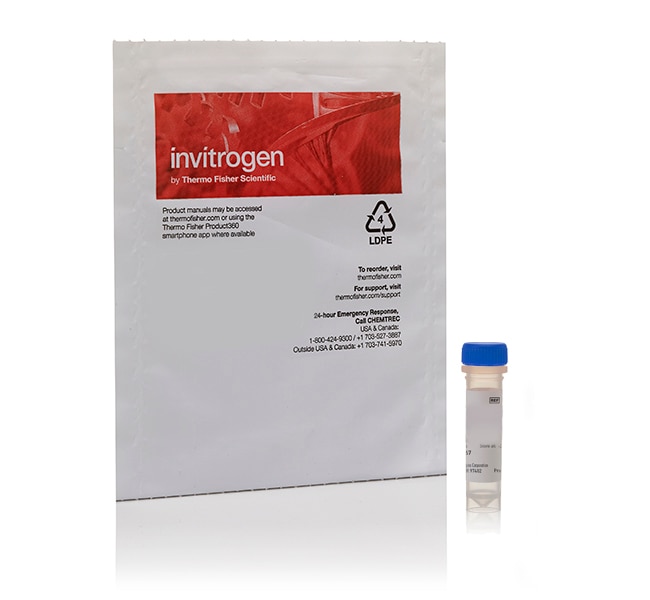
Streptavidin, Alkaline Phosphatase Conjugate
Thermo Scientific Streptavidin, Alkaline Phosphatase Conjugate includes streptavidin in a purified form, conjugated to alkaline phosphatase for substrate based detection.StreptavidinRead more
| Catalog Number | Quantity |
|---|---|
| S921 | 0.5 mL |
Catalog number S921
Price (USD)
392.65
Online exclusive
524.00Save 131.35
Each
Quantity:
0.5 mL
Price (USD)
392.65
Online exclusive
524.00Save 131.35
Each
Thermo Scientific Streptavidin, Alkaline Phosphatase Conjugate includes streptavidin in a purified form, conjugated to alkaline phosphatase for substrate based detection.
Streptavidin is a biotin-binding protein originally isolated from Streptomyces avidinii. In contrast to avidin, streptavidin has no carbohydrate and has a mildly acidic pI of 5. Thermo Scientific streptavidin products use a recombinant form of streptavidin having a mass of 53,000 daltons and a near-neutral pI. Streptavidin is a tetrameric protein, with each subunit binding one molecule of biotin with affinity similar to that of avidin. Guanidinium chloride will dissociate avidin and streptavidin into subunits, but streptavidin is more resistant to dissociation.
Streptavidin, Alkaline Phosphatase Conjugate enables detection of biotinylated antibodies and other probes in a variety of standard assay methods, including western blotting, ELISA, immunohistochemistry, and fluorescence imaging.
For Research Use Only. Not for use in diagnostic procedures.
Specifications
Concentration2 mg/mL
Label or DyeAP (Alkaline Phosphatase)
Product TypeStreptavidin Conjugate (fluorescent)
Quantity0.5 mL
Shipping ConditionWet Ice
ConjugateAP
FormLiquid
Unit SizeEach
Contents & Storage
Store in refrigerator (2–8°C).
Citations & References (28)
Citations & References
Abstract
Enumeration of antigen-specific IgE responses at the single-cell level by an ELISA plaque assay.
Journal:J Immunol Methods
PubMed ID:1703186
In vitro elicitation and enumeration of antigen-specific IgE-secreting cells in antigen-primed murine lymphocyte cultures can be reproducibly and accurately quantitated. Rat anti-mouse IgE monoclonal antibodies (Mab anti-epsilon) were developed. Antigen-specific IgE-secreting cells can be detected on antigen or MAb anti-epsilon coated nitrocellulose discs pasted to 24-well culture plates. This IgE
Detection of low copy numbers of HPV DNA by fluorescent in situ hybridization combined with confocal microscopy as an alternative to in situ polymerase chain reaction.
Journal:J Virol Methods
PubMed ID:9672129
'In genital lesions infected by human papillomavirus (HPV), histological criteria and HPV DNA typing are of prognostic value. Therefore, non-radioactive methods such as in situ hybridization are used extensively since they preserve the histological organization of the tissue, and allow the detection and characterization of HPV DNA. However, the sensitivity
Easily reversible desthiobiotin binding to streptavidin, avidin, and other biotin-binding proteins: uses for protein labeling, detection, and isolation.
Journal:Anal Biochem
PubMed ID:12419349
'The high-affinity binding of biotin to avidin, streptavidin, and related proteins has been exploited for decades. However, a disadvantage of the biotin/biotin-binding protein interaction is that it is essentially irreversible under physiological conditions. Desthiobiotin is a biotin analogue that binds less tightly to biotin-binding proteins and is easily displaced by
Binding of monoclonal antibody AA4 to gangliosides on rat basophilic leukemia cells produces changes similar to those seen with Fc epsilon receptor activation.
Journal:J Cell Biol
PubMed ID:1370498
'The mAb AA4 binds to novel derivatives of the ganglioside Gd1b on rat basophilic leukemia (RBL-2H3) cells. Some of the gangliosides are located close to the high affinity IgE receptor (Fc epsilon RI), and binding of mAb AA4 inhibits Fc epsilon RI-mediated histamine release. In the present study, mAb AA4
Ubiquitination and proteasomal activity is required for transport of the EGF receptor to inner membranes of multivesicular bodies.
Journal:J Cell Biol
PubMed ID:11864992
'EGF, but not TGF alpha, efficiently induces degradation of the EGF receptor (EGFR). We show that EGFR was initially polyubiquitinated to the same extent upon incubation with EGF and TGF alpha, whereas the ubiquitination was more sustained by incubation with EGF than with TGF alpha. Consistently, the ubiquitin ligase c-Cbl