Search


Citations & References (8)
Invitrogen™
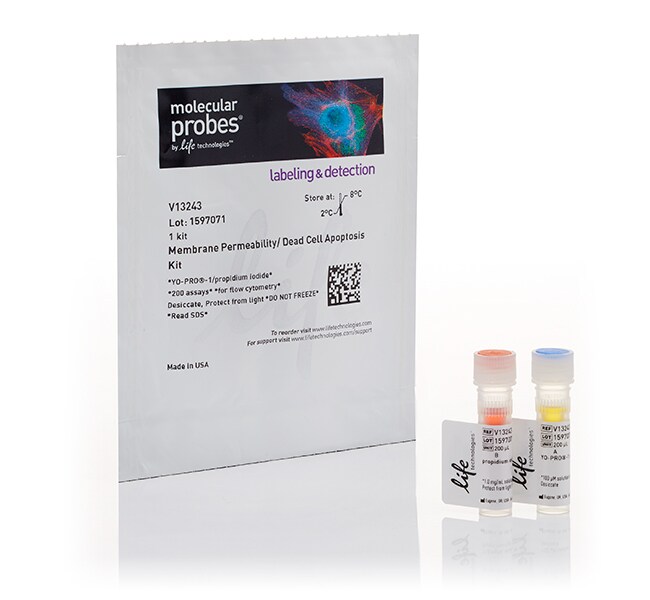
Vybrant™ Apoptosis Assay Kits for apoptotic and necrotic cell staining
Easily distinguish cells undergoing apoptosis with Vybrant Apoptosis Assay Kits, which offer dyes, including YO-PRO-1 and Hoechst 33342, for apoptotic and necrotic cell staining.
Have Questions?
Change view

| Catalog Number | Label or Dye | Description |
|---|---|---|
| V13243 | YO-PRO-1, propidium iodide | Vybrant Apoptosis Assay Kit #4 |
| V13244 | Hoechst 33342, Propidium Iodide | Vybrant Apoptosis Assay Kit #5 |
| V23200 | Alexa Fluor 350 Streptavidin, Propidium Iodide, Biotin-X Annexin V | Vybrant Apoptosis Assay Kit #6 |
Catalog number V13243
Price (USD)
334.65
Online exclusive
364.00Save 29.35
200 assays
Label or Dye:
YO-PRO-1, propidium iodide
Description:
Vybrant Apoptosis Assay Kit #4
Price (USD)
334.65
Online exclusive
364.00Save 29.35
200 assays
Apoptotic cells undergo several physiological processes, including changes in cell membrane permeability and chromatin condensation, which can be distinguished using different dyes in apoptotic and necrotic cell staining protocols. Vybrant Apoptosis Assay kits offer streptavidin biotin-annexin V, propidium iodide (PI), YO-PRO-1, and Hoechst 33342 dyes to differentiate live from apoptotic or necrotic cells, which can then be visualized using flow cytometry.
Vybrant Apoptosis Assay kits offer quick and convenient cell staining dye-based methodologies for differentiating apoptotic and necrotic versus healthy cells, which can then be visualized using flow cytometry.
The Vybrant Apoptosis Assay Kit #4 detects apoptosis via changes that occur in cell membrane permeability. This kit contains ready-to-use solutions of both YO-PRO-1 and propidium iodide (PI) nucleic acid stains. YO-PRO-1 stain selectively passes through the plasma membranes of apoptotic cells and labels them with moderate green fluorescence. Necrotic cells are stained fluorescent red with PI.
The Vybrant Apoptosis Assay Kit #5, or the Chromatin Condensation/Dead Cell Apoptosis Kit with Hoechst 33342 and PI for Flow Cytometry, provides a rapid and convenient assay for apoptosis based on fluorescence detection of the compacted state of the chromatin in apoptotic cells. This kit contains ready-to-use solutions of blue-fluorescent Hoechst 33342 dye, which stains the condensed chromatin of apoptotic cells more brightly than the chromatin of non-apoptotic cells, and red-fluorescent PI dye, which stains dead cells.
The Vybrant Apoptosis Assay Kit #6 provides a rapid and convenient assay for apoptosis, using the bright, blue-fluorescent Alexa Fluor 350 conjugate of streptavidin in conjunction with biotin-X annexin V to detect apoptotic cell populations either by flow cytometry or imaging. In addition, the kit includes a ready-to-use solution of the fluorescent red PI nucleic acid–binding dye. PI is impermeant to live cells and apoptotic cells, but stains dead cells with red fluorescence, binding tightly to their nucleic acid. The kit contains an ample amount of each reagent for about 50 flow cytometric assays.
The Vybrant Apoptosis Assay Kit #4 detects apoptosis via changes that occur in cell membrane permeability. This kit contains ready-to-use solutions of both YO-PRO-1 and propidium iodide (PI) nucleic acid stains. YO-PRO-1 stain selectively passes through the plasma membranes of apoptotic cells and labels them with moderate green fluorescence. Necrotic cells are stained fluorescent red with PI.
The Vybrant Apoptosis Assay Kit #5, or the Chromatin Condensation/Dead Cell Apoptosis Kit with Hoechst 33342 and PI for Flow Cytometry, provides a rapid and convenient assay for apoptosis based on fluorescence detection of the compacted state of the chromatin in apoptotic cells. This kit contains ready-to-use solutions of blue-fluorescent Hoechst 33342 dye, which stains the condensed chromatin of apoptotic cells more brightly than the chromatin of non-apoptotic cells, and red-fluorescent PI dye, which stains dead cells.
The Vybrant Apoptosis Assay Kit #6 provides a rapid and convenient assay for apoptosis, using the bright, blue-fluorescent Alexa Fluor 350 conjugate of streptavidin in conjunction with biotin-X annexin V to detect apoptotic cell populations either by flow cytometry or imaging. In addition, the kit includes a ready-to-use solution of the fluorescent red PI nucleic acid–binding dye. PI is impermeant to live cells and apoptotic cells, but stains dead cells with red fluorescence, binding tightly to their nucleic acid. The kit contains an ample amount of each reagent for about 50 flow cytometric assays.
For Research Use Only. Not for use in diagnostic procedures.
Specifications
ColorGreen, Red
DescriptionVybrant Apoptosis Assay Kit #4
Excitation/EmissionYO-PRO-1: 491/509
propidium iodide: 535/617
propidium iodide: 535/617
Flow Cytometer Laser Lines488
For Use With (Equipment)Flow Cytometer
Label TypeOther Label(s) or Dye(s)
Label or DyeYO-PRO-1, propidium iodide
Product LineVybrant
Product TypeApoptosis Assay Kit
Quantity200 assays
Shipping ConditionRoom Temperature
Detection MethodFluorescence
FormatTube
Unit Size200 assays
Contents & Storage
Contains 1 vial of YO-PRO-1, and 1 vial of propidium iodide. Store in refrigerator (2–8°C) and protect from light
Frequently asked questions (FAQs)
What are the fluorescence excitation/emission maxima for the dyes in the Membrane Permeability/Dead Cell Apoptosis Kit with YO-PRO-1 and PI for Flow Cytometry aka Vybrant Apoptosis Assay Kit #4, YO-PRO-1/Propidium Iodide)?
What is the relative time-frame of apoptosis progression, and what products can I use to detect the different apoptotic events?
Citations & References (8)
Citations & References
Abstract
Contribution of membrane localization to the apoptotic activity of PUMA.
Journal:Apoptosis
PubMed ID:17968660
'The BH3-only protein PUMA plays an important role in the activation of apoptosis in response to p53. In different studies, PUMA has been described to function by either directly activating the pro-apoptotic proteins Bax and Bak, or by neutralizing anti-apoptotic members of the Bcl2 family. We have examined the contribution
Release of hypoacetylated and trimethylated histone H4 is an epigenetic marker of early apoptosis.
Journal:J Biol Chem
PubMed ID:16531610
'Nuclear events such as chromatin condensation, DNA cleavage at internucleosomal sites, and histone release from chromatin are recognized as hallmarks of apoptosis. However, there is no complete understanding of the molecular events underlying these changes. It is likely that epigenetic changes such as DNA methylation and histone modifications that are
Chlorophenols and chlorocatechols induce apoptosis in human lymphocytes (in vitro).
Journal:Toxicol Lett
PubMed ID:19766705
In this work the effect of 2,4,5-trichlorophenol (2,4,5-TCP), pentachlorophenol (PCP), 4,6-dichloroguaiacol (4,6-DCG), tetrachloroguaiacol (TeCG), 4,5-dichlorocatechol (4,5-DCC) and tetrachlorocatechol (TeCC) on the induction of apoptosis in human peripheral blood lymphocytes was examined. The analysis of the changes in mitochondrial transmembrane potential (DeltaPsi(m)) was performed using JC-9 fluorescent probe. It was noted
Comparison of apoptosis and mortality measurements in peripheral blood mononuclear cells (PBMCs) using multiple methods.
Journal:Cell Prolif
PubMed ID:16202038
Death through apoptosis is the main process by which aged cells that have lost their function are eliminated. Apoptotic cells are usually detected microscopically by changes in their morphology. However, determination of early apoptotic events is important for in vitro (and ex vivo) studies. The main objective of the present
Relocalization of STIM1 for activation of store-operated Ca(2+) entry is determined by the depletion of subplasma membrane endoplasmic reticulum Ca(2+) store.
Journal:J Biol Chem
PubMed ID:17298947
STIM1 (stromal interacting molecule 1), an endoplasmic reticulum (ER) protein that controls store-operated Ca(2+) entry (SOCE), redistributes into punctae at the cell periphery after store depletion. This redistribution is suggested to have a causal role in activation of SOCE. However, whether peripheral STIM1 punctae that are involved in regulation of