Search
Invitrogen
CD197 (CCR7) Monoclonal Antibody (4B12), APC-eFluor™ 780, eBioscience™
{{$productOrderCtrl.translations['antibody.pdp.commerceCard.promotion.promotions']}}
{{$productOrderCtrl.translations['antibody.pdp.commerceCard.promotion.promocode']}}: {{promo.promoCode}} {{promo.promoTitle}} {{promo.promoDescription}}. {{$productOrderCtrl.translations['antibody.pdp.commerceCard.promotion.learnmore']}}
{{$ctrl.translations['antibody.pdp.skuNotes.additionalInformation']}}:
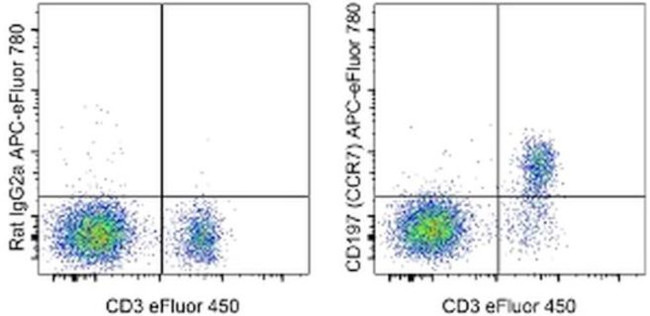
FIGURE: 1 / 12
CD197 (CCR7) Antibody (47-1971-82) in Flow
Staining of C57Bl/6 splenocytes with Anti-Mouse CD3e eFluor® 450 (Product # 48-0031-82) and 1 µg of Rat IgG2a K Isotype Control APC-eFluor® 780 (Product # 47-4321-82) (left) or 1 µg of Anti-Mouse CD197 (CCR7) APC-eFluor® 780 (right). Viable cells in the lymphocyte gate, as determined by staining with the 7-AAD Viability Staining Solution (Product # 00-6993-50), were used for analysis.


Please note: We are reviewing Western blot images included in the antibody testing data in our catalog, including those provided by third parties. Unless expressly labeled or annotated as “raw-unedited”, Western blot images included in the antibody testing data in our catalog may have been edited, optimized or otherwise adjusted for presentation.




Product Details
47-1971-82
Applications
Tested Dilution
Publications
Product Specifications
Species Reactivity
Mouse
Published species
Human,
Mouse
Host/Isotype
Rat
/ IgG2a, kappa
Recommended Isotype Control
Class
Monoclonal
Type
Antibody
Clone
4B12
Conjugate
APC-eFluor™ 780
APC-eFluor™ 780
APC-eFluor™ 780
Excitation/Emission Max
756/785 nm
View spectra
Form
Liquid
Concentration
0.2 mg/mL
Amount
100 µg
Purification
Affinity chromatography
Storage buffer
PBS, pH 7.2
Contains
0.09% sodium azide
Storage conditions
4°C, store in dark, DO NOT FREEZE!
Shipping conditions
Ambient (domestic); Wet ice (international)
RRID
Product Specific Information
Description: The 4B12 monoclonal antibody reacts with mouse CCR7, also known as EBI-1 and CD197. CCR7 is a chemokine receptor for the chemokines CCL19 (CKβ11, ELC, MIP3β, Scya19, Exodus-3) and CCL21 (CKβ9, SLC, MIP2β, Scya21, Exodus-2). In recent years, the role of chemokines in directing the migration of lymphocytes has been well-characterized. One of the most important mediators of homeostatic trafficking of naive T cells to secondary lymphoid organs (SLO) is the chemokine receptor CCR7. Binding of its ligands, CCL19 and CCL21, mediates the trans endothelial migration of T cells across high endothelial venules into SLO. It has also been demonstrated that CCR7 plays a role in the localization of dendritic cells and B cells during an immune response.
CCR7 is a chemokine receptor for the chemokines CCL19 (CKβ11, ELC, MIP3β, Scya19, Exodus-3) and CCL21 (CKβ9, SLC, MIP2β, Scya21, Exodus-2).
In addition to its significant role in the chemotaxis of lymphocytes, human CCR7 has also been recognized as a marker for a distinct subset of memory T cells, the central memory (TCM) population. These cells are characterized by the expression of CCR7 and CD62L and reside within peripheral lymphoid organs. CCR7 also plays a role in thymocyte development and its deficiency leads to disturbed thymic architecture, aberrant T cell development, and limited thymocyte expansion.
For optimal visualization of CCR7 expression on different cell types it is necessary to use multi-color staining to discriminate different cell subsets as well as following the protocol (incubation at 37C may be necessary). To address specificity, the staining profile of 4B12 has been compared to a polyclonal antibody generated against a CCR7 peptide (Bjorkdahl et al). This analysis confirms that the polyclonal antibody and 4B12 stain similar populations of cells. Furthermore, 4B12 stains mouse CCR7-GFP fusion protein-transfected RBL cells (see data in Product # 14-1971).
Applications Reported: This 4B12 antibody has been reported for use in flow cytometric analysis.
Applications Tested: This 4B12 antibody has been tested by flow cytometric analysis of mouse splenocytes. This can be used at less than or equal to 1 µg per test. A test is defined as the amount (µg) of antibody that will stain a cell sample in a final volume of 100 µL. Cell number should be determined empirically but can range from 10^5 to 10^8 cells/test. It is recommended that the antibody be carefully titrated for optimal performance in the assay of interest.
Important: Staining with the 4B12 monoclonal antibody requires different conditions than typically used for surface-antigen staining. Please use the protocol below. Moreover, we have found that staining at 37°C, rather than 2-8°C, results in brighter 4B12 staining, as well as better resolution between positive and negative populations. Please see data for the PE 4B12 (Product # 12-1971) which demonstrates a comparison of staining at 2-8°C and 37°C. Staining with 4B12 at 37°C is not expected to interfere with co-staining other antigens, however this should be evaluated for individual experiments.
1. Prepare cell suspension as normal and block Fc gamma III R/Fc gamma II R with 5 µg/million cells purified anti-mouse CD16/32 (Product # 14-0161) for 15 minutes on ice. If red blood cell lysis is carried out as part of cell preparation, ensure that fixatives are not present in the red blood cell lysis solution as this will eliminate 4B12 staining.
2. Without washing, add 1 µg/million cells 4B12 and incubate in a 37°C waterbath or at 2-8°C (please see notes above) for 0.5 hours.
3. Wash cells 1X with 3 mL of Flow Cytometry Staining Buffer (Product # 00-4222) and decant supernatant.
4. Analyze cells on flow cytometer or proceed with secondary staining on ice as normal.
Note: Co-staining mouse CCR7 with the 4B12 antibody and the CCR7 ligand CCL19-Fc (Product # 14-1972) may be difficult due to different binding conditions required for the antibody versus the ligand, and steric hindrance which may prevent co-staining of 4B12 and CCL19-Fc. Cross-blocking experiments have demonstrated that 4B12 binding is able to prevent the detectable binding of CCL19-Fc, however not the opposite. Furthermore, the correlation between 4B12 and CCL19-Fc staining may be difficult to predict due to the presence of unknown CCL19-Fc receptors in addition to CCR7.
APC-eFluor® 780 emits at 780 nm and is excited with the Red laser (633 nm). Please make sure that your instrument is capable of detecting this fluorochome.
Light sensitivity: This tandem dye is sensitive to photo-induced oxidation. Please protect this vial and stained samples from light.
Fixation: Samples can be stored in IC Fixation Buffer (Product # 00-8222) (100 µL of cell sample + 100 µL of IC Fixation Buffer) or 1-step Fix/Lyse Solution (Product # 00-5333) for up to 3 days in the dark at 4°C with minimal impact on brightness and FRET efficiency/compensation. Some generalizations regarding fluorophore performance after fixation can be made, but clone specific performance should be determined empirically.
Excitation: 633-647 nm; Emission: 780 nm; Laser: Red Laser.
Filtration: 0.2 µm post-manufacturing filtered.
Target Information
CCR7 is a member of the G-protein-coupled chemokine receptor family with seven membrane-spanning domains and functions as a receptor for 6Ckine/SLC (secondary lymphoid-tissue chemokine), CCL19 and CCL21. CCR7 has been shown to be internalized via clathrin-coated pits and the majority recycled back to the plasma membrane. CCR7 is expressed on T cells and can be used to distinguish populations of naive from central and effector memory T cells. CCR7 has been shown to play a role in migration of memory T cells to inflamed tissue. Expression of CCR7 is also found on DC's. During DC maturation CCR7 expression increases and is thought to be involved in a variety of functions: chemotaxis to the lymph node, cellular architecture, rate of endocytosis, survival and maturation.
For Research Use Only. Not for use in diagnostic procedures. Not for resale without express authorization.
How to use the Panel Builder
Watch the video to learn how to use the Invitrogen Flow Cytometry Panel Builder to build your next flow cytometry panel in 5 easy steps.
Bioinformatics
Protein Aliases: chemokine (C-C motif) receptor 7; chemokine (C-C) receptor 7; EBV-induced G-protein coupled receptor 1; epstein-Barr virus-induced G-protein coupled receptor 1; MIP-3 beta receptor; unnamed protein product
Gene Aliases: CC-CKR-7; CCR-7; CD197; Cdw197; Cmkbr7; EBI1; Ebi1h
UniProt ID: (Mouse) P47774
Entrez Gene ID: (Mouse) 12775
establishment of T cell polarity
myeloid dendritic cell chemotaxis
lymphocyte chemotaxis across high endothelial venule
positive regulation of dendritic cell antigen processing and presentation
regulation of tolerance induction to self antigen
positive regulation of hypersensitivity
positive regulation of humoral immune response
chemotaxis
inflammatory response
immune response
G-protein coupled receptor signaling pathway
positive regulation of cytosolic calcium ion concentration
positive regulation of macrophage chemotaxis
positive regulation of T cell chemotaxis
calcium-mediated signaling
actin cytoskeleton organization
regulation of Cdc42 protein signal transduction
response to lipopolysaccharide
regulation of interferon-gamma production
regulation of interleukin-1 beta production
negative regulation of interleukin-12 production
positive regulation of interleukin-1 beta production
positive regulation of interleukin-12 production
positive regulation of tumor necrosis factor production
response to prostaglandin E
positive regulation of Rac protein signal transduction
CCL19-activated CCR7 signaling pathway
CCL21-activated CCR7 signaling pathway
positive regulation of T cell proliferation
negative thymic T cell selection
positive regulation of T-helper 1 cell differentiation
positive regulation of JNK cascade
positive regulation of receptor-mediated endocytosis
lymph node development
homeostasis of number of cells
positive regulation of phagocytosis
positive regulation of T cell receptor signaling pathway
release of sequestered calcium ion into cytosol
positive regulation of filopodium assembly
positive regulation of protein kinase B signaling
cell chemotaxis
cellular response to cytokine stimulus
cellular response to prostaglandin E stimulus
response to nitric oxide
positive regulation of neutrophil chemotaxis
lymphocyte migration into lymph node
mature conventional dendritic cell differentiation
positive regulation of phospholipase C/protein kinase C signal transduction
negative regulation of leukocyte apoptotic process
positive regulation of cell motility
positive regulation of thymocyte migration
positive regulation of dendritic cell chemotaxis
positive regulation of immunological synapse formation
positive regulation of T cell costimulation
regulation of dendritic cell dendrite assembly
Disclaimer

Clicking the images or links will redirect you to a website hosted by BenchSci that provides third-party scientific content. Neither the content nor the BenchSci technology and processes for selection have been evaluated by us; we are providing them as-is and without warranty of any kind, including for use or application of the Thermo Fisher Scientific products presented.

Performance Guarantee
If an Invitrogen™ antibody doesn't perform as described on our website or datasheet,we'll replace the product at no cost to you, or provide you with a credit for a future purchase.*
Learn more
We're here to help
Get expert recommendations for common problems or connect directly with an on staff expert for technical assistance related to applications, equipment and general product use.
Contact tech support