Search
Bioss
GIP Polyclonal Antibody
{{$productOrderCtrl.translations['antibody.pdp.commerceCard.promotion.promotions']}}
{{$productOrderCtrl.translations['antibody.pdp.commerceCard.promotion.promocode']}}: {{promo.promoCode}} {{promo.promoTitle}} {{promo.promoDescription}}. {{$productOrderCtrl.translations['antibody.pdp.commerceCard.promotion.learnmore']}}
{{$ctrl.translations['antibody.pdp.skuNotes.additionalInformation']}}:

FIGURE: 1 / 2
GIP Antibody (BS-0098R) in IHC (P)
Paraformaldehyde-fixed, paraffin embedded mouse intestine tissue; Antigen retrieval by boiling in sodium citrate buffer (pH6.0) for 15min; Block endogenous peroxidase by 3% hydrogen peroxide for 20 minutes; Blocking buffer (normal goat serum) at 37°C for 30min; Antibody incubation with GIP Polyclonal Antibody, Unconjugated (bs-0098R) at 1:400 overnight at 4°C, followed by a conjugated secondary antibody and... View More


Please note: We are reviewing Western blot images included in the antibody testing data in our catalog, including those provided by third parties. Unless expressly labeled or annotated as “raw-unedited”, Western blot images included in the antibody testing data in our catalog may have been edited, optimized or otherwise adjusted for presentation.


Product Details
BS-0098R
Applications
Tested Dilution
Publications
Product Specifications
Species Reactivity
Human,
Mouse,
Rat
Host/Isotype
Rabbit
/ IgG
Class
Polyclonal
Type
Antibody
Immunogen
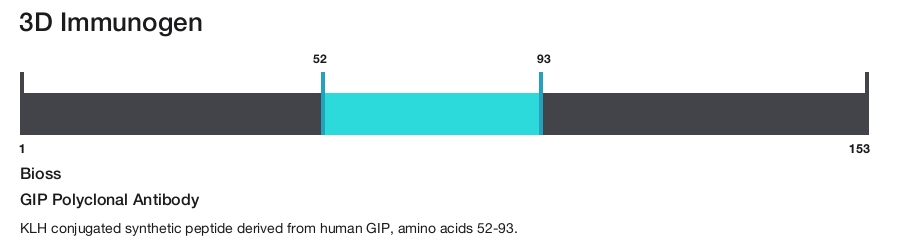
KLH conjugated synthetic peptide derived from human GIP, amino acids 52-93.
Conjugate
Unconjugated
Unconjugated
Unconjugated
Form
Liquid
Concentration
1 mg/mL
Amount
100 µg
Purification
Protein A
Storage buffer
0.01M TBS, pH 7.4, with 50% glycerol, 1% BSA
Contains
0.02% ProClin 300
Storage conditions
-20°C
Shipping conditions
Ambient (domestic); Wet ice (international)
Target Information
This gene encodes an incretin hormone and belongs to the glucagon superfamily. The encoded protein is important in maintaining glucose homeostasis as it is a potent stimulator of insulin secretion from pancreatic beta-cells following food ingestion and nutrient absorption. This gene stimulates insulin secretion via its G protein-coupled receptor activation of adenylyl cyclase and other signal transduction pathways. It is a relatively poor inhibitor of gastric acid secretion.
For Research Use Only. Not for use in diagnostic procedures. Not for resale without express authorization.
References (0)
Have you cited this product in a publication?
Let us know so we can reference it here.
Bioinformatics
Protein Aliases: Glucose-dependent insulinotropic peptide; glucose-dependent insulinotropic polypeptide; incretin hormone; Rabbit Anti GIP; unnamed protein product
Gene Aliases: Gludins; RATGLUDINS
UniProt ID: (Human) P09681, (Rat) Q06145, (Mouse) P48756
Entrez Gene ID: (Human) 2695, (Rat) 25040, (Mouse) 14607
adenylate cyclase-activating G-protein coupled receptor signaling pathway
female pregnancy
memory
adult locomotory behavior
response to xenobiotic stimulus
response to carbohydrate
response to glucose
response to selenium ion
response to acidic pH
positive regulation of glucose transport
sensory perception of pain
endocrine pancreas development
response to nutrient levels
positive regulation of insulin secretion
response to lipid
exploration behavior
gastric inhibitory peptide signaling pathway
regulation of fatty acid biosynthetic process
response to starvation
response to amino acid
response to peptide hormone
response to axon injury
regulation of insulin secretion
positive regulation of synaptic transmission
digestive system development
long-term synaptic potentiation
triglyceride homeostasis
positive regulation of cAMP/PKA signal transduction
signal transduction
Disclaimer

Clicking the images or links will redirect you to a website hosted by BenchSci that provides third-party scientific content. Neither the content nor the BenchSci technology and processes for selection have been evaluated by us; we are providing them as-is and without warranty of any kind, including for use or application of the Thermo Fisher Scientific products presented.

Performance Guarantee
If an Invitrogen™ antibody doesn't perform as described on our website or datasheet,we'll replace the product at no cost to you, or provide you with a credit for a future purchase.*
Learn more
We're here to help
Get expert recommendations for common problems or connect directly with an on staff expert for technical assistance related to applications, equipment and general product use.
Contact tech support