Search
Fabgennix
Smad4 Polyclonal Antibody
{{$productOrderCtrl.translations['antibody.pdp.commerceCard.promotion.promotions']}}
{{$productOrderCtrl.translations['antibody.pdp.commerceCard.promotion.promocode']}}: {{promo.promoCode}} {{promo.promoTitle}} {{promo.promoDescription}}. {{$productOrderCtrl.translations['antibody.pdp.commerceCard.promotion.learnmore']}}
{{$ctrl.translations['antibody.pdp.skuNotes.additionalInformation']}}:


Please note: We are reviewing Western blot images included in the antibody testing data in our catalog, including those provided by third parties. Unless expressly labeled or annotated as “raw-unedited”, Western blot images included in the antibody testing data in our catalog may have been edited, optimized or otherwise adjusted for presentation.

Product Details
SMAD4-421AP
Applications
Tested Dilution
Publications
Product Specifications
Species Reactivity
Human,
Mouse,
Rat
Host/Isotype
Rabbit
/ IgG
Class
Polyclonal
Type
Antibody
Immunogen
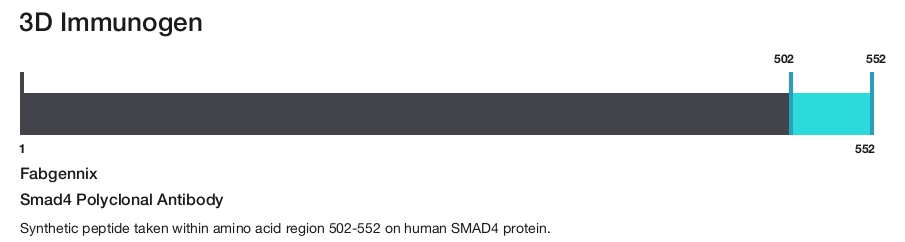
Synthetic peptide taken within amino acid region 502-552 on human SMAD4 protein.
Conjugate
Unconjugated
Unconjugated
Unconjugated
Form
Liquid
Concentration
0.5-1.5 mg/mL
Purification
Affinity chromatography
Storage buffer
proprietary buffer, pH 7.4-7.8, with 30% glycerol, 0.5% BSA
Contains
0.02% sodium azide
Storage conditions
-20°C
Shipping conditions
Ambient (domestic); Wet ice (international)
Target Information
Smad4 is encoded by the Smad4 gene that is located on chromosome 18 in humans. Smad4 is also known as Smad family member 4, Sma- and Mad-related protein 4 or Mothers against decapentaplegic (MAD) homolog 4. Smad4 contains N-terminal MH1 (MAD homology 1) and C-terminal MH2 (MAD homology 2) globular domains that are involved in DNA binding and protein interactions respectively. Binding of the TGF-beta superfamily of ligands that includes Transforming Growth Factor -beta (TGF-beta) and bone morphogenetic protein (BMP) to its cognate receptor allows phosphorylation of Smad 1, 2, 3, 5 and 8 (R-Smad, Receptor Smad). This signals for heterotrimerization with Smad4 (co-Smad, co-mediator Smad) and translocation of the complex to the nucleus. Inhibitory or antagonistic Smad (I-Smad) that includes Smad 6 and 7, interact with activated R-Smads and attenuate the signaling pathway. Smad4 acts as a tumor suppressor protein by transcriptionally regulating its target genes such as Cyclin D1 (downregulation) and collagen (upregulation) that inhibit cell proliferation. Dephosphorylation regulates nuclear export and nucleocytoplasmic dynamics of Smads.
For Research Use Only. Not for use in diagnostic procedures. Not for resale without express authorization.
References (0)
Have you cited this product in a publication?
Let us know so we can reference it here.
Bioinformatics
Protein Aliases: Deleted in Pancreatic Carcinoma 4 (DPC4); deleted in pancreatic carcinoma locus 4; deletion target in pancreatic carcinoma 4; deletion target in pancreatic carcinoma 4 homolog; hSMAD4; MAD (mothers against decapentaplegic Drosophila) homolog 4; MAD homolog 4; MAD homolog 4 (MADH4); mothers against decapentaplegic homolog 4; Mothers against decapentaplegic homolog 4 (MADH4); mothers against decapentaplegic, Drosophila, homolog of, 4; mothers against DPP homolog 4; SMAD; SMAD 4; SMAD, mothers against DPP homolog 4; Smad4; unnamed protein product
Gene Aliases: D18Wsu70e; DPC4; JIP; MADH4; MYHRS
UniProt ID: (Human) Q13485, (Mouse) P97471, (Rat) O70437
Entrez Gene ID: (Human) 4089, (Mouse) 17128, (Rat) 50554
transcription regulatory region sequence-specific DNA binding
RNA polymerase II regulatory region sequence-specific DNA binding
RNA polymerase II core promoter proximal region sequence-specific DNA binding
RNA polymerase II transcription factor activity, sequence-specific DNA binding
transcription corepressor binding
transcription coactivator binding
transcriptional activator activity, RNA polymerase II transcription regulatory region sequence-specific binding
DNA binding
chromatin binding
transcription factor activity, sequence-specific DNA binding
protein binding
collagen binding
filamin binding
identical protein binding
protein homodimerization activity
sulfate binding
sequence-specific DNA binding
macromolecular complex binding
SMAD binding
RNA polymerase II sequence-specific DNA binding transcription factor binding
I-SMAD binding
R-SMAD binding
negative regulation of transcription from RNA polymerase II promoter
ovarian follicle development
osteoblast differentiation
response to hypoxia
epithelial to mesenchymal transition
outflow tract septum morphogenesis
cardiac conduction system development
atrioventricular valve formation
epithelial to mesenchymal transition involved in endocardial cushion formation
left ventricular cardiac muscle tissue morphogenesis
cardiac septum development
transcription, DNA-templated
regulation of transcription, DNA-templated
regulation of transcription from RNA polymerase II promoter
cellular iron ion homeostasis
transforming growth factor beta receptor signaling pathway
positive regulation of cell proliferation
anatomical structure morphogenesis
regulation of gene expression
negative regulation of cardiac muscle hypertrophy
positive regulation of gene expression
epithelial cell migration
positive regulation of cardiac muscle cell apoptotic process
positive regulation of epithelial to mesenchymal transition
cardiac muscle hypertrophy in response to stress
cell differentiation
negative regulation of cell growth
adrenal gland development
BMP signaling pathway
positive regulation of transforming growth factor beta receptor signaling pathway
regulation of transforming growth factor beta2 production
activin receptor signaling pathway
intracellular signal transduction
atrioventricular canal development
endothelial cell activation
negative regulation of protein catabolic process
embryonic digit morphogenesis
negative regulation of transcription, DNA-templated
positive regulation of transcription, DNA-templated
positive regulation of transcription from RNA polymerase II promoter
neuron fate specification
positive regulation of SMAD protein import into nucleus
SMAD protein signal transduction
ventricular septum morphogenesis
endocardial cell differentiation
secondary palate development
interleukin-6-mediated signaling pathway
ERK1 and ERK2 cascade
negative regulation of ERK1 and ERK2 cascade
cellular response to glucose stimulus
cellular response to growth factor stimulus
response to transforming growth factor beta
cellular response to transforming growth factor beta stimulus
cellular response to BMP stimulus
metanephric mesenchyme morphogenesis
nephrogenic mesenchyme morphogenesis
negative regulation of canonical Wnt signaling pathway
extrinsic apoptotic signaling pathway
transforming growth factor beta receptor superfamily signaling pathway
positive regulation of extracellular matrix assembly
positive regulation of pri-miRNA transcription from RNA polymerase II promoter
negative regulation of cardiac myofibril assembly
positive regulation of cell proliferation involved in heart morphogenesis
ureteric bud development
branching involved in ureteric bud morphogenesis
in utero embryonic development
gastrulation with mouth forming second
kidney development
brainstem development
spermatogenesis
single fertilization
gastrulation
axon guidance
endoderm development
mesoderm development
cell proliferation
negative regulation of cell proliferation
male gonad development
female gonad development
anterior/posterior pattern specification
neural crest cell differentiation
somite rostral/caudal axis specification
positive regulation of luteinizing hormone secretion
regulation of cell proliferation
positive regulation of follicle-stimulating hormone secretion
developmental growth
neuron fate commitment
tissue morphogenesis
sebaceous gland development
formation of anatomical boundary
regulation of hair follicle development
uterus development
female gonad morphogenesis
seminiferous tubule development
Disclaimer

Clicking the images or links will redirect you to a website hosted by BenchSci that provides third-party scientific content. Neither the content nor the BenchSci technology and processes for selection have been evaluated by us; we are providing them as-is and without warranty of any kind, including for use or application of the Thermo Fisher Scientific products presented.

Performance Guarantee
If an Invitrogen™ antibody doesn't perform as described on our website or datasheet,we'll replace the product at no cost to you, or provide you with a credit for a future purchase.*
Learn more
We're here to help
Get expert recommendations for common problems or connect directly with an on staff expert for technical assistance related to applications, equipment and general product use.
Contact tech support