Search
Invitrogen
VEGF Recombinant Rabbit Monoclonal Antibody (R012)
{{$productOrderCtrl.translations['antibody.pdp.commerceCard.promotion.promotions']}}
{{$productOrderCtrl.translations['antibody.pdp.commerceCard.promotion.promocode']}}: {{promo.promoCode}} {{promo.promoTitle}} {{promo.promoDescription}}. {{$productOrderCtrl.translations['antibody.pdp.commerceCard.promotion.learnmore']}}
{{$ctrl.translations['antibody.pdp.skuNotes.additionalInformation']}}:

FIGURE: 1 / 1
VEGF Antibody (MA5-36004) in Neu
Measured by its ability to neutralize VEGF165 induced proliferation of human umbilical vein endothelial cells (HUVEC). The Neutralization Titer (IC50) is typically 15-75 ng/mL in the presence of 10 ng/mL VEGF Recombinant Monoclonal Antibody (Product # MA5-36004).

Please note: We are reviewing Western blot images included in the antibody testing data in our catalog, including those provided by third parties. Unless expressly labeled or annotated as “raw-unedited”, Western blot images included in the antibody testing data in our catalog may have been edited, optimized or otherwise adjusted for presentation.

Product Details
MA5-36004
Product Specifications
Species Reactivity
Cynomolgus monkey,
Human
Host/Isotype
Rabbit
/ IgG
Expression System
HEK293 cells
Class
Recombinant Monoclonal
Type
Antibody
Clone
R012
Immunogen
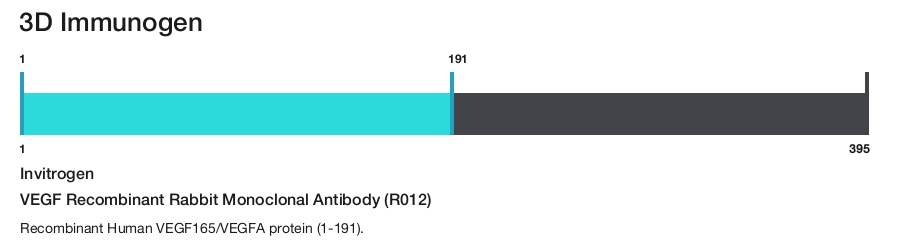
Recombinant Human VEGF165/VEGFA protein (1-191).
Conjugate
Unconjugated
Unconjugated
Unconjugated
Form
Liquid
Concentration
2.43 mg/mL
Amount
200 µg
Purification
Protein A
Storage buffer
PBS
Contains
no preservative
Storage conditions
Store at 4°C short term. For long term storage, store at -20°C, avoiding freeze/thaw cycles.
Shipping conditions
Ambient (domestic); Wet ice (international)
RRID
Target Information
VEGF (vascular endothelial growth factor) which is a 45 kDa homodimeric, disulfide-linked glycoprotein involved in angiogenesis which promotes tumor progression and metastasis. VEGF has a variety of effects on vascular endothelium, including the ability to promote endothelial cell viability, mitogenesis, chemotaxis, and vascular permeability. The VEGF family currently includes VEGF-A, VEGF-B, VEGF-C, VEGF-D, VEGF-E, and PIGF. VEGF and its receptor system have been shown to be the fundamental regulators in the cell signaling of angiogenesis. Most tumors have the absolute requirement of angiogenesis, and VEGF has been described as the most potent angiogenic cytokine linked to this process. To date 5 different isoforms of VEGF have been described. These isoforms are generated as the result of alternative splicing from a single VEGF gene. These various isoforms have been shown to bind to two tyrosine-kinase receptors flt-1 (VEGFR-1) and flk-1/KDR (VEGFR-2), which have been found to be expressed almost exclusively on endothelial cells. VEGF and its high-affinity binding receptors, the tyrosine kinases FLK1 and FLT1, are thought to be important for the development of embryonic vasculature. Studies have shown that an alternately spliced form of FLT1 produces a soluble protein, termed sFLT1, which binds vascular endothelial growth factor with high affinity, playing an inhibitory role in angiogenesis. Elevated levels of VEGF is linked to POEMS syndrome (Polyneuropathy, Organomegaly, Endocrinopathy, Monoclonal gammopathy, Skin changes) also known as Crow-Fukase syndrome which affects multiple organs in the body.
For Research Use Only. Not for use in diagnostic procedures. Not for resale without express authorization.
References (0)
Have you cited this product in a publication?
Let us know so we can reference it here.
Bioinformatics
Protein Aliases: growth factor; MGC70609; RP1-261G23.1; VAS; vascular endothelial growth factor; vascular endothelial growth factor A121; vascular endothelial growth factor A165; vascular endothelial growth factor isoform 165/endothelial-specific mitogen; vascular permeability factor; vascular permeability factor precursor; Vasculotropin; VEGF; VEGF1; VEGF121; VEGFMGC70609; VPF ant
Gene Aliases: L-VEGF; MVCD1; simVEGF165; VEGF; VPF
UniProt ID: (Human) P15692
Entrez Gene ID: (Human) 7422, (Cynomolgus monkey) 102140241
fibronectin binding
cytokine activity
platelet-derived growth factor receptor binding
vascular endothelial growth factor receptor binding
protein binding
growth factor activity
heparin binding
transmembrane receptor protein tyrosine kinase activator activity
neuropilin binding
chemoattractant activity
identical protein binding
vascular endothelial growth factor receptor 1 binding
vascular endothelial growth factor receptor 2 binding
receptor agonist activity
extracellular matrix binding
growth factor
negative regulation of transcription from RNA polymerase II promoter
angiogenesis
ovarian follicle development
patterning of blood vessels
vasculogenesis
response to hypoxia
in utero embryonic development
kidney development
positive regulation of protein phosphorylation
positive regulation of endothelial cell proliferation
sprouting angiogenesis
cell migration involved in sprouting angiogenesis
positive regulation of neuroblast proliferation
positive regulation of receptor internalization
immune system process
basophil chemotaxis
positive regulation of leukocyte migration
heart morphogenesis
outflow tract morphogenesis
coronary vein morphogenesis
regulation of transcription from RNA polymerase II promoter
phospholipase C-activating G-protein coupled receptor signaling pathway
nervous system development
mesoderm development
lactation
positive regulation of cell proliferation
regulation of cell shape
positive regulation of endothelial cell migration
positive regulation of gene expression
negative regulation of gene expression
negative regulation of epithelial to mesenchymal transition
monocyte differentiation
macrophage differentiation
lung development
positive regulation of cell migration
epithelial cell differentiation
post-embryonic camera-type eye development
retinal ganglion cell axon guidance
positive regulation of protein complex assembly
positive regulation of protein autophosphorylation
tube formation
endothelial cell chemotaxis
cellular response to vascular endothelial growth factor stimulus
lymph vessel morphogenesis
vascular endothelial growth factor receptor-2 signaling pathway
positive regulation of endothelial cell chemotaxis by VEGF-activated vascular endothelial growth factor receptor signaling pathway
vascular endothelial growth factor signaling pathway
positive regulation of cell proliferation by VEGF-activated platelet derived growth factor receptor signaling pathway
VEGF-activated neuropilin signaling pathway
eye photoreceptor cell development
negative regulation of apoptotic process
positive regulation of vascular permeability
positive regulation of I-kappaB kinase/NF-kappaB signaling
surfactant homeostasis
positive regulation of MAPK cascade
positive regulation of blood vessel endothelial cell migration
positive regulation of angiogenesis
positive regulation of cell adhesion
positive regulation of transcription from RNA polymerase II promoter
vascular endothelial growth factor receptor signaling pathway
cell maturation
camera-type eye morphogenesis
positive regulation of axon extension involved in axon guidance
artery morphogenesis
positive regulation of epithelial cell proliferation
positive chemotaxis
positive regulation of positive chemotaxis
induction of positive chemotaxis
positive regulation of focal adhesion assembly
positive regulation of protein kinase B signaling
cardiac muscle cell development
primitive erythrocyte differentiation
mammary gland alveolus development
positive regulation of mast cell chemotaxis
cardiac vascular smooth muscle cell development
coronary artery morphogenesis
vascular wound healing
positive regulation of ERK1 and ERK2 cascade
cellular response to hypoxia
dopaminergic neuron differentiation
commissural neuron axon guidance
positive regulation of cell migration involved in sprouting angiogenesis
positive regulation of branching involved in ureteric bud morphogenesis
motor neuron migration
cellular stress response to acid chemical
positive regulation of cold-induced thermogenesis
negative regulation of nitric oxide-cGMP mediated signal transduction
positive regulation of vascular endothelial growth factor signaling pathway
positive regulation of trophoblast cell migration
negative regulation of pri-miRNA transcription from RNA polymerase II promoter
positive regulation of protein localization to early endosome
negative regulation of establishment of endothelial barrier
negative regulation of adherens junction organization
positive regulation of blood vessel endothelial cell proliferation involved in sprouting angiogenesis
positive regulation of sprouting angiogenesis
positive regulation of epithelial tube formation
positive regulation of blood vessel branching
negative regulation of blood-brain barrier permeability
negative regulation of cell-cell adhesion mediated by cadherin
positive regulation of DNA biosynthetic process
positive regulation of endothelial cell chemotaxis
Disclaimer

Clicking the images or links will redirect you to a website hosted by BenchSci that provides third-party scientific content. Neither the content nor the BenchSci technology and processes for selection have been evaluated by us; we are providing them as-is and without warranty of any kind, including for use or application of the Thermo Fisher Scientific products presented.

Performance Guarantee
If an Invitrogen™ antibody doesn't perform as described on our website or datasheet,we'll replace the product at no cost to you, or provide you with a credit for a future purchase.*
Learn more
We're here to help
Get expert recommendations for common problems or connect directly with an on staff expert for technical assistance related to applications, equipment and general product use.
Contact tech support