Search
Additional Information:
{{banner.description}}

FIGURE: 1 / 5
CREB Antibody (710149) in ICC/IF
Immunofluorescent analysis of CREB was performed on 70% confluent log phase U-2 OS cells. The cells were fixed with 4% paraformaldehyde for 15 minutes, permeabilized with 0. 25% Triton X-100 for 10 minutes, and blocked with 5% BSA for 1 hour at room temperature. The cells were labeled with CREB Recombinant Rabbit Superclonal™ Antibody (Product # 710149) at a dilution of 1:1000 in 1% BSA and incubated for 3 hours at room temperature and then labeled with Alexa Fluor® 488 Goat anti-Rabbit IgG secondary antibody (Product # A-11008) at a dilut... View More


Please note: We are reviewing Western blot images included in the antibody testing data in our catalog, including those provided by third parties. Unless expressly labeled or annotated as “raw-unedited”, Western blot images included in the antibody testing data in our catalog may have been edited, optimized or otherwise adjusted for presentation.


Product Details
710149
Applications
Tested Dilution
Publications
Product Specifications
Species Reactivity
Human
Host/Isotype
Rabbit
/ IgG
Expression System
Expi293
Class
Recombinant Superclonal
Type
Antibody
Clone
3HCLC
Immunogen
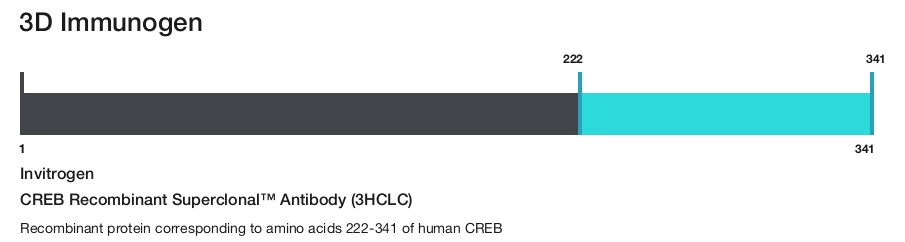
Recombinant protein corresponding to amino acids 222-341 of human CREB
Conjugate
Unconjugated
Unconjugated
Unconjugated
Form
Liquid
Concentration
0.5 mg/mL
Amount
100 µg
Purification
Protein A
Storage buffer
PBS, pH 7.2-7.4
Contains
0.09% sodium azide
Storage conditions
Store at 4°C short term. For long term storage, store at -20°C, avoiding freeze/thaw cycles.
Shipping conditions
Wet ice
RRID
Product Specific Information
Recombinant rabbit Superclonal™ antibodies are unique offerings from Thermo Fisher Scientific. They are comprised of a selection of multiple different recombinant monoclonal antibodies, providing the best of both worlds - the sensitivity of polyclonal antibodies with the specificity of monoclonal antibodies - all delivered with the consistency only found in a recombinant antibody. While functionally the same as a polyclonal antibody - recognizing multiple epitope sites on the target and producing higher detection sensitivity for low abundance targets - a recombinant rabbit Superclonal™ antibody has a known mixture of light and heavy chains. The exact population can be produced in every lot, circumventing the biological variability typically associated with polyclonal antibody production. Note: Formerly called “Recombinant polyclonal antibody”, this product is now rebranded as “Recombinant Superclonal™ antibody”. The physical product and the performance remain unchanged.
Target Information
CREB (Cyclic AMP response element binding protein) is a 43 kDa basic/leucine zipper transcription factor that binds the cyclic AMP response element (CRE) and activates transcription in response to a variety of extracellular signals including neurotransmitters, hormones, membrane depolarization, and growth and neurotrophic factors. Activation of CREB is dependent upon the phosphorylation of serine 133. Phosphorylation of CREB occurs via p44/42 MAP kinase and p90RSK, and via p38 MAP kinase and MSK1. Although CREB will bind DNA independent of its phosphorylation state, only the phosphorylated form is competent as a transcription factor. CREB binding protein (CBP), a transcriptional coactivator that directly interacts with CREB, binds to CREB in the region of serine 133. CREB is involved in different cellular processes including the synchronization of circadian rhythmicity, differentiation of adipose cells, and learning and memory. In humans, the gene is located on the q arm of chromosome 2. Diseases associated with CREB dysfunction include Alzheimer's Disease, histiocytoma and soft tissue melanoma.
For Research Use Only. Not for use in diagnostic procedures. Not for resale without express authorization.
References (0)
Have you cited this product in a publication?
Let us know so we can reference it here.
Bioinformatics
Protein Aliases: active transcription factor CREB; active transcription factor CREB-A; active transcription factor CREB-B; cAMP-response element-binding protein-1; CREB1; cyclic adenosine 3',5'-monophosphate response element binding protein; cyclic adenosine 3',5'-monophosphate response element-binding protein CREB; cyclic AMP response element-binding protein-1 alpha isoform; delta CREB; htCREB; MGC9284; OTTHUMP00000206661; OTTHUMP00000206662; OTTHUMP00000206667; transactivator protein; unnamed protein product
Gene Aliases: CREB; CREB-1
UniProt ID: (Human) P16220
Entrez Gene ID: (Human) 1385
transcription regulatory region sequence-specific DNA binding
RNA polymerase II regulatory region sequence-specific DNA binding
RNA polymerase II core promoter proximal region sequence-specific DNA binding
RNA polymerase II transcription factor activity, sequence-specific DNA binding
transcription coactivator binding
transcriptional activator activity, RNA polymerase II transcription regulatory region sequence-specific binding
DNA binding
transcription factor activity, sequence-specific DNA binding
protein binding
enzyme binding
Hsp70 protein binding
histone acetyltransferase binding
cAMP response element binding
identical protein binding
sequence-specific DNA binding
RNA polymerase II sequence-specific DNA binding transcription factor binding
arrestin family protein binding
sequence-specific double-stranded DNA binding
negative regulation of transcription from RNA polymerase II promoter
response to hypoxia
regulation of transcription, DNA-templated
regulation of transcription from RNA polymerase II promoter
protein phosphorylation
signal transduction
transforming growth factor beta receptor signaling pathway
memory
circadian rhythm
visual learning
response to xenobiotic stimulus
negative regulation of gene expression
response to purine-containing compound
response to activity
cell differentiation
positive regulation of transforming growth factor beta3 production
response to glucagon
chemotaxis to arachidonic acid
response to nicotine
response to erythropoietin
cellular response to platelet-derived growth factor stimulus
response to cocaine
mRNA transcription from RNA polymerase II promoter
regulation of apoptotic process
positive regulation of apoptotic process
negative regulation of apoptotic process
response to morphine
response to ethanol
positive regulation of fat cell differentiation
positive regulation of gluconeogenesis
positive regulation of transcription, DNA-templated
positive regulation of RNA polymerase II transcriptional preinitiation complex assembly
positive regulation of transcription from RNA polymerase II promoter
positive regulation of lipid biosynthetic process
regulation of fibroblast proliferation
protein stabilization
regulation of glial cell proliferation
cellular response to retinoic acid
cellular response to growth factor stimulus
cellular response to fatty acid
cellular response to transforming growth factor beta stimulus
cAMP/PKA signal transduction
positive regulation of long-term synaptic potentiation
response to L-glutamate
response to dehydroepiandrosterone
positive regulation of membrane depolarization
cellular response to forskolin
cellular response to nerve growth factor stimulus
cellular response to insulin-like growth factor stimulus
response to hypobaric hypoxia
regulation of testosterone biosynthetic process
Disclaimer

Clicking the images or links will redirect you to a website hosted by BenchSci that provides third-party scientific content. Neither the content nor the BenchSci technology and processes for selection have been evaluated by us; we are providing them as-is and without warranty of any kind, including for use or application of the Thermo Fisher Scientific products presented.

Performance Guarantee
If an Invitrogen™ antibody doesn't perform as described on our website or datasheet,we'll replace the product at no cost to you, or provide you with a credit for a future purchase.*
Learn more
We're here to help
Get expert recommendations for common problems or connect directly with an on staff expert for technical assistance related to applications, equipment and general product use.
Contact tech support