Search
 Element Search
 Structure Search


Thermo Scientific Chemicals
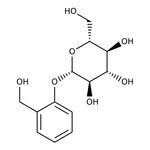
D-(-)-Salicin, 99%
CAS: 138-52-3 | C13H18O7 | 286.28 g/mol
Have Questions?
Change view


Catalog number A16524.06
also known as A16524-06
Price (USD)
45.70
Each
Quantity:
5 g
Price (USD)
45.70
Each
Chemical Identifiers
CAS138-52-3
IUPAC Name(2R,3S,4S,5R,6S)-2-(hydroxymethyl)-6-[2-(hydroxymethyl)phenoxy]oxane-3,4,5-triol
Molecular FormulaC13H18O7
InChI KeyNGFMICBWJRZIBI-UJPOAAIJSA-N
SMILESOC[C@H]1O[C@@H](OC2=CC=CC=C2CO)[C@H](O)[C@@H](O)[C@@H]1O
View more
Specifications Specification Sheet
Specification SheetAssay (HPLC)≥98.5%
Optical Rotation-59.5? to -63.5? (c=5 in Water)
FormCrystals or powder or crystalline powder
Identification (FTIR)Conforms
Appearance (Color)White to pale cream
Salicin is used as an analgesic and antipyretic. It is also used as a substrate for beta-glucosidase and an inhibitor of Cox. It finds application as an anti-inflammatory agent. It is involved in antipyretic action without causing gastric injury.
This Thermo Scientific Chemicals brand product was originally part of the Alfa Aesar product portfolio. Some documentation and label information may refer to the legacy brand. The original Alfa Aesar product / item code or SKU reference has not changed as a part of the brand transition to Thermo Scientific Chemicals.
Solubility
Soluble in water, alkalies, pyridine, glacial acetic acid and hot ethanol. Insoluble in ether and chloroform.
Notes
Store in cool place. Light and heat sensitive. Air senstive and moisture sensitive. Incompatible with strong oxidizing agents.
Soluble in water, alkalies, pyridine, glacial acetic acid and hot ethanol. Insoluble in ether and chloroform.
Notes
Store in cool place. Light and heat sensitive. Air senstive and moisture sensitive. Incompatible with strong oxidizing agents.
RUO – Research Use Only
General References:
- Substrate for ß -glucosidase.
- Li, Y.; Wu, Q.; Deng, Y.; Lv, H.; Qiu, J.; Chi, G.; Feng, H. D(-)-Salicin inhibits the LPS-induced inflammation in RAW264.7 cells and mouse models. Int. Immunopharmacol. 2015, 26 (2), 286-294.
- Li, T.; Chang, D.; Xu, H.; Chen, J.; Su, L.; Guo, Y.; Chen, Z.; Wang, Y.; Wang, L.; Wang, J.; Fang, X.; Liu, C. Impact of a short-term exposure to spaceflight on the phenotype, genome, transcriptome and proteome of Escherichia coli. Int. J. Astrobiol. 2015, 14 (3), 435-444.