Search


Citations & References (14)
Invitrogen™
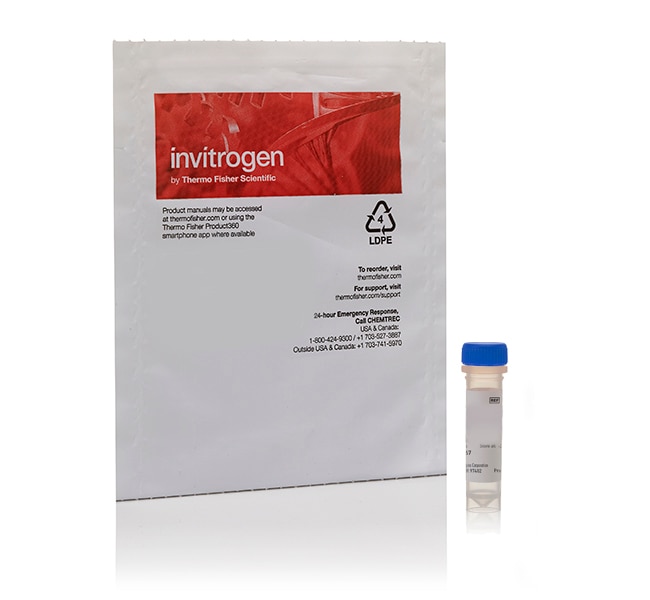
FluoroMyelin™ Red Fluorescent Myelin Stain - Solution in Water
The FluoroMyelin™ Red fluorescent myelin stain enables quick and selective labeling of myelin in brain cryosections in a single 20-minuteRead more
| Catalog Number | Quantity |
|---|---|
| F34652 | 1 mL |
Catalog number F34652
Price (USD)
356.00
Each
Quantity:
1 mL
Price (USD)
356.00
Each
The FluoroMyelin™ Red fluorescent myelin stain enables quick and selective labeling of myelin in brain cryosections in a single 20-minute labeling step plus washes. This stain can be used in conjunction with antibodies and other dyes, and with standard histochemical methods for cryosection material.
For Research Use Only. Not for use in diagnostic procedures.
Specifications
ColorRed
Detection MethodFluorescence
For Use With (Equipment)Fluorescence Microscope
Label or DyeFluoroMyelin™ Red
Product TypeRed Fluorescent Myelin Stain
Quantity1 mL
Shipping ConditionRoom Temperature
Sub Cellular LocalizationMyelin
Excitation/Emission558/654 nm
Product LineFluoroMyelin
Unit SizeEach
Contents & Storage
• Provided as 300X concentration in water.
• When stored at 4°C, stable for at least 6 months after receipt.
• Protect from light.
• When stored at 4°C, stable for at least 6 months after receipt.
• Protect from light.
Frequently asked questions (FAQs)
I used one of your FluoroMyelin stains and noticed it stains cells other than glial cells. Is there something wrong with the product?
Can the FluoroMyelin stains be used on neurons in culture?
Can the FluoroMyelin myelin stains be used on paraffin sections?
What are the FluoroMyelin myelin stains?
Citations & References (14)
Citations & References
Abstract
Prion protein (PrPc) positively regulates neural precursor proliferation during developmental and adult mammalian neurogenesis.
Journal:Proc Natl Acad Sci U S A
PubMed ID:16492732
'The misfolding of the prion protein (PrP(c)) is a central event in prion diseases, yet the normal function of PrP(c) remains unknown. PrP(c) has putative roles in many cellular processes including signaling, survival, adhesion, and differentiation. Given the abundance of PrP(c) in the developing and mature mammalian CNS, we investigated
Rescuing qkV dysmyelination by a single isoform of the selective RNA-binding protein QKI.
Journal:J Neurosci
PubMed ID:17079655
Alternative splicing of the qkI transcript generates multiple isoforms of the selective RNA-binding protein QKI, which play key roles in controlling the homeostasis of their mRNA targets. QKI deficiency in oligodendrocytes of homozygous quakingviable (qkV/qkV) mutant mice results in severe hypomyelination, indicating the essential function of QKI in myelinogenesis. However,
Neuronal glutathione deficiency and age-dependent neurodegeneration in the EAAC1 deficient mouse.
Journal:Nat Neurosci
PubMed ID:16311588
Uptake of the neurotransmitter glutamate is effected primarily by transporters expressed on astrocytes, and downregulation of these transporters leads to seizures and neuronal death. Neurons also express a glutamate transporter, termed excitatory amino acid carrier-1 (EAAC1), but the physiological function of this transporter remains uncertain. Here we report that genetically
Collagen XXVIII, a novel von Willebrand factor A domain-containing protein with many imperfections in the collagenous domain.
Journal:J Biol Chem
PubMed ID:16330543
Here we describe a novel collagen belonging to the class of von Willebrand factor A (VWA) domain-containing proteins. This novel protein was identified by screening the EST data base and was subsequently recombinantly expressed and characterized as an authentic tissue component. The COL28A1 gene on human chromosome 7p21.3 and on
Skin and gut imprinted helper T cell subsets exhibit distinct functional phenotypes in central nervous system autoimmunity.
Journal:Nat Immunol
PubMed ID:34099917