Search

Thermo Scientific™
Piko PCR Plate, 96-well, white
The Thermo Scientific 96-well Piko PCR Plates, white are a family of PCR plates which have the footprint of aRead more
Have Questions?
Change view

| Catalog Number | Quantity |
|---|---|
| SPL0961 | 200/Cs. |
| SPL096150 | 50 Plates |
Catalog number SPL0961
Price (USD)
714.00
Quantity:
200/Cs.
Price (USD)
714.00
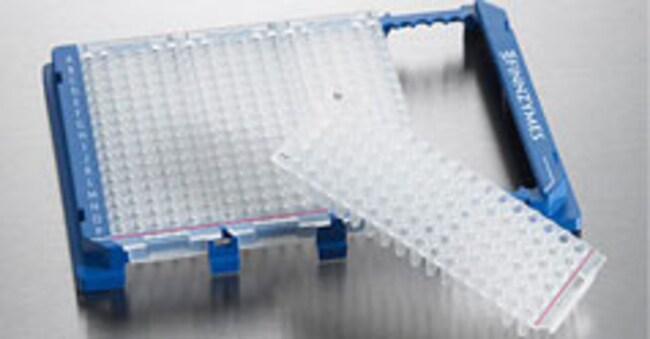
The Thermo Scientific 96-well Piko PCR Plates, white are a family of PCR plates which have the footprint of a microscope slide. We have not only shrunk the size of the plate, but dramatically reduced the thickness of the well walls utilizing our patented ultra-thin wall (UTW) technology.
Four plates can be snapped into a single frame producing the equivalent of a standard 384-well microplate.
Features
• Ultra Thin Wall (UTW) for fast PCR/qPCR applications
• Low profile
• Designed for use with the Piko and PikoReal 96-well thermal cyclers
• Plates can be snapped into the plate frame to create a standard 384-well plate
• Compatible with standard multi-channel pipettes and liquid-handling platforms
• Well spacing and footprint conform to industry (ANSI) dimensions
Applications
• qPCR/Real-Time PCR
Related Products
Piko PCR Plate, 96-well, clear
Piko PCR Plate, 96-well, white
Plate Frame for 96-well Piko PCR Plates, white
Four plates can be snapped into a single frame producing the equivalent of a standard 384-well microplate.
Features
• Ultra Thin Wall (UTW) for fast PCR/qPCR applications
• Low profile
• Designed for use with the Piko and PikoReal 96-well thermal cyclers
• Plates can be snapped into the plate frame to create a standard 384-well plate
• Compatible with standard multi-channel pipettes and liquid-handling platforms
• Well spacing and footprint conform to industry (ANSI) dimensions
Applications
• qPCR/Real-Time PCR
Related Products
Piko PCR Plate, 96-well, clear
Piko PCR Plate, 96-well, white
Plate Frame for 96-well Piko PCR Plates, white
For Research Use Only. Not for use in diagnostic procedures.
Specifications
Certifications/ComplianceCertified RNase/DNase-free
For Use With (Equipment)Piko Thermal Cycler, PikoReal Real-Time PCR System
Packaging200 Plate
Product TypePCR Microplate
Quantity200/Cs.
Reaction SpeedStandard
BarcodeNo Barcode
ColorWhite
MaterialPolypropylene
No. of Wells96
Product LinePiko