Search
Mouse Anti-Alpha Tubulin Monoclonal Antibody (Cat. No. A11126)
Comparison of the photobleaching rates of the Alexa Fluor® 488 and Alexa Fluor® 546 dyes and the well-known fluorescein and Cy3 fluorophores. The cytoskeleton of bovine pulmonary artery endothelial cells (BPAEC) was labeled with (top series) Alexa Fluor® 488 phalloidin (Cat. no. A12379) and mouse monoclonal anti–alpha-tubulin antibody (Cat. no. A11126) in combination with Alexa Fluor® 546 goat anti–mouse IgG antibody (Cat. no. A11003) or (bottom series) fluorescein phalloidin (F432) and the anti–alpha-tubulin antibody in combination with a commercially available Cy3 goat anti–mouse IgG antibody. The pseudocolored images were taken at 30-second intervals (0, 30, 90, and 210 seconds of exposure from left to right). The images were acquired with bandpass filter sets appropriate for fluorescein and rhodamine.


Related Products
Related Images
A prometaphase muntjac skin fibroblast stained with Alexa Fluor® 350 phalloidin, an anti–a-tubulin antibody and an anti–cdc6 peptide antibody. Go ›

Bovine pulmonary artery endothelial cells (BPAEC). MitoTracker® Red CMXRos, SYTOX® Green nucleic acid stain, biotin-XX goat anti–mouse IgG antibody and Cascade Blue® NeutrAvidin biotin-binding protein. Go ›
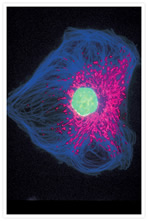
Endothelial cells. Go ›

Mouse Anti-Alpha Tubulin Monoclonal Antibody (Cat. No. A11126) Go ›

Increase in accuracy and precision using the Qubit® Go ›

Performance of the Qubit® dsDNA HS Assay Go ›

Muntjac fibroblast labeled with probes for actin and the nucleus. Go ›

Multicolor fluorescence analysis of muntjac fibroblasts. Go ›
