Search

Advanced multimode reader with up to 5 detection modes
The Thermo Scientific Varioskan LUX Multimode Microplate Reader is designed to help deliver results you can trust across a wide range of assays, with minimal setup and optimization. Built for laboratories with diverse and evolving needs, it combines high-performance detection with intelligent automation to help reduce setup time, minimize errors, and support reliable first-read results. Features such as automated dynamic range selection and built-in safety checks adapt measurements to signal intensity and help prevent common experimental issues before a run begins. Flexible hardware options and efficient software integration allow capabilities to be expanded over time, so that the system may grow with your research rather than limiting it.
Core capabilities
- Absorbance
- Fluorescence
- Luminescence
- Top and bottom reading
Optional add-ons
- Dual dispenser*
- Gas control
- Advanced detection modes (AlphaScreen & time-resolved fluorescence)*

*Available at purchase or as a future upgrade.
Features
Confidence across low- and high-intensity signals
Automatic dynamic range selection adjusts the reading range based on signal intensity in each well, allowing low and high signals to be measured accurately in a single run while reducing manual optimization and the risk of saturation.
Fewer errors and more reliable first-read results
Smart safety controls help identify potential issues before a measurement begins, reducing common setup and runtime errors and helping protect valuable samples.
A system that grows with your research
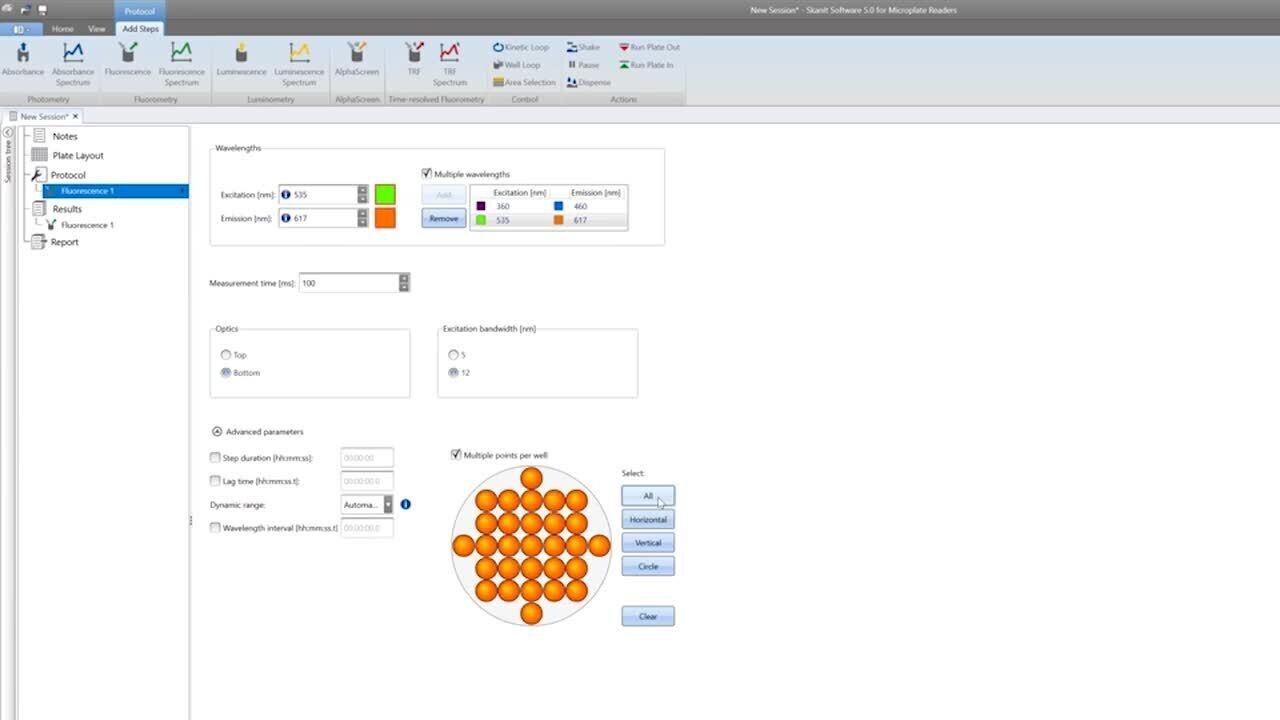
Modular and upgradeable design allows the Varioskan LUX to be configured for current needs and expanded over time. Optional hardware upgrades are supported within SkanIt Software, enabling new functionality without disrupting existing workflows or retraining users.
Flexibility for diverse assay requirements
Offers assay flexibility by pairing monochromator-based wavelength selection for absorbance and fluorescence intensity with filter-based optics that help ensure higher sensitivity and specificity for luminescence, time-resolved fluorescence, and AlphaScreen assays.
Videos and demos




Specifications
Category |
Attribute |
Description |
Absorbance |
Plate types |
6–384 well plates |
Wavelength selection |
Double monochromators |
|
Wavelength range |
200–1,000 nm |
|
Light source |
Xenon flash lamp |
|
Linear measurement range |
0–4 Abs (96-well plate) at 450 nm, ± 2% 0–3 Abs (384-well plate) at 450 nm, ± 2% |
|
Accuracy |
0.003 Abs or ± 2%, at 200–399 nm (0–2 Abs) 0.003 Abs or ± 1%, at 400–1,000 nm (0–3 Abs) |
|
Precision |
SD <0.001 Abs or CV <0.5%, at 450 nm (0–3 Abs) |
|
Fluorescence intensity |
Plate types |
6–1536-well plates (top reading) 6–384-well plates (bottom reading) |
Wavelength selection |
Double excitation and emission monochromators |
|
Excitation wavelength range |
200–822 nm |
|
Emission wavelength range |
270–840 nm |
|
Light source |
Xenon flash lamp |
|
Sensitivity |
Top reading: <0.4 fmol fluorescein/well (black 384-well plate) Bottom reading: <4 fmol fluorescein/well, (clear bottom black 384 square well plate) |
|
Dynamic range |
Top reading >6 decades Bottom reading >5.5 decades |
|
Time-resolved fluorescence |
Plate types |
6–1,536 well plates |
Wavelength selection |
Filters (spectral scanning with double excitation and emission monochromators) |
|
Excitation wavelength range |
Fixed to 334 nm (spectral scanning 200–840 nm) |
|
Emission wavelength range |
400–670 nm (spectral scanning 270–840 nm) |
|
Light source |
Xenon flash lamp |
|
Sensitivity |
<1 amol Eu/well (white low volume 384 well plate) |
|
Dynamic range |
>6 decades |
|
Luminescence |
Plate types |
6–1536 well plates (spectral scanning 6-384 well plates) |
Wavelength selection |
Direct or filters (spectral scanning with double monochromators) |
|
Wavelength range |
360–670 nm |
|
Sensitivity |
<7 amol ATP/well (white 384-well plate) |
|
Dynamic range |
>7 decades |
|
Alpha |
Plate types |
6–1536 well plates |
Wavelength selection |
Filters |
|
Excitation wavelength range |
Fixed to 680 nm |
|
Emission wavelength range |
400–660 nm |
|
Light source |
LED |
|
Sensitivity |
<100 amol phosphotyrosine/well (white 384-well plate) |
|
Dispensing |
Plate types |
6–384 well plates |
No. of dispensers |
None or two |
|
Syringe size |
1 mL |
|
Dispensing volume |
2–5,000 μL, in 1 µL increments |
|
Accuracy |
<1 μL with 50 μL |
|
Precision |
<1 μL with 50 μL |
|
Dead volume |
Reagent loss <100 μL, Total tubing volume <800 μL |
|
Incubator and shaker |
Temperature range |
From ambient + 4 °C to 45 °C |
Shaking type |
Orbital |
|
Integrated gas module |
Measurement chamber O2 concentration accuracy |
±1.0% (37 °C, 1% O2) |
Measurement chamber CO2 concentration accuracy |
±1.0%. (37 °C, 5% CO2) |
|
Measurement chamber O2 concentration |
1–21% |
|
Measurement chamber CO2 concentration |
0.1–15% |
|
Gas concentration recovery time |
10 minutes |
|
General features |
Measurement modes |
Endpoint, kinetic, spectra, multipoint and kinetic spectra |
Measurement speed |
Reads a 96-well plate in 15 s, a 384-well plate in 45 s, and a 1,536-well plate in 135 s (minimum times) |
|
Interface |
PC software (SkanIt software) |
|
Dimensions (D x W x H) |
58 x 53 x 51 cm (23 x 21 x 20 in) |
|
Weight |
53–60 kg, (117-132 lb), depending on configuration |
Ordering information
For Research Use Only. Not for use in diagnostic procedures.