Search
Culture Systems & Reagents for Definitive Endoderm Differentiation
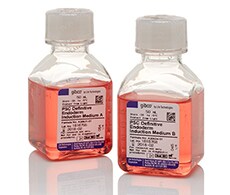
Definitive endoderm cells in 48 hours
- Two media, ready to use with no mixing of components required
- High-quality cells in up to 50% less time than many published protocols
- Highly pure cells show ≥90% high expression of key markers Sox17 and FoxA2 across multiple PSC lines
- Functional cells are capable of differentiating to downstream lineages
“We have been very happy with the PSC Definitive Endoderm Induction kit. It has been easy to follow the protocol and it worked for us the first time!” Marcie Glicksman, Ph.D., Vice President, Orig3n, Inc.

How to Differentiate Pluripotent Stem Cells into Definitive Endoderm Cells
Generating definitive endoderm cells from PSCs is a crucial step before cells can be differentiated into downstream endoderm lineages. Why not get through that step faster? Compared to other differentiation protocols*, the PSC Definitive Endoderm Induction Kit produces cells in up to 50% less time and requires no predifferentiation or mixing of media.
Gibco PSC Definitive Endoderm Induction Kit


A simple protocol is used to initiate PSC induction to definitive endoderm using only two media, in just two days.
The protocol can be viewed on left and includes:
- Plate PSCs in Essential 8 Medium on Vitronectin-coated plates
- Feed cells with Definitive Endoderm Induction Medium A.
- Aspirate Definitive Endoderm Induction Medium A and replace with Definitive Endoderm Induction Medium B.
- Characterize cells or differentiate to downstream lineages.
Cells generated using the PSC Definitive Endoderm Induction Kit show ≥90% CXCR4+/PDGFRα– across multiple cell lines and express the key markers Sox17 and FoxA2.

Enlarge
Figure 1. The PSC Definitive Endoderm Induction Kit media produce definitive endoderm populations with high efficiency (>90%) across hESC and iPSC cell lines, including episomal and CytoTune reprogrammed lines. Representative dot plots show CXCR4+/PDGFRα– cell populations. For each experiment, unstained cells were used to set quadrant gates.
Sox17

FOXA2

Oct4

Figure 2. Immunocytochemistry of hESCs treated with PSC Definitive Endoderm Induction Kit media. At day 3, induced cells were immunostained for the endodermal transcription factors Sox17 and FoxA2, and the pluripotent marker Oct4. Nuclei were counterstained with DAPI (blue) to assess total cell numbers.
Functional cells generated using this kit are capable of differentiating into midgut/hindgut, pancreatic endoderm, or liver bud progenitors that express relevant physiological markers. Data credited to L.T. Ang, K.M. Loh, and B. Lim of the Genome Institute of Singapore
Midgut/hindgut progenitors

Immunocytochemistry (10x) of H1 ESCs treated with PSC Definitive Endoderm Induction Kit media and differentiated into midgut/hindgut progenitors. Cells were stained for (A) nuclei, (B) FoxA2, (C) Cdx2, and (D) merged.
Pancreatic endoderm

Immunocytochemistry (10x) of H1 ESCs treated with PSC Definitive Endoderm Induction Kit media and differentiated into pancreatic endoderm. Cells were stained for (A) nuclei, (B) FoxA2, (C) Pdx1, and (D) merged.
Liver bud progenitors

Immunocytochemistry (10x) of H1 ESCs treated with PSC Definitive Endoderm Induction Kit media and differentiated into liver bud progenitors. Cells were stained for (A) nuclei, (B) AFP, and (C) merged.
- H9 ESCs were seeded at 20% density on Matrigel coated 6-well plates in Essential 8 (E8) Medium containing RevitaCell according to Gibco PSC Definitive Endoderm Induction Kit (Gibco DE kit) product insert.
- To induce definitive endoderm, medium was changed to DE kit Medium A on Day 1 and DE kit Medium B on Day 2 after seeding.
- On Day 3, the hepatoblast specification protocol was followed according to each protocol and continued through the end of hepatocyte specification.
- Morphology images were captured daily. Protein and RNA was collected from H9 cells cultured in E8 for 3 days, DE induced cells on Day 3, and at the end of each protocol’s hepatocyte specification protocol.

Hepatic Differentiation Protocol 1: Szkolnicka D, Farnworth SL, Lucendo-Villarin B, and Hay DC. Deriving functional hepatocytes from pluripotent stem cells. Curr Protoc Stem Cell Biol, 30:1G.5.1-1G.5.12, 2014.
Hepatic Differentiation Protocol 2: Hannan NR, Segeritz CP, Touboul T, and Vallier L. Production of hepatocyte-like cells from human pluripotent stem cells. Nat Protoc, 8(2): 430-7, 2013.
Representative data using Gibco DE kit


Click image to enlarge
Representative data showing utility of Gibco DE upstream of hESC differentiation to hepatocytes using two different published methods.
A. Representative images of hESC H9 cells cultured for 3 days in E8 medium, H9 cells cultured and treated with Gibco DE kit at day 3, and hepatocyte-like cells generated downstream of DE at the end of differentiation protocol for each method tested. B. qRT-PCR analysis of the above cells to determine their stem-ness (Nanog, Oct3/4), induction to definitive endoderm (CXCR4, FOXA2) and finally expression of hepatic markers (AFP and Albumin). C. Western blot analysis of cells generated using Gibco DE kit and two differentiation methods as compared to HepG2 and primary hepatocytes. As expected, E8 and DE cells do not express hepatic markers, whereas both differentiated cell groups show distinctive presence of AFP and Albumin denoting their hepatocyte-like phenotype. Note that HepG2 cells express AFP and Albumin whereas primary hepatocytes express Albumin only indicating their fully mature phenotype that is characterized by absence of AFP. Also note that the primary hepatocyte line has been underloaded as shown by weak Actin band.
Generate high-quality definitive endoderm with these simple steps:
- Efficiently reprogram somatic cells to pluripotent stem cells (PSCs) using the CytoTune-iPS 2.0 Sendai Reprogramming Kit.
- Culture and expand PSCs feeder-free with Essential 8 Medium.
- Induce definitive endoderm in 2 days using the PSC Definitive Endoderm Induction Kit.
- Differentiate to the desired terminal lineage.

* Protocol provided for the STEMdiff™ Definitive Endoderm Kit is an estimate based on the published web protocol.
For Research Use Only. Not for use in diagnostic procedures.