Search
DAPI Protocol for Fluorescence Imaging

Nuclear counterstain for fluorescence microscopy
A popular nuclear and chromosome counterstain, Thermo Scientific™ DAPI (4′,6-diamidino-2-phenylindole) emits blue fluorescence upon binding to AT regions of DNA.
This protocol can be used for:
- Nucleic acid (nuclear) staining in fluorescence microscopy
This protocol should not be used for:
- Flow cytometry
You will need the following for this protocol:
- Cells growing in culture
- DAPI, hydrochloride (Cat. No. D1306)
- Phosphate-buffered saline (PBS) or other suitable buffer
- Fluorescence microscope
Simulate your staining experiment before you run it
The Stain-iT simulator can help reduce trial and error and wasted reagents.
Protocol
Preparing solutions
 1. Add 2 mL of deionized water (diH2O) or dimethylformamide (DMF) to the entire contents of the DAPI vial to make a 14.3 mM (5 mg/mL) DAPI stock solution. Note: DAPI has poor solubility in water, so sonicate as necessary to dissolve. The 5 mg/mL DAPI stock solution may be stored at 2–6°C for up to 6 months or at ≤–20°C for longer periods. 1. Add 2 mL of deionized water (diH2O) or dimethylformamide (DMF) to the entire contents of the DAPI vial to make a 14.3 mM (5 mg/mL) DAPI stock solution. Note: DAPI has poor solubility in water, so sonicate as necessary to dissolve. The 5 mg/mL DAPI stock solution may be stored at 2–6°C for up to 6 months or at ≤–20°C for longer periods. |
 2. Add 2.1 µL of the 14.3 mM DAPI stock solution to 100 µL PBS to make a 300 µM DAPI intermediate dilution 2. Add 2.1 µL of the 14.3 mM DAPI stock solution to 100 µL PBS to make a 300 µM DAPI intermediate dilution |
| 3. Dilute the 300 µM DAPI intermediate dilution 1:1,000 in PBS as needed to make a 300 nM DAPI stain solution. |
Labeling fixed cells
First, fix and permeabilize cultured cells with a protocol appropriate for your sample.
 1. Wash the cells 1–3 times in PBS as needed. 1. Wash the cells 1–3 times in PBS as needed. |
 2. Add sufficient 300 nM DAPI stain solution to cover the cells. 2. Add sufficient 300 nM DAPI stain solution to cover the cells. |
 3. Incubate for 1–5 minutes, protected from light. 3. Incubate for 1–5 minutes, protected from light. |
 4. Remove the stain solution. 4. Remove the stain solution. |
| 5. Wash the cells 2–3 times in PBS. |
 6. Image the cells. 6. Image the cells. |
Spectral information and storage
| DAPI | |
|---|---|
| Excitation/Emission (nm) | 358/461 |
| Standard filter set | DAPI |
| Invitrogen™ EVOS™ Light Cube | DAPI |
| Storage conditions | ≤–20°C |
Protocol tips
- DAPI is a known mutagen and should be handled with care.
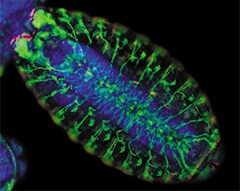
Drosophila melanogaster embryo staining. Wild type (Canton-S) Drosophila melanogaster embryo exhibiting microtubule staining (green fluorescence), denticle band staining (red fluorescence), and nuclear staining (blue-fluorescent DAPI).